Free Business Growth Assessment, Score & Profile ►

Marketing & Business Growth Glossary for Financial Professionals

GLOSSARY OF MARKETING TERMS

Unlock Business Growth with Our Essential Glossary of Terms

This glossary contains plain-English definitions of 500+ marketing, sales, CRM, automation, and business growth terms written specifically for financial professionals — including accountants, CPAs, bookkeepers, tax professionals, estate planners, financial planners, and financial advisors.

Terms are organized alphabetically and was created by Patrick Muldoon, CPA, Founder of Business Growth Success Inc., with 35+ years of experience in financial services and business systems consulting.
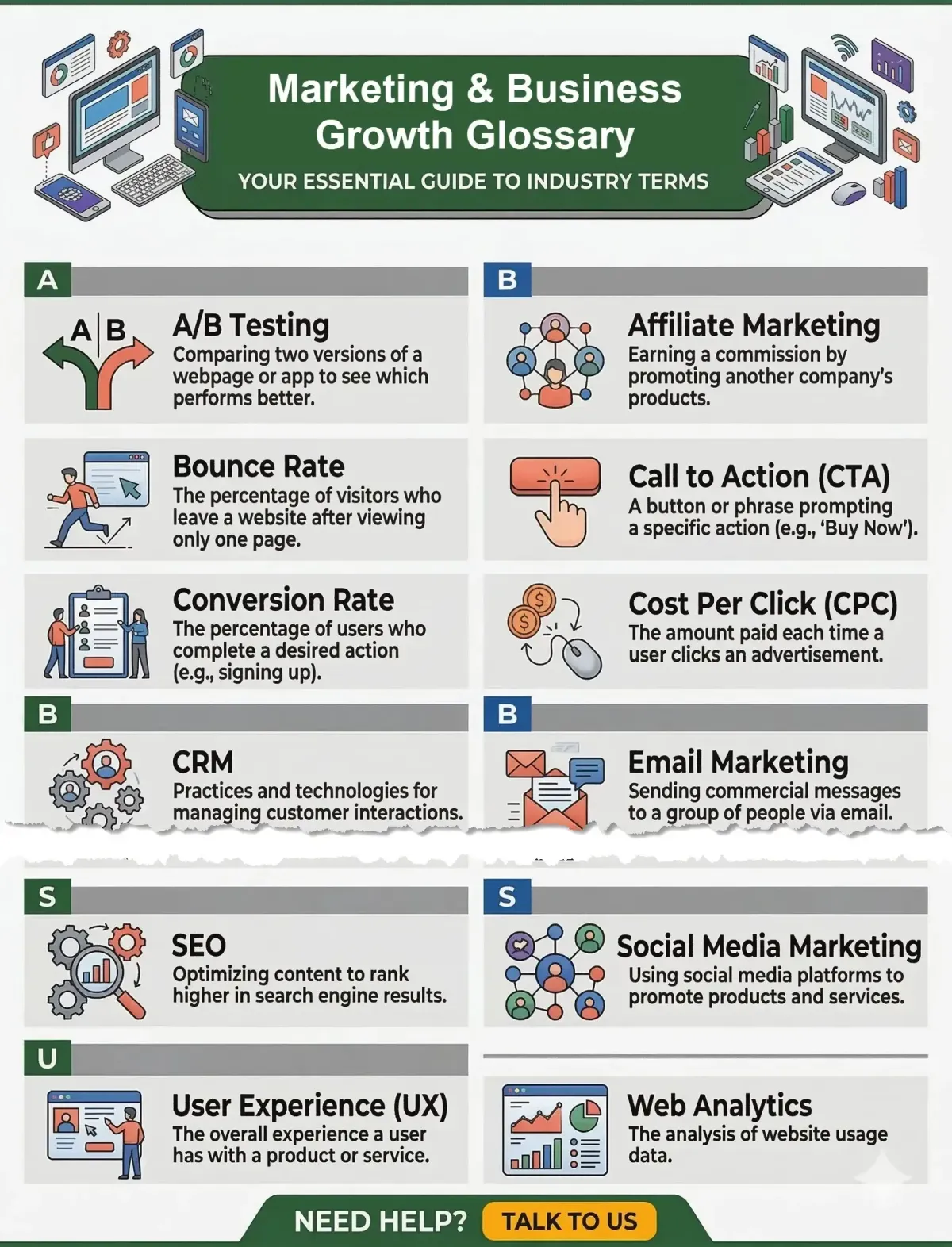

Marketing & Business Growth Glossary for Financial Professionals image
Patrick Muldoon, CPA Owner Business Growth Success image

About the Author

Patrick Muldoon, CPA, is the Founder & President of Business Growth Success Inc. With 35+ years of experience - including roles at PwC, Deloitte, and RBC Dominion Securities - Patrick combines deep financial expertise with proven business growth systems to help accountants, CPAs, bookkeepers, tax professionals, and financial advisors simplify their growth.

This glossary reflects the terminology Patrick's clients encounter most often when modernizing and marketing their financial practices.

[Read Patrick's Full Bio →]

How to Use This Glossary

  • Click any letter in the A–Z navigation to jump to that section

  • Each term is tagged with a category: [AI & Emerging Tech], [Financial Business Growth], [Marketing & Sales], [Work Mgmt, Apps & Tools]

  • Terms in bold within definitions link to related glossary entries

  • Looking for a term not listed? Contact us and we'll add it.

  • New to business growth systems? → Start with the Business Growth Assessment

Quick List: The 10 Most Important Terms for Growing a Financial Practice

If you're new to business growth and marketing, these are the ten terms that will have the biggest impact on your practice — listed in the order you'll encounter them as you grow.

01. Lead Generation - How you attract new prospective clients

02. CRM (Client Relationship Management) - How you organize and track every client and prospect

03. Marketing Funnel - The stages a prospect moves through before becoming a client

04. Conversion Rate - The percentage of prospects who become paying clients

05. Drip Campaign - Automated email sequences that nurture leads without manual effort

06. Marketing Automation - Using software to eliminate repetitive marketing tasks

07. Customer Lifetime Value (CLV) - The total value of a client relationship over time

08. Churn Rate - The rate at which clients stop using your services

09. Call-to-Action (CTA) - The specific prompt that gets a prospect to take the next step

10. A/B Testing - How you improve your marketing by testing two versions against each other

Full Glossary

1-Click Deployment
[Work Mgmt, Apps & Tools]
Simplified deployment of custom apps or workflows with a single action, minimizing setup time.
1-Click Integration
[Work Mgmt, Apps & Tools]
Seamless connection to external tools or platforms with a single action, simplifying setup and enhancing productivity.
1-Click Upsell
[Marketing & Sales]
An e-commerce technique that allows a customer to add an additional product or service to their purchase with a single click, immediately after completing their initial transaction — without re-entering payment details. For financial professionals offering tiered services, such as adding a tax review to a bookkeeping package, a 1-click upsell can significantly increase average transaction value with minimal friction. The key is presenting the upsell offer at the moment of highest buying intent — right after the first purchase is confirmed.
1:1 Marketing
[Marketing & Sales]
A highly personalized marketing approach that tailors messages, offers, and communications to an individual client based on their specific history, preferences, and behaviors — rather than sending the same message to everyone. For financial professionals, 1:1 marketing might look like sending a tax planning tip specifically to clients who flagged a business expansion last quarter, or following up with an estate planning offer only to clients who recently reached a certain age milestone. This approach consistently outperforms broadcast messaging because it demonstrates genuine knowledge of the client's situation.
100% Data Encryption
[Work Mgmt, Apps & Tools]
A security feature ensuring all data stored and transmitted within the system is fully encrypted for maximum protection.
10x Scaling
[Work Mgmt, Apps & Tools]
A capability to expand system resources or user capacity tenfold without performance degradation.
12-Month Rolling Forecast
[Work Mgmt, Apps & Tools]
A feature to continuously update and project performance metrics over a one-year period based on current data.
2-Factor Authentication (2FA)
[Work Mgmt, Apps & Tools]
A security feature requiring two forms of identity verification, such as a password and a one-time code, for enhanced system security.
2-Step Verification in Marketing
[Marketing & Sales]
A security measure that requires users to confirm their identity through a second action — such as clicking a link in a confirmation email — before gaining access to an account, completing a subscription, or finalizing a purchase. For financial professionals, 2-step verification on client portals, booking systems, and email lists builds trust, reduces fraudulent sign-ups, and ensures that the contacts in your database are legitimate and engaged. It is especially important in financial services where client data security and regulatory compliance are non-negotiable.
2-Way Syncing
[Work Mgmt, Apps & Tools]
A feature that ensures data remains consistent across two systems or platforms, updating both in real time.
24-Hour Task Monitoring
[Work Mgmt, Apps & Tools]
Real-time tracking of tasks over a 24-hour period to ensure deadlines and progress are met.
24/7 Accessibility
[Work Mgmt, Apps & Tools]
Ensuring the work management system or custom app is available around the clock, supporting global or remote teams.
3-Tier Architecture
[Work Mgmt, Apps & Tools]
A system design with three layers—user interface, application logic, and database—to ensure scalability and flexibility in custom apps.
3-Way Matching
[Marketing & Sales]
A verification process used in procurement and financial operations that cross-references three documents — the purchase order, the vendor invoice, and the receipt of goods or services — to confirm accuracy before approving payment. For accountants, bookkeepers, and CPAs, 3-way matching is a foundational internal control that prevents overpayments, duplicate billing, and vendor fraud. Automating this process through an integrated business platform eliminates the manual checking that consumes hours each month in financial practices.
3-Way Matching
[Work Mgmt, Apps & Tools]
A process that compares three elements—purchase orders, invoices, and receipts—to ensure accuracy and prevent fraud in expense tracking.
301 Redirect
[Marketing & Sales]
A permanent redirect that forwards visitors and search engines from one URL to another, signaling that the original page has moved to a new location indefinitely. For financial professionals managing a website, 301 redirects are critical when renaming pages, changing your domain, or restructuring your site — they preserve the SEO ranking authority of the original URL so you don't lose the search visibility you've built. Failing to set up 301 redirects when moving pages is one of the most common causes of unexplained traffic drops for small business websites.
302 Redirect
[Marketing & Sales]
A temporary redirect that forwards visitors from one URL to another while signaling to search engines that the original page will return — meaning search engines should continue indexing the original URL rather than transferring its authority to the new one. For financial professionals, 302 redirects are appropriate for short-term situations like a seasonal promotional page or a temporarily unavailable service page. Using a 302 when you actually intend a permanent change is a common technical SEO mistake that results in the loss of page ranking over time.
360-Degree Marketing
[Marketing & Sales]
A comprehensive marketing strategy that engages prospects and clients across every relevant touchpoint — including email, SMS, social media, website, paid ads, events, and in-person interactions — delivering a consistent message and experience regardless of where or how someone encounters your brand. For financial professionals, a 360-degree approach ensures that a prospective client who sees your LinkedIn post, then visits your website, then receives a follow-up email experiences a coherent, professional journey rather than disconnected one-off communications. Business Growth One is designed to enable this kind of integrated, omnichannel marketing from a single platform.
360-Degree Feedback
[Work Mgmt, Apps & Tools]
A performance evaluation tool that collects feedback from multiple perspectives—managers, peers, and subordinates.
360-Degree Marketing
[Marketing & Sales]
A holistic strategy that covers all touchpoints, channels, and platforms to provide a seamless customer experience.
3D Visualizations
[Work Mgmt, Apps & Tools]
Advanced tools for creating interactive, three-dimensional models of data, workflows, or processes.
4-Step Workflow
[Work Mgmt, Apps & Tools]
A simple and common process design with four key stages: initiation, processing, completion, and review.
404 Error
[Marketing & Sales]
An HTTP status code that appears when a visitor tries to access a webpage that no longer exists or whose URL has changed — effectively a dead end that frustrates visitors and signals to search engines that your site has broken links. For financial professionals, 404 errors typically occur after website redesigns, deleted blog posts, or expired promotional pages, and each one represents a lost visitor who may not return. Regularly auditing your site for 404 errors and setting up 301 redirects to relevant replacement pages is a quick technical fix with meaningful SEO and user experience benefits.
4Ps of Marketing
[Marketing & Sales]
The foundational framework of marketing strategy, covering four essential elements: Product (what you offer), Price (what you charge), Place (where and how clients access your services), and Promotion (how you communicate your value). For financial professionals, applying the 4Ps means clearly defining the specific services you offer, setting fees that reflect your value and attract the right clients, making your services easy to discover and access online, and promoting your expertise consistently through content, referrals, and digital channels. Most financial practices that struggle to grow have at least one of these four elements poorly defined.
5 Forces Analysis
[Marketing & Sales]
A strategic framework developed by Michael Porter that evaluates the competitive dynamics of an industry by examining five forces: the threat of new entrants, the bargaining power of clients, the bargaining power of suppliers, the threat of substitute services, and the intensity of rivalry among existing competitors. For financial professionals, running a 5 Forces Analysis reveals whether your market is becoming more crowded, whether clients have increasing leverage to demand lower fees, and where your practice has defensible competitive advantages. Understanding these forces helps you make smarter decisions about which services to develop and which client segments to pursue.
5-Why Analysis
[Work Mgmt, Apps & Tools]
A problem-solving technique that asks "why" five times to identify the root cause of an issue in workflows or processes.
50/50 Task Splitting
[Work Mgmt, Apps & Tools]
A task management feature that allows splitting a task equally between two or more team members for balanced workload distribution.
50/50 Testing
[Marketing & Sales]
A form of A/B testing in which two versions of a marketing asset — such as an email subject line, landing page, or ad — are shown to an exactly equal split of your audience simultaneously, providing statistically comparable performance data. For financial professionals using email marketing or paid ads, 50/50 testing removes guesswork from campaign decisions by letting real audience behavior determine which version performs better before you commit to a full send or budget. Even small improvements identified through testing — such as a 5% increase in email open rate across thousands of contacts — compound significantly over time.
7 Ps of Marketing
[Marketing & Sales]
An extended marketing framework that adds three elements to the original 4Ps — People (your team and how they interact with clients), Process (the systems and workflows through which services are delivered), and Physical Evidence (the tangible signals of quality such as your website, office, and branded materials). For service-based businesses like financial practices, the additional three Ps are arguably more important than the original four, because clients are often choosing you as much as they are choosing your services. A polished website, a smooth onboarding process, and a professional, responsive team are often the deciding factors when a prospect compares financial professionals.
80/20 Rule (Pareto Principle)
[Marketing & Sales]
A broadly observed business principle stating that approximately 80% of your results come from 20% of your efforts, clients, or activities — meaning a small portion of inputs typically drives the majority of outcomes. For financial professionals, the 80/20 rule often reveals that 20% of clients generate 80% of revenue, or that 20% of marketing activities drive 80% of new leads, making it a powerful lens for deciding where to focus time and where to automate or eliminate. Applying this principle to your client roster, service offerings, and marketing channels is one of the fastest ways to improve profitability without working more hours.
90-Day Action Plan
[Marketing & Sales]
A short-term strategic plan that outlines specific, measurable marketing and business growth goals along with the concrete actions required to achieve them within a 90-day period — short enough to maintain urgency and long enough to produce meaningful results. For financial professionals, a 90-day action plan might focus on launching a referral program, activating a reactivation campaign for dormant clients, or building out an automated lead nurture sequence — with clear weekly milestones to stay on track. The 90-day window aligns well with quarterly business rhythms and is the planning horizon used inside the Business Growth 360° Diagnostic roadmap.

A

A/B Testing
[Marketing & Sales]
A controlled experiment in which two versions of a marketing asset — such as an email subject line, webpage headline, call-to-action button, or ad — are shown to different segments of your audience simultaneously to determine which version produces better results. For financial professionals, A/B testing is most valuable applied to email subject lines, booking page layouts, and lead capture forms, where even small improvements in click-through or conversion rate translate directly into more booked calls and new clients. The golden rule of A/B testing is to change only one variable at a time — otherwise you cannot know which change caused the difference in performance.
Above the Fold
[Marketing & Sales]
The portion of a webpage that is visible in the browser window without scrolling — the first impression every visitor receives before deciding whether to read further or leave. For financial professionals, the above-the-fold section of your website or landing page must immediately communicate who you serve, what problem you solve, and what action you want the visitor to take — because research consistently shows that most visitors decide within a few seconds whether to stay or go. A strong above-the-fold section typically includes a clear headline, a compelling subheadline, your primary call-to-action button, and a trust signal such as credentials or a testimonial.
Access Controls
[Work Mgmt, Apps & Tools]
Permissions settings that determine who can view, edit, or manage specific data, apps, or workflows within a system.
Acquisition Cost
[Marketing & Sales]
The total amount of money spent on marketing and sales activities divided by the number of new clients acquired during the same period — expressed as a cost per new client. For financial professionals, knowing your acquisition cost is essential for evaluating whether your marketing investments are generating an acceptable return, especially when compared to each client's lifetime value. A CPA or financial advisor whose average client generates $3,000 per year for five years can justify a much higher acquisition cost than one whose engagements are one-time transactions.
Action Button
[Work Mgmt, Apps & Tools]
A clickable element in apps or dashboards that triggers a specific action, such as updating a record or sending an email.
Actionable Insights
[Work Mgmt, Apps & Tools]
Data or analytics that provide clear, meaningful recommendations or actions for improving work management or app performance.
Activity Stream
[Work Mgmt, Apps & Tools]
A real-time feed displaying updates, comments, and changes within a work management system, enhancing collaboration.
Ad Campaign
[Marketing & Sales]
A coordinated series of paid advertisements — running across one or more channels such as Google, Facebook, LinkedIn, or Instagram — designed to achieve a specific business objective within a defined timeframe and budget. For financial professionals, the most effective ad campaigns are tightly focused on a single audience segment and a single offer — such as promoting a free Business Growth Assessment to accountants in a specific region — rather than broad, generic awareness advertising. The success of any ad campaign depends on the alignment between the audience targeted, the message shown, and the landing page or offer the click leads to.
Ad Copy
[Marketing & Sales]
The written text within an advertisement — including the headline, body text, and call-to-action — designed to capture attention, communicate value, and motivate the reader to take a specific action. For financial professionals, effective ad copy speaks directly to a pain point your ideal client is experiencing right now — such as "Spending 10+ hours a week managing your tools instead of serving clients?" — rather than listing credentials or features. The most consistently high-performing ad copy is benefit-focused, audience-specific, and ends with a clear, low-friction call-to-action.
Ad Impressions
[Marketing & Sales]
The total number of times an advertisement is displayed to users across a platform, regardless of whether anyone clicks on it — a measure of reach and visibility rather than engagement. For financial professionals running paid ads, impressions provide context for understanding click-through rates: a high number of impressions with a low click-through rate typically signals that the ad is being shown to the right audience but the message or creative is not compelling enough to earn a click. Tracking impressions alongside clicks, conversions, and cost-per-acquisition gives a complete picture of campaign efficiency.
Ad Retargeting
[Marketing & Sales]
A paid advertising technique that shows targeted ads specifically to people who have previously visited your website, viewed a specific page, or interacted with your content — re-engaging warm prospects who already know your brand but haven't yet taken action. For financial professionals, retargeting is one of the most cost-effective forms of advertising because you're marketing to people who have already demonstrated interest, dramatically increasing the likelihood of conversion compared to cold audience advertising. A common retargeting sequence for a financial practice might show a testimonial ad to everyone who visited the pricing page but didn't book a call.
Ad Spend
[Marketing & Sales]
The total amount of money allocated to and spent on paid advertising — across all platforms including Google Ads, Facebook Ads, LinkedIn Ads, and any other paid channels — during a specific period. For financial professionals, tracking ad spend alongside the revenue and new clients generated from those ads is the only way to know whether paid advertising is producing a positive return on investment. A well-managed financial practice should know its cost-per-lead and cost-per-client-acquired from each advertising channel, and should not continue investing in any channel that cannot demonstrate a measurable return.
AEO (Answer Engine Optimization)
[AI & Emerging Tech]
The practice of structuring website content so it is selected and cited by AI-powered answer engines — such as Google AI Overviews, Perplexity, and ChatGPT — when users ask questions relevant to your business, by writing in plain, direct language with clear headings, structured definitions, and schema markup. For financial professionals, AEO is the modern evolution of SEO: where traditional SEO focused on ranking in a list of blue links, AEO focuses on being the source whose content AI tools quote directly as the answer — meaning your glossary definitions, FAQ pages, and service descriptions need to be written as standalone, self-contained answers rather than partial content that requires the reader to scroll for context. A financial practice that invests in AEO today is positioning itself to be cited by AI tools as the authoritative voice on business growth for financial professionals — a competitive advantage that will only compound as AI-powered search continues to grow.
Affiliate Link
[Marketing & Sales]
A unique, trackable URL assigned to an individual or organization that refers traffic or sales to a business in exchange for a commission — allowing the originating referral to be attributed and compensated accurately. For financial professionals, affiliate links are most commonly encountered when recommending software tools, educational resources, or services to clients, where a referral commission can create a passive income stream alongside the core practice. If you recommend Business Growth One or other tools to peers or clients, affiliate tracking ensures you receive proper credit for those referrals.
Affiliate Marketing
[Marketing & Sales]
A performance-based marketing strategy where a business rewards affiliates for driving traffic or sales through their marketing efforts.
Agile Board
[Work Mgmt, Apps & Tools]
A visual representation of tasks or workflows in columns, often used to implement Agile methodologies in work management tools.
Agile Project Management
[Work Mgmt, Apps & Tools]
A methodology that promotes iterative development and collaborative approaches, ideal for work management systems.
Agile Workflow
[Work Mgmt, Apps & Tools]
A flexible approach to managing tasks and projects, allowing for iterative progress and adjustments as work evolves.
AI Agent (Agentic AI)
[AI & Emerging Tech]
An AI system capable of independently planning and executing sequences of actions — such as browsing the web, drafting emails, booking appointments, filling forms, or updating CRM records — to complete a multi-step task with minimal human involvement at each step, going far beyond simple question-and-answer interactions. For financial professionals, AI agents represent the next frontier of practice automation: rather than manually configuring a workflow to trigger one action, an AI agent can be given a goal — "follow up with every lead who hasn't responded in 14 days" — and autonomously determine and execute the most appropriate sequence of actions to accomplish it. While fully autonomous AI agents are still maturing, understanding this technology now positions financial professionals to adopt it strategically as it becomes embedded in platforms like Business Growth One.
AI Hallucination
[AI & Emerging Tech]
A response generated by an AI language model that sounds confident and plausible but contains factually incorrect, fabricated, or misleading information — a known limitation of AI systems that occurs because they generate text based on probability patterns rather than verified facts. For financial professionals using AI tools to draft client communications, blog posts, tax guidance summaries, or social media content, hallucination is a meaningful risk: an AI tool might confidently state an incorrect tax rate, invent a regulation that doesn't exist, or misattribute a statistic — errors that can damage client trust and professional credibility if published without review. The practical rule is straightforward: AI-generated content in a professional context should always be reviewed by a qualified professional before sending or publishing, treating AI as a capable first drafter rather than a final authority.
AI Overview
[AI & Emerging Tech]
A feature introduced by Google in 2024 that uses generative AI to produce a synthesized summary answer at the very top of search results pages — above all organic listings and paid ads — drawing content from multiple websites and providing users with a direct answer without requiring them to click through to any individual page. For financial professionals, AI Overviews represent both the biggest threat and the biggest opportunity in modern SEO: a threat because they reduce clicks to websites for many informational queries, and an opportunity because being the source Google's AI cites in an Overview establishes significant brand authority and credibility with the searcher even without earning a direct visit. Optimizing your website's content — particularly your glossary, FAQ pages, and service descriptions — to be selected as an AI Overview source is the core objective of AEO strategy.
AI Prompt
[AI & Emerging Tech]
The instruction, question, or input a user provides to an AI tool — such as ChatGPT, Claude, or Gemini — to generate a specific response, image, code block, or automated action; the specificity, clarity, and context provided in the prompt directly determines the quality, accuracy, and usefulness of the output. For financial professionals, learning to write effective AI prompts is quickly becoming a core business skill: a vague prompt like "write an email to a client" produces generic output, while a detailed prompt that specifies the client's situation, the purpose of the email, the desired tone, and the preferred length produces something genuinely usable in minutes. Investing time in developing a library of well-crafted prompt templates for recurring tasks — such as drafting engagement letters, writing blog posts, or creating email campaigns — is one of the fastest ways to put AI to practical, time-saving use in a financial practice.
Algorithm
[Marketing & Sales]
A set of rules and calculations used by search engines like Google or social media platforms like LinkedIn and Facebook to determine which content to show to which users, in what order, and at what time — based on factors like relevance, engagement, recency, and authority. For financial professionals, understanding that algorithms favor content that generates genuine engagement — comments, shares, saves, and time spent reading — helps explain why educational, opinion-based, and story-driven posts consistently outperform promotional announcements on social platforms. Platforms change their algorithms frequently, which is one reason building an owned audience through email and SMS is more reliable than relying entirely on organic social reach.
All-in-One Platform
[Marketing & Sales]
A single, integrated software system that consolidates multiple business tools — such as CRM, email marketing, SMS, website, appointment booking, invoicing, e-signatures, and marketing automation — into one unified platform with a single login, a shared database, and tools that communicate with each other automatically. For financial professionals, an all-in-one platform eliminates the fragmented "tool stack" problem that consumes 5–10 hours per week in platform-switching, manual data entry, and integration troubleshooting — replacing 10–20+ separate subscriptions with one system that costs less, does more, and keeps every client interaction in one place. Business Growth One is an all-in-one platform purpose-built for financial professionals, consolidating 26 essential business tools into a single system starting at $299/month USD.
Analytics
[Marketing & Sales]
The process of collecting, measuring, and interpreting data about how prospects and clients interact with your marketing — including your website, emails, ads, and social media — to identify what is working, what is not, and where to focus your efforts. For financial professionals, the most important analytics to track are website visitors, lead form submissions, booking page conversions, email open and click rates, and the source of new client inquiries — because these metrics directly connect marketing activity to business outcomes. Without analytics, marketing decisions are based on intuition; with them, you can make changes that are grounded in evidence and produce predictable results.
Appointment Booking Automation
[Marketing & Sales]
The use of online scheduling software that allows prospects and clients to view your real availability and self-book meetings directly from your website or a shared link — with automatic confirmation messages, reminder texts, and follow-up workflows triggered immediately upon booking, without any manual effort from your team. For financial professionals, appointment booking automation eliminates one of the most consistent time drains in practice management: the back-and-forth emails and phone calls required to find a mutually available time, which typically wastes 20–40 minutes per booking. Business Growth One's Calendars & Automated Appointment Booking feature handles the entire booking workflow — from availability display through confirmation, reminder, and post-appointment follow-up — entirely on autopilot.
Anchor Text
[Marketing & Sales]
The clickable, visible text of a hyperlink — such as "learn more about our services" or "download the free guide" — which tells both readers and search engines what the linked page is about and why it is relevant. For financial professionals managing a website, using descriptive, keyword-relevant anchor text in internal links — such as linking the phrase "marketing automation for CPAs" to your platform page rather than just saying "click here" — is one of the simplest and most effective technical SEO improvements you can make. Search engines use anchor text as a signal to understand and rank the destination page, making thoughtful anchor text an easy, no-cost ranking improvement.
API (Application Programming Interface)
[Work Mgmt, Apps & Tools]
A set of protocols that allow different software applications to communicate and integrate, enabling automation and custom app development.
API Key
[Work Mgmt, Apps & Tools]
A unique code provided by platforms to authenticate integrations between systems and custom applications.
App Builder
[Work Mgmt, Apps & Tools]
A feature within platforms like Zoho Creator that allows users to design and deploy custom applications without extensive coding knowledge.
App Dashboard
[Work Mgmt, Apps & Tools]
A central hub in platforms like SmartSuite or Zoho Creator where users can monitor and manage key app metrics and activities.
App Marketplace
[Work Mgmt, Apps & Tools]
A curated collection of pre-built applications available for download or customization, often found in tools like SmartSuite and Zoho Creator.
Application Lifecycle Management (ALM)
[Work Mgmt, Apps & Tools]
The process of managing an app’s development, deployment, and updates over time, ensuring long-term functionality.
Approval Workflow
[Work Mgmt, Apps & Tools]
A structured process for reviewing and approving tasks, documents, or requests, ensuring consistency and accountability.
Asset Management
[Work Mgmt, Apps & Tools]
A module or app used to track and manage physical or digital assets, including inventory, licenses, or resources.
Asynchronous Collaboration
[Work Mgmt, Apps & Tools]
A way of working where team members contribute at different times, facilitated by tools like SmartSuite to keep projects moving forward.
Attention Economy
[Marketing & Sales]
The concept that in an environment of information overload, human attention is the scarcest and most valuable resource — and that businesses compete as much for attention as they do for revenue, because attention must precede any sale. For financial professionals, recognizing the attention economy means accepting that your ideal clients are bombarded with hundreds of marketing messages daily, and that earning a moment of their focus requires content that is genuinely useful, immediately relevant, and delivered at the right time through the right channel. The financial professionals who win in today's market are those who consistently produce content valuable enough that prospects seek it out rather than scroll past it.
Attribute
[Work Mgmt, Apps & Tools]
A characteristic or field in a database or work management system, such as a task’s status, priority, or deadline.
Attribution Model
[Marketing & Sales]
A framework that defines how credit for a sale or new client is assigned across the multiple marketing touchpoints a prospect encountered before converting — such as a social media post, a Google search, an email, and a referral. For financial professionals, understanding attribution helps identify which marketing channels and content types are actually driving new clients, rather than just the last touchpoint seen before a booking. Common models include last-touch attribution (full credit to the final touchpoint), first-touch attribution (full credit to the first contact), and multi-touch attribution (credit distributed across all touchpoints), each of which tells a different story about where marketing dollars are most effective.
Audience Insights
[Marketing & Sales]
Data and analysis about the demographics, behaviors, preferences, pain points, and motivations of your target market — used to make marketing messages more relevant, choose the right channels, and time communications more effectively. For financial professionals, audience insights might reveal that your most valuable clients are business owners aged 45–55 who search for help after a significant life event like a business sale, inheritance, or divorce — information that should directly shape your content topics, ad targeting, and service offerings. The deeper your understanding of your ideal client's actual behavior and language, the more precisely you can market to attract more of them.
Audience Segmentation
[Marketing & Sales]
The practice of dividing your contact database into distinct groups — or segments — based on shared characteristics such as industry, life stage, service type, engagement level, or geography, so that each group can receive marketing that is specifically relevant to them. For financial professionals, effective segmentation might mean sending a tax deadline reminder only to individual tax clients, a business growth offer only to small business owners, and a retirement planning campaign only to contacts over a certain age — rather than blasting the same message to everyone. Segmented email campaigns consistently generate significantly higher open and conversion rates than unsegmented broadcasts, because relevance drives response.
Audit Trail
[Work Mgmt, Apps & Tools]
A detailed record of changes, activities, or transactions within a system, used for tracking and compliance purposes.
Authority Site
[Marketing & Sales]
A website that is widely recognized as a credible, comprehensive, and trustworthy source of information on a specific topic — typically characterized by a large volume of high-quality content, strong inbound links from other respected sites, and consistent expert authorship. For financial professionals, building an authority site means consistently publishing educational content about your specialty — whether that is tax planning, bookkeeping, financial advisory, or estate planning — so that both Google and prospective clients come to see your website as the go-to resource in your niche. Authority sites attract organic traffic, generate passive leads, and command higher professional fees because expertise is demonstrated, not just claimed.
Auto-Scaling
[Work Mgmt, Apps & Tools]
A feature that adjusts system resources automatically to handle varying workloads, ensuring optimal app performance.
Automation Rules
[Work Mgmt, Apps & Tools]
Predefined conditions and actions that automate repetitive tasks, such as sending notifications, updating records, or creating workflows.
Autoresponder
[Marketing & Sales]
An automated email system that sends pre-written messages to contacts immediately or on a scheduled sequence following a specific trigger — such as a new lead submitting a contact form, a prospect downloading a resource, or a client completing an onboarding step. For financial professionals, autoresponders solve the "speed to lead" problem entirely: the moment a prospect expresses interest, they receive a professional, personalized response within seconds — even at 11pm on a Saturday — creating the impression of attentiveness that converts more inquiries into booked consultations. A well-configured autoresponder sequence can nurture a cold lead into a warm prospect over weeks without requiring any manual effort.
Awareness Stage
[Marketing & Sales]
The first phase of the buyer's journey, in which a potential client becomes conscious of a problem, gap, or opportunity they are experiencing — but has not yet begun evaluating specific providers or solutions. For financial professionals, content that targets the awareness stage addresses broad challenges like "why is my accounting firm not growing?" or "signs you need a financial advisor" — topics that attract prospects who are recognizing a need but are not yet ready to buy. Reaching prospects at the awareness stage through blog posts, social media, and educational videos builds familiarity and trust long before they are actively comparing options, positioning you as the obvious expert when they are finally ready to engage.

B

B2B (Business-to-Business)
[Marketing & Sales]
A business model in which a company sells its products or services primarily to other businesses rather than directly to individual consumers — typically involving longer sales cycles, higher transaction values, and relationship-driven purchasing decisions. For financial professionals, most practices operate in a B2B model when serving small business owners, corporations, or other professional firms — which means marketing should speak to business outcomes, ROI, and operational efficiency rather than emotional or lifestyle-based appeals. Understanding that your clients are making business decisions, not personal purchases, should inform every aspect of your messaging, pricing structure, and sales process.
B2C (Business-to-Consumer)
[Marketing & Sales]
A business model in which a company sells its products or services directly to individual consumers for personal use — typically involving shorter decision cycles, higher volume, and more emotion-driven purchasing. For financial professionals such as personal financial advisors, tax preparers serving individuals, or estate planners, B2C marketing requires messaging that connects to personal life goals, financial security, and family well-being rather than business metrics. Many financial practices serve both B2B and B2C segments simultaneously, which means maintaining two distinct messaging strategies — one that speaks to business owners and one that speaks to individual clients — for maximum effectiveness.
Backlink
[Marketing & Sales]
A hyperlink on another website that points to a page on your website — one of the most significant signals search engines use to assess a site's authority, trustworthiness, and relevance when determining search rankings. For financial professionals, earning backlinks from reputable industry directories, professional associations, accounting publications, and complementary service providers — such as business attorneys or mortgage brokers — gradually improves your search visibility across all the keywords you are targeting. High-quality backlinks are earned through publishing genuinely useful content, being listed in directories, and building reciprocal referral relationships — not through shortcuts that can result in search penalties.
Backlog
[Work Mgmt, Apps & Tools]
A list of tasks, projects, or features that are yet to be started or prioritized, commonly used in Agile project management.
Backup and Restore
[Work Mgmt, Apps & Tools]
Features that allow users to save and retrieve data from previous states, ensuring data security and recovery.
Banner Ad
[Marketing & Sales]
A graphic display advertisement embedded in a webpage — typically appearing at the top, bottom, or sides of the page — designed to build brand awareness or drive clicks to a landing page or offer. For financial professionals, banner ads are most effective as part of a retargeting strategy that shows your brand to people who have already visited your website, reinforcing recognition and bringing warm prospects back to book a call. Standalone banner ads targeting cold audiences typically generate very low click rates in professional services, making them a lower-priority advertising format compared to search ads or social media ads for most financial practices.
Baseline
[Work Mgmt, Apps & Tools]
A reference point for project performance, such as timelines, budgets, or milestones, used to measure progress and deviations.
Batch Processing
[Work Mgmt, Apps & Tools]
A method of automating repetitive tasks by processing multiple records or actions simultaneously, often used in custom apps.
Behavioral Targeting
[Marketing & Sales]
The practice of delivering marketing messages, ads, or content to individuals based on their observed online behaviors — such as pages they have visited, searches they have conducted, content they have engaged with, or purchases they have made. For financial professionals, behavioral targeting allows you to show different ads to someone who visited your "bookkeeping services" page versus someone who visited your "retirement planning" page — ensuring that each prospect sees the most relevant message for their apparent interest. Platforms like Google Ads and Facebook Ads make behavioral targeting accessible to even small practices, significantly improving ad efficiency compared to broad demographic-only targeting.
Benchmarking
[Marketing & Sales]
The process of comparing your practice's marketing performance metrics — such as email open rates, website conversion rates, cost per lead, or client retention rates — against industry standards, competitors, or your own historical performance to identify gaps and set realistic improvement targets. For financial professionals, benchmarking reveals whether your 22% email open rate is excellent for your industry (it is) or whether your 1.2% website conversion rate is below average (it likely is) — providing the context needed to prioritize which metrics deserve immediate attention. Without benchmarks, it is impossible to know whether your marketing is performing well or leaving significant opportunity on the table.
Big Data
[Marketing & Sales]
Extremely large and complex datasets that, when analyzed through machine learning and advanced analytics, reveal patterns, trends, and correlations about customer behavior, market movements, and business performance that would be impossible to detect through manual analysis. For financial professionals, big data most commonly surfaces through aggregated client behavior insights on platforms like Google Analytics or CRM reporting dashboards — showing patterns such as which service pages lead to the most bookings or which email sequences generate the most referrals. While large-scale big data infrastructure is typically an enterprise concern, the principles of data-driven decision making apply directly to how financial practices should interpret and act on the data their own systems collect.
Billing Integration
[Work Mgmt, Apps & Tools]
Connecting work management or custom apps to invoicing or payment systems to streamline billing processes.
Blog
[Marketing & Sales]
A regularly updated section of a website featuring articles, guides, and educational content — one of the most powerful and cost-effective tools a financial professional can use to attract organic search traffic, demonstrate expertise, and build trust with prospective clients before they ever make contact. For accountants, CPAs, bookkeepers, and financial advisors, a well-maintained blog creates a permanent library of searchable content that answers the specific questions your ideal clients type into Google — meaning your blog generates leads around the clock without any ongoing ad spend. Each article published is an asset that compounds over time, continuing to attract traffic and generate leads months or years after the original publication date.
Blueprint
[Work Mgmt, Apps & Tools]
A detailed plan or template for a workflow or process, often used in platforms like Zoho Creator to standardize operations.
Board View
[Work Mgmt, Apps & Tools]
A visual interface that organizes tasks or projects into columns, such as Kanban boards, to track progress.
BOFU (Bottom of Funnel)
[Marketing & Sales]
The final stage of the marketing funnel, where a prospect has moved from general awareness through research and evaluation and is now actively ready to make a purchasing decision — requiring content and offers designed to convert rather than educate. For financial professionals, BOFU content includes testimonials and case studies, pricing pages, free consultation offers, comparison guides, and risk-reversal guarantees — the kind of content that addresses the final objections standing between a prospect and a signed engagement. The biggest BOFU mistake financial professionals make is sending prospects to a generic homepage when they click an ad or email link, rather than to a dedicated page designed specifically to convert that one specific offer.
Bot Automation
[Work Mgmt, Apps & Tools]
The use of software bots to execute repetitive tasks, such as data entry or notifications, within a work management system.
Bounce Rate
[Marketing & Sales]
The percentage of website visitors who leave after viewing only a single page — without clicking on any links, filling out any forms, or navigating to any other section of the site — typically indicating a mismatch between what the visitor expected to find and what the page actually delivered. For financial professionals, a high bounce rate on a service page or booking page usually signals one of three things: the page loads too slowly, the message doesn't immediately match what was promised in the ad or email that sent the visitor there, or the call-to-action is unclear or buried. Reducing bounce rate is often more impactful than increasing ad spend, because it extracts more value from the traffic you are already paying for.
Brand Authority
[Marketing & Sales]
The degree to which a brand is recognized as a trusted, credible, and go-to expert in its field — built over time through consistent content publication, demonstrated client results, visible credentials, peer recognition, and a professional online presence that collectively signal deep, genuine expertise rather than self-promotion. For financial professionals, brand authority is the compound interest of marketing: every blog post published, every Google review earned, every speaking engagement completed, and every client result documented adds a small increment of authority that accumulates into a reputation that generates leads, referrals, and premium pricing power without constant active marketing effort. The financial professionals who invest consistently in building brand authority — even when immediate results are not visible — find that after 12 to 18 months, a significant and growing proportion of their new clients arrive already convinced of their credibility before any sales conversation begins.
Brand Awareness
[Marketing & Sales]
The degree to which your target market recognizes your name, understands what you do, and associates you with a specific area of expertise — the foundation that makes all other marketing more effective, because people prefer to hire professionals they already know of. For financial professionals, brand awareness is built over time through consistent content publishing, social media presence, community involvement, speaking engagements, referral partner relationships, and positive client reviews — not through a single campaign or advertising burst. The practical value of strong brand awareness is that it shortens the sales cycle: a prospect who has already heard your name and seen your content three times will convert much faster than a completely cold lead.
Brand Equity
[Marketing & Sales]
The premium value that your brand name adds to your services above and beyond the functional value of what you deliver — the reason one financial professional can charge $500 for a service another charges $200 for, when the actual work is virtually identical. For financial professionals, brand equity is built through a consistent track record of results, visible expertise, strong testimonials, professional credentials, and a recognizable market position — and it directly impacts pricing power, referral rates, and client loyalty. Practices with strong brand equity are also significantly more valuable at sale or succession, because a recognized name and reputation is an asset that transfers to a buyer.
Brand Identity
[Marketing & Sales]
The complete visual and verbal system that represents your business — including your logo, color palette, typography, photography style, tagline, and tone of voice — which together create a consistent, recognizable impression across every touchpoint where a prospect or client encounters your brand. For financial professionals, a cohesive brand identity communicates professionalism and attention to detail before a prospect reads a single word — while an inconsistent or outdated identity can undermine trust in a field where credibility is everything. Your brand identity should be applied consistently across your website, email templates, social media profiles, proposals, and any physical materials to create the impression of a well-run, trustworthy practice.
Brand Loyalty
[Marketing & Sales]
The tendency of clients to continue using your services over time, renew engagements without being solicited, refer others without being asked, and resist switching to competitors even when alternatives are available — the ultimate measure of a financial practice's long-term health. For financial professionals, brand loyalty is built through consistent delivery of results, proactive communication, personalized service, and the sense that you genuinely understand and care about each client's financial wellbeing. Clients who feel genuinely valued and understood rarely leave, even during fee increases, and their referrals bring in new clients who arrive with a predisposition to trust you.
Brand Positioning
[Marketing & Sales]
The deliberate strategic process of defining and communicating how your practice is distinctly different from and better than alternatives in the mind of your ideal client — answering the question "why should I choose you over every other financial professional available to me?" For financial professionals, strong positioning is almost always built on specificity: the accountant who specializes in e-commerce businesses, the financial planner who works exclusively with physicians, or the bookkeeper who focuses on construction contractors all command higher fees and attract better clients than generalists with no defined market position. In a crowded market, the professionals who try to serve everyone typically end up winning no one.
Brand Voice
[Marketing & Sales]
The consistent personality, tone, and style that characterizes all of your business communications — from website copy and social media posts to email newsletters and client proposals — making your brand feel recognizably human and distinct across every channel. For financial professionals, a well-defined brand voice balances authority with approachability: authoritative enough that prospects trust your expertise, conversational enough that they don't feel like they are being lectured by a compliance document. Patrick Muldoon's brand voice, for example, is professional yet direct, confident without arrogance, and deliberately avoids jargon to make complex ideas accessible to busy practitioners.
Breadcrumbs
[Marketing & Sales]
A secondary navigation element — typically displayed near the top of a webpage as a trail of links such as "Home > Services > Tax Planning" — that shows visitors exactly where they are within a website's structure and provides a quick way to navigate back to higher-level pages. For financial professionals, breadcrumbs improve user experience on multi-page websites with multiple service categories, reducing the frustration of visitors who want to explore related content without using the back button. From an SEO perspective, breadcrumbs also help search engines understand your site's hierarchy and relationships between pages, and can appear directly in Google search results as a visual signal of site organization.
Breakdown Structure
[Work Mgmt, Apps & Tools]
A hierarchical arrangement of tasks or components, such as Work Breakdown Structures (WBS), to organize complex projects.
Broadcast Messages
[Work Mgmt, Apps & Tools]
A communication feature for sending announcements or updates to all team members within a work management platform.
Bucket
[Work Mgmt, Apps & Tools]
A grouping feature in project or task management systems used to organize items by category, phase, or priority.
Budget Tracking
[Work Mgmt, Apps & Tools]
A feature or module for monitoring project or organizational budgets, ensuring financial goals are met.
Bug Lifecycle
[Work Mgmt, Apps & Tools]
The stages a bug goes through, from identification and reporting to resolution and closure, managed within tracking systems.
Bug Tracking
[Work Mgmt, Apps & Tools]
A system or module within work management tools for identifying, documenting, and resolving software issues.
Built-in Templates
[Work Mgmt, Apps & Tools]
Ready-made configurations for common workflows, projects, or applications provided by tools like SmartSuite and Zoho Creator.
Bulk Editing
[Work Mgmt, Apps & Tools]
A feature that allows users to modify multiple records or entries at once, saving time in data management.
Business Development
[Marketing & Sales]
The strategic activities a financial practice undertakes to create long-term growth through new markets, new service lines, referral partnerships, and client relationship expansion — encompassing everything from identifying new client segments to forming alliances with complementary professionals. For financial professionals, business development is the proactive, relationship-driven counterpart to marketing: where marketing creates awareness, business development builds the specific relationships and opportunities that turn awareness into revenue. Practices that separate "business development" from their day-to-day client work — dedicating protected time each week to it — consistently outgrow those that treat growth as something that happens when capacity allows.
Business Growth 360° Diagnostic
[Financial Business Growth]
A proprietary 88-question assessment created by Patrick Muldoon, CPA, that evaluates a financial practice across seven growth categories — Trust & Presence, Attract & Capture, Nurture & Close, Retain & Resell, Systems & Automation, Strategy & Mindset, and Financial & Valuation — delivering an immediate, personalized score and roadmap that identifies specific gaps and prioritizes the highest-impact improvements. For financial professionals, the 360° Diagnostic replaces the guesswork of "I know I should be growing faster but I don't know what to fix first" with a data-driven, category-by-category assessment that shows exactly where the biggest growth opportunities are hiding — and in what order to address them for maximum impact. Learn more about the Business Growth 360° Diagnostic, currently available to Charter Members at $499 (regular price $1,499).
Business Growth One
[Financial Business Growth]
An all-in-one business growth platform purpose-built for financial professionals — including accountants, CPAs, bookkeepers, tax professionals, estate planners, financial planners, and financial advisors — that consolidates 26 essential business tools into one integrated system, built by Business Growth Success Inc. on the HighLevel platform, replacing fragmented software subscriptions for CRM, email marketing, SMS, website, booking, invoicing, automation, AI, and more. For financial professionals tired of juggling 10–20+ separate tools with different logins, different costs, and no integration between them, Business Growth One provides everything needed to attract clients, close more business, and retain and resell to existing clients — all from one dashboard, at one predictable monthly cost starting at $299/month USD. Explore Business Growth One to see all 26 features, plan pricing, and how setup is handled by the Business Growth Success team.
Business Intelligence (BI)
[Work Mgmt, Apps & Tools]
The use of data analytics and visualization tools to derive insights and support decision-making within work management systems.
Business Logic
[Work Mgmt, Apps & Tools]
The custom rules and algorithms implemented in applications to enforce specific processes or behaviors.
Business Process Automation (BPA)
[Work Mgmt, Apps & Tools]
The use of software tools to automate routine business processes, enhancing efficiency and reducing manual effort.
Business Rules
[Work Mgmt, Apps & Tools]
Predefined conditions and actions that automate decision-making in workflows, ensuring consistency in processes.
Buyer Persona
[Marketing & Sales]
A detailed, research-based profile of the ideal client your practice most wants to attract — including their demographics, professional role, goals, pain points, decision-making process, preferred communication channels, and the language they use to describe their own challenges. For financial professionals, a well-defined buyer persona might be "Maria, a 48-year-old bookkeeper with $350K in annual revenue who is overwhelmed managing 30+ clients, terrified of losing clients if she raises fees, and looking for systems that let her work fewer hours without sacrificing quality." The more specific and accurate your persona, the more precisely your marketing can speak to real motivations — making every dollar of marketing spend more effective.
Buyer's Journey
[Marketing & Sales]
The progression a potential client moves through from the moment they first recognize a need or problem — through researching and evaluating options — to finally selecting and engaging a service provider, mapped across three stages: Awareness, Consideration, and Decision. For financial professionals, understanding the buyer's journey means having the right content and touchpoints in place at each stage: educational blog posts and social content for the Awareness stage, comparison guides and case studies for Consideration, and consultation offers and testimonials for Decision. Most financial practices only market at the Decision stage, missing the larger pool of prospects who are earlier in their journey and could be nurtured into clients over weeks or months.
Buzz Marketing
[Marketing & Sales]
A marketing strategy designed to generate organic word-of-mouth conversation and excitement about a product, service, or brand — making the audience itself do the promotional work by creating something noteworthy, surprising, or share-worthy enough that people talk about it without being asked. For financial professionals, buzz marketing most commonly takes the form of an unusually generous free resource, a bold public statement about the industry, a creative event, or a piece of content so remarkably useful that colleagues and clients share it without prompting. In a profession built on trust, authentic word-of-mouth buzz from satisfied clients and respected peers carries far more conversion power than any paid advertising.

C

Calendar View
[Work Mgmt, Apps & Tools]
A visual representation of tasks, deadlines, or events in a calendar format, helping users manage schedules and timelines.
Call-to-Action (CTA)
[Marketing & Sales]
A specific, direct prompt that tells a visitor, reader, or viewer exactly what action to take next — such as "Book Your Free Clarity Call," "Download the Free Guide," or "Get Your Business Growth Score" — and is the single most important conversion element on any webpage, email, or advertisement. For financial professionals, every piece of marketing content should have one clear, singular CTA — because giving visitors multiple options typically results in decision paralysis and no action at all. The most effective CTAs are benefit-focused rather than action-focused: "Get My Free Growth Score" outperforms "Submit" because it tells the prospect what they receive, not just what they do.
Campaign
[Marketing & Sales]
A coordinated set of marketing activities — unified by a central message, offer, or objective — executed across one or more channels during a defined timeframe and measured against specific performance goals. For financial professionals, a campaign might be a tax season lead generation push running across email, Facebook ads, and Google for six weeks, or a reactivation sequence reaching out to dormant clients over 30 days. The key discipline of campaign thinking is treating each initiative as a testable, measurable unit — knowing exactly how much you spent, how many leads you generated, and how many clients converted — so results can be replicated or improved next time.
Campaign Management
[Work Mgmt, Apps & Tools]
Tools or modules for planning, executing, and tracking marketing or project campaigns within work management systems.
Capability Mapping
[Work Mgmt, Apps & Tools]
The process of identifying and documenting the capabilities a custom app or work management tool needs to fulfill.
Capacity Planning
[Work Mgmt, Apps & Tools]
The process of determining the resources needed to meet project or workload demands.
Card View
[Work Mgmt, Apps & Tools]
A visual layout where tasks or records are displayed as individual cards, often used in Kanban boards.
Change Management
[Work Mgmt, Apps & Tools]
The systematic approach to managing changes in processes, workflows, or systems within an organization.
Channel Marketing
[Marketing & Sales]
A strategy of promoting and delivering services through specific distribution or communication channels — such as email, social media, search advertising, referral partners, or in-person networking — each of which reaches different segments of your audience in different states of buying readiness. For financial professionals, effective channel marketing requires understanding which channels your ideal clients actually use to find and evaluate service providers — for many financial practices, Google search, LinkedIn, and referral networks are the three highest-value channels, while TikTok and Pinterest may generate traffic but few qualified leads. Spreading marketing effort too thin across too many channels is one of the most common growth mistakes; mastering two or three channels consistently outperforms mediocre presence on ten.
ChatGPT
[AI & Emerging Tech]
A generative AI chatbot developed by OpenAI that uses large language model technology to write content, answer questions, analyze documents, generate code, create images, and assist with a broad range of business tasks through a natural, conversational interface. For financial professionals, ChatGPT is most practically applied to first-draft content creation — such as drafting client emails, writing blog post outlines, creating social media posts, summarizing meeting notes, and generating initial versions of client-facing documents — dramatically reducing the time required for routine writing tasks while still requiring professional review before use. Understanding ChatGPT and its capabilities is increasingly important for financial professionals not just as a personal productivity tool, but because their clients are already using it and asking questions about AI that a trusted advisor should be equipped to address.
Charter Member Pricing
[Financial Business Growth]
A discounted rate offered exclusively to early adopters of a new product or service during a limited launch window — rewarding the first purchasers with significantly reduced pricing before the product moves to its standard, full-price structure. For financial professionals evaluating Business Growth One, Charter Member pricing represents a meaningful financial advantage: the first 50 purchasers of the Business Growth 360° Diagnostic pay $499 instead of the regular $1,499, and the first 50 purchasers of Business Growth One pay reduced setup fees of $699 (Launch) or $999 (Grow) instead of the regular $999 and $1,499 respectively. Charter Member pricing is a genuine, time-limited opportunity — once the first 50 spots are filled, pricing returns to standard rates with no exceptions.
Checklist
[Work Mgmt, Apps & Tools]
A feature that allows users to create and track a series of subtasks or items within a larger task or project.
Churn Rate
[Marketing & Sales]
The percentage of clients who stop doing business with your practice during a given period — calculated by dividing the number of clients lost by the total number at the start of that period — one of the most important indicators of client satisfaction, service quality, and long-term business health. For financial professionals, even a seemingly modest churn rate of 15% annually means replacing nearly one-sixth of your entire client base each year just to stay flat, making client retention strategies not just important but mathematically critical to sustainable growth. The most effective way to reduce churn in a financial practice is a combination of proactive communication, consistent value delivery, and a structured touchpoint program that ensures no client feels forgotten between engagements.
Click-Through Rate (CTR)
[Marketing & Sales]
The percentage of people who click on a link, ad, or call-to-action button relative to the total number who saw it — calculated by dividing clicks by impressions and expressed as a percentage — one of the most widely used metrics for measuring the effectiveness of email campaigns, ads, and website elements. For financial professionals, email click-through rate is typically more meaningful than open rate because it measures actual engagement with your content, not just whether someone glanced at a subject line. A low CTR on an email or ad usually signals that the content is not relevant enough to the audience, the offer is not compelling enough, or the call-to-action is not clear or prominent enough.
Clickbait
[Marketing & Sales]
Content — typically headlines, thumbnails, or subject lines — deliberately designed to provoke curiosity or emotional reaction to drive clicks, often by making exaggerated, misleading, or incomplete promises that the actual content does not fully deliver on. For financial professionals, the temptation to use clickbait headlines for blog posts or email subject lines must be weighed against the long-term damage it does to trust — which is the single most valuable asset in financial services. Instead of clickbait, the most effective approach for financial professionals is "honest intrigue": headlines that are specific, benefit-focused, and genuinely surprising without misrepresenting the content, such as "The One CRM Feature That Cuts Client Follow-Up Time by 80%."
Client Portal
[Marketing & Sales]
A secure, branded online hub where clients can log in to access their documents, course materials, community membership, invoices, and shared resources — providing self-service access to everything they need without requiring them to email or call your team for every file or update. For financial professionals, a client portal dramatically elevates the perceived professionalism of the practice, reduces the volume of "where is my document?" and "can you resend that?" inquiries that interrupt the workday, and gives clients access to their information on their own schedule rather than yours. Business Growth One includes a built-in Client Portal (Feature 26 — Bonus) that integrates with your existing courses, community, and document storage — no third-party platform required.
Client Relationship Management (CRM)
[Marketing & Sales]
The practice — and the software that supports it — of systematically managing every aspect of your relationships with clients and prospects, including contact information, communication history, service history, follow-up tasks, and pipeline stage, all in one centralized platform. For financial professionals, a CRM is the operational backbone of a growing practice: it ensures no follow-up is missed, every client feels remembered, and the right people receive the right communications at the right time — regardless of how busy tax season gets. Practices still managing client relationships through email inboxes, sticky notes, and spreadsheets are operating with a fundamental structural disadvantage that compounds into lost clients and missed revenue every single quarter.
Cloud Hosting
[Work Mgmt, Apps & Tools]
Storing apps, data, and systems on cloud servers to ensure accessibility, scalability, and reliability.
Code-Free Development
[Work Mgmt, Apps & Tools]
Tools or platforms like Zoho Creator that allow users to build applications without writing traditional code.
Collaboration Tools
[Work Mgmt, Apps & Tools]
Features such as comments, file sharing, and chat integrations that facilitate teamwork within work management systems.
Collaborative Marketing
[Marketing & Sales]
A strategy in which two or more businesses with complementary audiences and non-competing services partner on joint marketing initiatives — such as co-hosted webinars, cross-promotional email campaigns, or shared resource guides — to reach new audiences cost-effectively. For financial professionals, the most powerful collaborative marketing partnerships are with professionals whose clients are your ideal clients: business attorneys who work with small business owners, mortgage brokers who work with first-time homebuyers, HR consultants who work with growing companies, or estate lawyers who work with high-net-worth individuals. A single well-structured referral partnership with the right complementary professional can generate more qualified leads than months of solo marketing effort.
Collapsible Sections
[Work Mgmt, Apps & Tools]
Interface elements that can expand or collapse, used to organize data and streamline navigation in apps.
Competitor Analysis
[Marketing & Sales]
The systematic process of researching and evaluating your competitors — their services, pricing, positioning, marketing channels, client reviews, and online presence — to identify gaps in the market, differentiation opportunities, and potential vulnerabilities in your own strategy. For financial professionals, competitor analysis involves reviewing the websites, Google reviews, social media content, and service offerings of comparable practices in your market — not to copy them, but to identify what they are missing and where you can be meaningfully better or different. The goal is not to beat competitors on every dimension, but to be the undisputed best choice for your specific ideal client.
Conditional Logic
[Work Mgmt, Apps & Tools]
Rules that trigger specific actions in workflows or custom apps based on predefined conditions.
Content AI
[AI & Emerging Tech]
An artificial intelligence tool that generates professional, audience-specific written content — including blog posts, emails, social media posts, website copy, ad headlines, and newsletters — in minutes, based on specified topics, tone, audience profile, and goals, eliminating the blank-page problem and dramatically reducing the time required for routine content creation. For financial professionals without a marketing background or dedicated writing time, Content AI makes it possible to maintain a consistent, professional content presence across all channels without hiring a copywriter or spending evenings writing — instead of a blog post taking three hours, it takes 20 minutes to brief, generate, review, and publish. Business Growth One's Content AI feature (Feature 04) is built directly into the platform alongside your CRM, email marketing, and social planner — so content goes from creation to scheduling without leaving the system.
Content Cluster
[Marketing & Sales]
A strategic content architecture in which a comprehensive "pillar page" covers a broad topic in depth, surrounded by a collection of more specific "cluster" articles that each address a subtopic in detail and link back to the pillar — creating an interconnected web of content that signals topical authority to search engines and provides a complete educational journey for readers. For financial professionals, an example content cluster might have "How to Grow a Financial Practice" as the pillar page, with cluster articles covering lead generation for accountants, client retention strategies, marketing automation for CPAs, and pricing strategy for bookkeepers — all linking back to the central hub. Search engines reward this model by ranking the entire cluster more strongly than isolated articles because the interlinked structure demonstrates comprehensive, authoritative coverage of a subject rather than scattered, one-off content.
Content Marketing
[Marketing & Sales]
A long-term marketing strategy centered on creating and distributing genuinely useful, educational, or entertaining content — such as blog posts, videos, newsletters, podcasts, and social media posts — to attract, engage, and build trust with a target audience, with the goal of ultimately converting that audience into clients. For financial professionals, content marketing is uniquely powerful because expertise is your primary product: publishing content that demonstrates your knowledge — about tax strategy, business growth, financial planning, or bookkeeping best practices — simultaneously attracts prospects who have the problems you solve and pre-qualifies them by demonstrating your competence before any sales conversation begins. The financial professionals who blog, post, and email consistently almost always grow faster than those who rely only on referrals and word of mouth.
Content Repository
[Work Mgmt, Apps & Tools]
A centralized location within a system for storing and managing digital assets like documents, images, or videos.
Conversation AI
[AI & Emerging Tech]
An AI-powered chat and messaging system that responds instantly to client and prospect inquiries across multiple channels — including website live chat, SMS/MMS, Facebook Messenger, Instagram Direct Messages, WhatsApp, audio/voice, and email — handling lead qualification, answering common questions, and booking appointments automatically, 24 hours a day, 365 days a year. For financial professionals, Conversation AI directly solves the "Speed to Lead" problem: the moment a prospect sends a message at any hour, they receive a professional, intelligent response within seconds — creating the impression of exceptional responsiveness that converts more inquiries into booked consultations, compared to the 40% of leads that go cold when responses arrive hours or days later. Business Growth One's Conversation AI feature (Feature 02) is included in both the Launch and Grow plans, operating entirely autonomously after a simple initial configuration.
Conversational Search
[AI & Emerging Tech]
A search behavior in which users phrase their queries as natural, spoken-language questions or sentences — such as "what is the best CRM for a small accounting firm?" rather than "CRM accounting firm" — increasingly common with AI search tools like Perplexity, ChatGPT, and Google AI Overviews, as well as with voice search via Siri, Alexa, and Google Assistant. For financial professionals, conversational search is reshaping the way prospects find and evaluate service providers: instead of discovering a list of websites and clicking through each one, users increasingly receive a direct, synthesized answer from an AI tool — making it essential that your website content is written in the same natural, question-and-answer language that AI tools are trained to recognize and cite. Structuring your web pages, blog posts, and glossary definitions to directly answer the conversational questions your ideal clients are asking is the practical implementation of this principle.
Conversion Rate
[Marketing & Sales]
The percentage of people who complete a desired action — such as booking a call, submitting a lead form, or purchasing a service — relative to the total number of people who had the opportunity to take that action, making it the most direct measure of how effectively your marketing turns interest into results. For financial professionals, the most important conversion rates to track are: website visitor to lead form submission, lead form submission to booked call, booked call to signed engagement, and existing client to upsell or referral. Improving conversion rates at each stage of your funnel is almost always more cost-effective than spending more to generate additional top-of-funnel traffic, because it multiplies the return on every marketing dollar already being invested.
Cookie
[Marketing & Sales]
A small text file that a website stores on a visitor's device to remember information about them across sessions — such as login status, browsing behavior, preferences, or items viewed — enabling both personalized user experiences and targeted advertising through behavioral data. For financial professionals, cookies are most relevant in the context of website analytics (cookies enable Google Analytics to track visitor behavior), retargeting ads (cookies allow platforms to identify and re-show ads to previous website visitors), and compliance requirements (GDPR and similar regulations require visitor consent for certain types of cookies). As third-party cookies are increasingly restricted by browsers, first-party data collection through your own forms and CRM becomes proportionally more valuable.
Cookieless Marketing
[Marketing & Sales]
Marketing strategies that target, track, and personalize audience experiences without relying on third-party browser cookies — which are being phased out by major browsers including Chrome, Firefox, and Safari due to increasing privacy regulations and consumer demand for data transparency — requiring marketers to shift toward first-party and zero-party data as the primary foundation for audience intelligence. For financial professionals, the cookieless transition reinforces the strategic importance of owning your audience directly: an email list, a CRM full of opted-in contacts, and a client community are assets you own outright — unlike cookie-based retargeting audiences that are borrowed from third-party platforms and subject to platform policy changes. Practices that invest now in building rich first-party data through forms, assessments, booking systems, and client surveys are building marketing infrastructure that becomes more valuable as third-party tracking diminishes.
Copywriting
[Marketing & Sales]
The craft of writing text specifically designed to persuade, motivate, or guide a reader toward a desired action — including website pages, email campaigns, ad headlines, landing pages, sales letters, and calls-to-action — as distinct from general writing, which may inform or entertain without a specific conversion goal. For financial professionals, strong copywriting translates complex services into clear benefits that resonate with your ideal client's actual desires: not "comprehensive tax planning services" but "keep more of what you earn with a proactive tax strategy built around your specific situation." The underlying principle of effective copywriting is always the same: speak to the reader's problem, not your credentials — and lead with what they gain, not what you do.
Core Web Vitals
[Marketing & Sales]
A set of standardized performance metrics defined by Google — currently comprising Largest Contentful Paint (LCP, measuring load speed), Interaction to Next Paint (INP, measuring responsiveness), and Cumulative Layout Shift (CLS, measuring visual stability) — that directly influence how a website ranks in Google search results and how satisfying the experience is for visitors. For financial professionals, Core Web Vitals are a practical reminder that marketing and technology are not separate disciplines: a beautifully designed website with poor load times or a jarring layout shift will lose rankings and drive away visitors regardless of how well the content is written. Checking your website's Core Web Vitals performance is free using Google's PageSpeed Insights tool, and addressing the most common issues — oversized images, unused JavaScript, and unstable page elements — typically produces meaningful ranking improvements without requiring a full site redesign.
Cost Per Acquisition (CPA)
[Marketing & Sales]
The total marketing spend required to acquire one new paying client, calculated by dividing total marketing costs for a period by the number of new clients acquired during that same period — the single most important metric for evaluating the true cost-efficiency of any marketing program. For financial professionals, knowing your CPA across different channels — such as $180 per client from referral marketing versus $620 per client from Google Ads — allows you to allocate your marketing budget toward the strategies that generate the highest return and away from those that are inefficiently consuming resources. A CPA that exceeds a new client's first-year revenue is an unsustainable model; a CPA well below a client's lifetime value is a growth engine worth scaling.
Cost Per Click (CPC)
[Marketing & Sales]
The amount an advertiser pays each time a user clicks on their ad in a pay-per-click advertising system — such as Google Ads or Facebook Ads — where budget is consumed by actual clicks rather than by impressions or time. For financial professionals, CPC varies dramatically by keyword and platform: "financial advisor near me" on Google may cost $8–$25 per click, while a broad Facebook ad might cost $0.50–$3.00 per click — making the relevance and conversion rate of the landing page critically important, since a high CPC is only justified if the traffic it generates ultimately converts into booked calls and new clients. Tracking CPC alongside conversion rate and client acquisition cost provides a complete picture of paid advertising efficiency.
Critical Path
[Work Mgmt, Apps & Tools]
The sequence of tasks in a project that determines the minimum completion time, essential for project management.
Cross-Platform Integration
[Work Mgmt, Apps & Tools]
The ability to connect and synchronize data across multiple tools and systems, such as SmartSuite and Zoho Creator.
Cross-Selling
[Marketing & Sales]
The practice of offering existing clients additional, complementary services they are not currently using — such as suggesting tax planning services to a bookkeeping client, or estate planning to a financial advisory client — leveraging the trust already established in the relationship to expand the engagement. For financial professionals, cross-selling is one of the highest-return growth strategies available because it costs a fraction of what new client acquisition costs and operates from a foundation of existing trust. A structured cross-sell campaign — targeting existing clients with specific offers based on their current services and likely adjacent needs — is one of the most reliably profitable uses of a CRM and email automation system.
Custom Fields
[Work Mgmt, Apps & Tools]
User-defined fields in apps or workflows that allow for more specific data collection tailored to business needs.
Custom Permissions
[Work Mgmt, Apps & Tools]
Settings that allow administrators to control who can access or modify specific data or features in a work management system.
Custom Reports
[Work Mgmt, Apps & Tools]
User-defined reports that aggregate and visualize data based on specific metrics or criteria.
Customer Experience (CX)
[Marketing & Sales]
The complete sum of all interactions, impressions, and emotions a client has across every touchpoint with your practice — from discovering you online through to ongoing service delivery, communication quality, and how issues are resolved — determining whether clients stay, refer others, and expand their relationship with you. For financial professionals, client experience is the primary competitive differentiator in a market where technical competence is assumed and rarely what drives the final decision to hire or stay. The financial practices that consistently win on client experience are those that make clients feel remembered, informed, and valued between engagements — not just during them — through proactive communication, personalized follow-up, and smooth operational systems.
Customer Journey
[Marketing & Sales]
The complete sequence of experiences and interactions a person goes through from the moment they first become aware of your practice to the point where they become a long-term, loyal client — including every touchpoint along the way: discovery, evaluation, first contact, onboarding, service delivery, ongoing relationship, and referral. For financial professionals, mapping the customer journey reveals where the biggest gaps and friction points are — often the transition from "booked call" to "signed agreement," or from "completed engagement" to "ongoing relationship maintenance." Systematically improving each stage of the customer journey, rather than focusing only on acquisition, is what transforms a good practice into one that grows consistently through both new clients and client retention.
Customer Lifetime Value (CLV)
[Marketing & Sales]
The total estimated revenue a practice expects to earn from a single client relationship over its entire duration — calculated by multiplying the average annual value of the engagement by the average number of years clients remain — representing the true long-term worth of each client acquired. For financial professionals, CLV is the most important number to know when evaluating marketing spend, because a bookkeeping client worth $2,400 per year who typically stays for seven years has a CLV of $16,800 — justifying a much higher client acquisition investment than a CLV calculation based on only the first year's revenue. CLV also reinforces the compounding financial value of client retention: reducing annual churn from 15% to 8% can double the average CLV without acquiring a single additional new client.
Customer Portal
[Work Mgmt, Apps & Tools]
A self-service interface for clients to view and interact with specific data or applications, often built using Zoho Creator.
Customer Retention
[Marketing & Sales]
The combination of strategies, systems, and practices a business uses to keep existing clients engaged, satisfied, and continuing to purchase — as opposed to acquiring new ones — making it the highest-ROI growth lever available to most financial practices. For financial professionals, client retention is driven by three core factors: consistent delivery of promised results, proactive communication that keeps clients informed and feeling valued between engagements, and a structured touchpoint program that ensures no client feels like they only hear from you when you want to sell them something. Because acquiring a new client typically costs five to ten times more than retaining an existing one, every percentage point improvement in retention rate directly increases profitability without additional marketing spend.
Cycle Time
[Work Mgmt, Apps & Tools]
The time it takes to complete a task or process from start to finish, often tracked in work management systems.

D

Daily Standup
[Work Mgmt, Apps & Tools]
A feature or report summarizing daily tasks, progress, and blockers, often used in Agile workflows.
Dark Social
[Marketing & Sales]
Web traffic that originates from private, untracked sharing channels — such as direct messages, personal email forwards, WhatsApp conversations, private Slack groups, and iMessage — that arrives at a website with no referral source data, making it appear as "direct" traffic in analytics tools despite actually being word-of-mouth referrals. For financial professionals, dark social is a significant and chronically underestimated source of new client inquiries: the colleague who forwards your newsletter to a business owner friend, or the client who shares your blog post in their industry WhatsApp group, generates referral traffic that your analytics attribute to direct visits — meaning your true referral impact is almost certainly higher than your data suggests. Recognizing dark social's contribution to your pipeline reinforces the importance of creating genuinely shareable content — practical guides, insightful articles, and useful tools — that clients and partners want to send to people in their networks.
Dashboard
[Marketing & Sales]
A visual representation of key metrics and performance indicators, often used to monitor the success of marketing campaigns.
Dashboard
[Marketing & Sales]
A centralized visual display of your most important marketing and business performance metrics — such as new leads, conversion rates, email open rates, ad spend, and revenue — presented in a format that allows for quick assessment of progress and identification of issues without digging through multiple reports. For financial professionals, a well-configured marketing dashboard eliminates the hours spent manually compiling performance data from multiple platforms by pulling key metrics into one view — making it immediately clear which campaigns are working, which are underperforming, and where the most urgent attention is needed. Business Growth One includes built-in reporting dashboards that track leads, pipeline activity, and campaign performance across all channels in a single interface.
Data Analytics
[Marketing & Sales]
The systematic process of collecting, processing, and interpreting data generated by your marketing activities — including website behavior, email engagement, ad performance, and CRM activity — to identify patterns, measure outcomes, and make evidence-based decisions about where to invest time and budget. For financial professionals who are trained to work with data in client engagements, applying the same analytical rigor to their own marketing is both natural and highly effective — yet most practices rely on intuition rather than data when making marketing decisions. The practices that track which content generates the most leads, which channels produce the highest-quality clients, and which campaigns deliver the best ROI consistently outgrow those that market by guesswork.
Data Encryption
[Work Mgmt, Apps & Tools]
Security measures to protect sensitive data within work management systems or custom apps.
Data Enrichment
[Marketing & Sales]
The process of appending additional, useful information to existing contact records in your CRM — such as company size, industry, job title, social profiles, or behavioral data — to create a more complete picture of each prospect and enable more targeted, relevant marketing. For financial professionals, data enrichment might mean automatically adding a LinkedIn profile and company revenue estimate to a new lead's contact record the moment they submit a form — so the follow-up conversation is informed rather than generic. Richer contact data enables better audience segmentation, more personalized outreach, and higher conversion rates by ensuring that every prospect receives messaging calibrated to their actual situation.
Data Import/Export
[Work Mgmt, Apps & Tools]
The ability to transfer data into or out of a work management system, often using CSV files or API integrations.
Data Mapping
[Work Mgmt, Apps & Tools]
The process of connecting fields in one system or app to corresponding fields in another, ensuring data consistency during integration.
Data Validation
[Work Mgmt, Apps & Tools]
Rules or processes that ensure the accuracy, consistency, and reliability of data entered into a system or app.
Data Visualization
[Work Mgmt, Apps & Tools]
Graphical representation of data using charts, graphs, or infographics to help users understand trends and metrics.
Data-Driven Marketing
[Marketing & Sales]
A marketing philosophy and operational practice in which every significant decision — from which channels to invest in, to what messages to send, to when and how to follow up — is guided by actual performance data rather than assumptions, preferences, or conventional wisdom. For financial professionals with analytical backgrounds, data-driven marketing should feel intuitive: it is simply applying the same evidence-based decision making to your marketing that you already apply to client financial analysis. The most important shift for most financial practices is establishing the habit of consistently measuring marketing outcomes — leads, conversions, and client acquisition cost by channel — so that marketing budget and effort are continuously redistributed toward what demonstrably works.
Database Integration
[Work Mgmt, Apps & Tools]
The ability to connect a custom app or work management system to external databases for seamless data sharing and management.
Dayparting
[Marketing & Sales]
The practice of scheduling ads, emails, or social media posts to publish or run only during specific hours or days when your target audience is most likely to be active, engaged, and in a receptive mindset — maximizing performance while minimizing wasted impressions or sends. For financial professionals targeting other business owners and professionals, dayparting data typically shows the highest email open rates on Tuesday through Thursday mornings, and the highest ad engagement during weekday business hours and Sunday evenings when professionals review their business priorities for the coming week. Testing different send times and analyzing performance data from your own audience is more reliable than following industry generalizations.
Deadline Management
[Work Mgmt, Apps & Tools]
Tools or features for setting, tracking, and notifying users of deadlines to ensure tasks are completed on time.
Deep Research (AI)
[AI & Emerging Tech]
An AI-powered research capability — available through tools such as Perplexity, ChatGPT, and Gemini — that automatically searches multiple online sources, reads and synthesizes the findings, and produces a comprehensive, cited written report on a given topic, completing in minutes what would otherwise require hours of manual research and synthesis. For financial professionals, AI deep research is a genuine productivity tool for competitive analysis, regulatory research, market opportunity assessment, and client industry background preparation — dramatically reducing the research time required before a client advisory conversation or a new service development project. The important caveat is that AI deep research tools, like all AI systems, can hallucinate or miss context-specific nuances in regulated fields like taxation and financial advice — making professional review of AI-generated research essential before it informs any client-facing recommendation.
Demographics
[Marketing & Sales]
The statistical characteristics that define a specific population or audience segment — including age, gender, income level, education, occupation, geographic location, and business size — used to identify, describe, and target the people most likely to need and purchase your services. For financial professionals, core demographic targeting typically focuses on age range (35–60), professional role (CPA, bookkeeper, financial advisor, tax professional), annual revenue ($150K–$750K), and geography (US, Canada, UK, Australia, New Zealand, Ireland) — the demographic profile of the decision-makers most likely to invest in a business growth system. Demographic data alone is insufficient for truly effective marketing; it is most powerful when combined with psychographic information about motivations, fears, and goals.
Dependency Tracking
[Work Mgmt, Apps & Tools]
Monitoring tasks that are reliant on the completion of other tasks, ensuring proper workflow sequencing.
Digital Marketing
[Marketing & Sales]
The full spectrum of marketing activities conducted through digital channels — including search engine optimization, paid advertising, email marketing, social media, content marketing, and marketing automation — as distinct from traditional offline marketing like print, direct mail, and in-person events. For financial professionals, digital marketing represents the most scalable and measurable way to grow a practice: unlike referral-dependent growth, which is largely outside your control, a well-configured digital marketing system generates a consistent, predictable flow of new leads that can be optimized and scaled based on real performance data. The shift from waiting for referrals to actively generating leads through digital channels is one of the highest-leverage operational changes a financial practice can make.
Digital Transformation
[Work Mgmt, Apps & Tools]
The adoption of digital tools and systems, such as SmartSuite or Zoho Creator, to improve business processes and productivity.
Direct Mail
[Marketing & Sales]
A traditional marketing channel in which physical promotional materials — such as postcards, letters, brochures, or newsletters — are sent by postal mail to a targeted list of prospects or clients, typically used to create tangible brand impressions or re-engage contacts who have not responded to digital outreach. For financial professionals, direct mail can be highly effective in local markets where digital competition is intense and a physical, personalized letter stands out — particularly for high-value prospects where the cost of a well-designed mailing is justified by the potential client lifetime value. Combining direct mail with digital follow-up — such as mailing a postcard and following up by email — typically outperforms either channel used in isolation.
Direct Marketing
[Marketing & Sales]
A marketing approach that communicates directly and personally with individual prospects or clients through channels such as email, SMS, direct mail, or phone calls — with a specific, measurable offer or call-to-action — rather than broadcasting a general message to a mass audience. For financial professionals, direct marketing is the primary driver of short-term revenue because it reaches people who already know you with specific, relevant offers — making it far more effective than awareness advertising for filling your pipeline quickly. The effectiveness of any direct marketing campaign depends on three equal factors: the quality of the list (who you are contacting), the relevance of the offer (what you are offering them), and the strength of the message (how you are presenting it).
Discount Marketing
[Marketing & Sales]
A promotional strategy that uses reduced pricing, limited-time offers, or special incentives to attract new clients or encourage existing ones to purchase additional services — most effective when used strategically and sparingly rather than as a default pricing approach. For financial professionals, discount marketing must be used with caution because frequent discounting can devalue your services, attract price-sensitive clients who rarely become loyal, and make it difficult to return to standard fees. More effective for financial professionals is value-added incentives — such as including a free business growth assessment with a new engagement — that increase perceived value without reducing the stated price.
Display Advertising
[Marketing & Sales]
A form of paid online advertising that places visual banner, image, or video ads on websites, apps, and platforms across the internet — typically managed through networks like Google Display Network — targeting audiences based on demographics, interests, browsing behavior, or retargeting lists. For financial professionals, display advertising is most effective as a retargeting tool — showing your brand to people who have already visited your website — rather than as a cold prospecting channel, where the low click rates typical of display ads make it a less efficient use of budget compared to search or social ads. A consistent retargeting display campaign helps keep your brand visible to warm prospects who are still in the evaluation phase.
Document Collaboration
[Work Mgmt, Apps & Tools]
Features that enable multiple users to work on the same document simultaneously, with version control and commenting.
Document Management System (DMS)
[Work Mgmt, Apps & Tools]
A module or tool for organizing, storing, and retrieving digital documents efficiently.
Domain Authority (DA)
[Marketing & Sales]
A third-party metric developed by Moz — scored from 1 to 100 — that estimates how likely a website is to rank well in search engine results based on the quantity and quality of websites linking to it, providing a useful benchmark for comparing your site's SEO strength against competitors. For financial professionals, increasing domain authority requires consistently earning backlinks from reputable sources — such as accounting associations, business directories, local chambers of commerce, and industry publications — which signals to search engines that your site is a credible, authoritative source in the financial services space. While DA is not a metric Google uses directly, it is a reliable indicator of overall link profile strength and correlates well with organic search performance.
Domain Name
[Marketing & Sales]
The unique web address — such as businessgrowthsuccess.com — that identifies and directs visitors to a specific website, functioning as the permanent digital address and primary brand asset for your online presence. For financial professionals, choosing a domain name that is easy to spell, easy to remember, and closely aligned with your practice name or primary service is one of the most basic but important branding decisions you will make — because it appears on every piece of marketing, every email, and every business card for the life of the practice. Securing your exact-match business name as a domain, along with common variations (.net, .ca, .co.uk), prevents competitors or squatters from registering similar addresses that could cause confusion among your clients.
Double Opt-In
[Marketing & Sales]
An email list subscription process that requires new subscribers to confirm their sign-up by clicking a verification link sent to their inbox — adding a second step between initial sign-up and list membership that filters out fake addresses and ensures genuine consent. For financial professionals, double opt-in produces a smaller but dramatically more engaged email list, because every subscriber has actively confirmed their interest twice — resulting in higher open rates, lower spam complaint rates, and better email deliverability overall. In regions with strict email marketing regulations such as Canada (CASL) and the EU (GDPR), double opt-in also provides documented proof of consent, which is important for compliance in a regulated profession.
Downloadable Content
[Marketing & Sales]
A digital resource — such as a checklist, guide, template, calculator, report, or eBook — offered on a website in exchange for a visitor's contact information, functioning as a lead magnet that converts anonymous website visitors into identifiable prospects in your CRM. For financial professionals, the most effective downloadable content directly addresses a specific problem your ideal client is experiencing right now — such as a "Tax Season Preparation Checklist for Small Business Owners" or a "10-Point Business Valuation Guide for Financial Advisors" — making it immediately relevant and worth trading contact details to receive. The key measure of success for downloadable content is not downloads alone but the rate at which those downloads convert into booked consultations.
Drag-and-Drop Builder
[Work Mgmt, Apps & Tools]
A user-friendly interface feature in tools like SmartSuite and Zoho Creator that allows users to design workflows or apps visually by dragging and dropping elements.
Drag-and-Drop Scheduling
[Work Mgmt, Apps & Tools]
A feature that allows users to adjust schedules, timelines, or task assignments easily by dragging items on a calendar or Gantt chart.
Drill-Down Reports
[Work Mgmt, Apps & Tools]
Interactive reports that allow users to click on high-level data points to view more detailed information.
Drip Campaign
[Marketing & Sales]
A pre-written sequence of automated messages — delivered via email, SMS, or both — sent to prospects or clients at scheduled intervals following a specific trigger event, designed to nurture the relationship, build trust, and guide recipients toward a desired next step without requiring any manual effort after the initial setup. For financial professionals, drip campaigns are one of the highest-leverage automation tools available: a well-designed nurture sequence can take a cold lead who downloaded a resource and systematically build enough trust over 4–6 weeks of valuable, relevant emails that they book a consultation — without you remembering to follow up. The most effective drip campaigns for financial professionals alternate between pure-value educational content and gentle, non-pushy calls-to-action that invite engagement when the prospect is ready.
Drop Shipping
[Marketing & Sales]
A retail fulfillment model in which a seller takes orders and accepts payment without holding inventory, forwarding orders directly to a third-party supplier who ships the product to the end customer — relevant to financial professionals primarily when advising clients who operate e-commerce or product-based businesses that use this model. Understanding drop shipping is valuable for CPAs, bookkeepers, and financial advisors who serve e-commerce entrepreneurs, as the accounting, tax, and cash flow considerations for drop shipping businesses differ significantly from those of traditional inventory-holding retailers. For financial professionals serving business clients, knowing the operational and financial nuances of their clients' business models is a key differentiator in delivering genuinely useful advisory services.
Dwell Time
[Marketing & Sales]
The amount of time a visitor spends on your website or a specific page before navigating away — a behavioral signal that search engines use as one of many indicators of content quality and relevance, with longer dwell times generally suggesting that the content is genuinely useful to the visitor. For financial professionals, improving dwell time typically involves making content easier to read (shorter paragraphs, subheadings, bullet points), adding embedded videos or interactive tools like calculators, and ensuring that each page delivers on whatever promise the search result or link that brought the visitor there made. A short dwell time on a key service page — even if traffic to that page is high — is a clear signal that the page content is not matching what visitors expected to find.
Dynamic Content
[Marketing & Sales]
Website pages or email content that automatically changes and personalizes based on who is viewing it — drawing on data such as the viewer's location, industry, previous behavior, CRM tags, or stage in the buyer journey — to deliver a more relevant experience than a single static version could provide. For financial professionals using an advanced email marketing system, dynamic content allows a single email template to show different service recommendations to bookkeeping clients versus tax clients versus financial advisory clients — dramatically increasing relevance without requiring separate campaigns. Business Growth One supports dynamic content in emails, enabling financial practices to deliver personalized communications at scale without manual customization for each segment.
Dynamic Dashboards
[Work Mgmt, Apps & Tools]
Real-time dashboards that update automatically based on new data, providing the most current insights.
Dynamic Fields
[Work Mgmt, Apps & Tools]
Fields in apps or forms that change based on user input, enhancing interactivity and personalization.
Dynamic Pricing
[Marketing & Sales]
A pricing strategy in which fees or rates adjust in real time based on variables such as demand, timing, client segment, or competitive conditions — most familiar in airline and hotel pricing, but increasingly relevant to professional services as value-based and tiered pricing models gain adoption. For financial professionals considering dynamic or value-based pricing models, the shift from hourly billing to service packages or retainers is a foundational form of dynamic pricing — where the fee is set based on the perceived value delivered rather than the hours required. Understanding when to apply premium pricing (high-complexity clients, tax season urgency, specialized niche expertise) versus standard pricing is a key profit lever that many financial practices leave largely unexplored.
Dynamic Workflow
[Work Mgmt, Apps & Tools]
A flexible workflow that adapts based on changes in conditions or user input, automating decision-making processes.

E

E-E-A-T (Experience, Expertise, Authoritativeness, Trustworthiness)
[Marketing & Sales]
A framework used by Google's search quality evaluators to assess whether a webpage's content was created by someone with genuine first-hand experience, relevant domain expertise, recognized authority in their field, and a demonstrably trustworthy reputation — with all four dimensions influencing how Google ranks content, particularly in "Your Money or Your Life" categories that include financial and professional services. For financial professionals, E-E-A-T is not an abstract SEO concept but a direct description of the credentials and proof you already possess: Patrick Muldoon's 35+ years of experience at PwC, Deloitte, and RBC, his CPA designation, his published content, his client results, and his consistent professional presence across LinkedIn and Google are all E-E-A-T signals that — when properly surfaced through schema markup, author bio blocks, and credential displays — tell Google's systems that his content deserves to rank. Practically, improving E-E-A-T means making your credentials, experience, and client outcomes visible and verifiable throughout your website rather than burying them in an About page most visitors never reach.
E-commerce
[Marketing & Sales]
The buying and selling of products or services through digital platforms — including websites, mobile apps, and online marketplaces — encompassing everything from storefront setup and payment processing to inventory management, shipping logistics, and digital marketing. For financial professionals, e-commerce is most relevant in two contexts: serving small business clients who operate online stores (requiring specialized bookkeeping, tax, and cash flow knowledge) and building a digital sales channel for your own practice's products, courses, or subscription services through platforms like Business Growth One. Financial professionals who understand e-commerce mechanics are increasingly valuable advisors to the growing segment of small business owners who sell online.
E-Signature
[Work Mgmt, Apps & Tools]
A feature that allows users to electronically sign documents within a work management or custom app platform.
Earned Media
[Marketing & Sales]
Publicity and exposure generated organically — through media coverage, journalist mentions, podcast appearances, client testimonials, social media shares, online reviews, and word-of-mouth referrals — rather than through paid advertising or owned content channels. For financial professionals, earned media is the most credible and trusted form of marketing because it represents third-party validation of your expertise and reputation — a glowing Google review from a satisfied client or a mention in an accounting industry publication carries far more persuasive weight than any self-promotional advertisement. Building a strategy to actively cultivate earned media — through consistent client review requests, speaking opportunities, industry contributions, and relationship building with journalists — should be a core component of every financial practice's growth plan.
Earnings Per Click (EPC)
[Marketing & Sales]
A metric used primarily in affiliate and email marketing that measures the average revenue generated for each click on a link — calculated by dividing total revenue produced by a campaign by the total number of clicks it generated — providing a useful measure of how effectively a specific piece of content or offer converts traffic into revenue. For financial professionals running email campaigns that promote specific service offers or digital products, EPC helps identify which offers and messages generate the most revenue per engaged reader, allowing you to prioritize the most profitable content in future campaigns. Higher EPC typically indicates strong message-to-audience alignment and a well-designed offer.
Ecosystem Marketing
[Marketing & Sales]
A strategy of creating an interconnected network of products, services, content, and partner relationships that collectively reinforce each other — making each element more valuable because of its connection to the whole system rather than as a standalone offering. For financial professionals, an ecosystem marketing approach means designing your services, tools, content, and referral relationships to work together — where a free assessment feeds into a diagnostic, which leads to a software subscription, which is supported by ongoing advisory services and educational content — so that clients move naturally deeper into the relationship over time. Business Growth One is itself an ecosystem platform: each of its 26 tools is designed to reinforce and connect with the others.
Editable Grids
[Work Mgmt, Apps & Tools]
A feature that allows users to modify data directly within grid views, improving efficiency in data management.
Editorial Calendar
[Marketing & Sales]
A planning document or system that maps out the topics, formats, channels, and publication dates for all planned marketing content over a defined period — typically 30, 60, or 90 days — ensuring consistent output and strategic alignment between content themes and business goals. For financial professionals, an editorial calendar is the practical tool that transforms the intention to "post more content" into a reliable, manageable system — by pre-planning what to write, when to publish it, and where to distribute it, rather than scrambling to produce something at the last minute. Aligning your editorial calendar with the natural rhythms of the financial calendar — tax deadlines, year-end planning season, Q1 goal setting — ensures your content is maximally relevant when your ideal clients are most receptive.
Efficient Search
[Work Mgmt, Apps & Tools]
Advanced search capabilities within systems to quickly locate records, files, or tasks based on keywords or filters.
Effort Estimation
[Work Mgmt, Apps & Tools]
A feature for predicting the time or resources required to complete a task or project, aiding in planning and resource allocation.
Email Integration
[Work Mgmt, Apps & Tools]
Connecting email systems with work management tools to enable seamless communication, task updates, and notifications.
Email Marketing
[Marketing & Sales]
A direct marketing channel that uses email to communicate with prospects and clients — delivering newsletters, promotional offers, educational content, automated nurture sequences, event invitations, and transactional messages — typically offering the highest return on investment of any digital marketing channel when executed with good list hygiene, relevant content, and consistent frequency. For financial professionals, email is the most powerful owned marketing channel available because it reaches contacts directly in a medium they check daily, without the algorithm dependency of social media or the ongoing cost of paid advertising. A financial practice with a well-maintained email list of 2,000 engaged prospects and clients has a marketing asset that generates ongoing leads and referrals at near-zero marginal cost — making list building one of the highest-priority growth investments a practice can make.
Embedded Widgets
[Work Mgmt, Apps & Tools]
Interactive components, such as charts or forms, that can be embedded into external websites or dashboards for real-time data interaction.
Emotional Branding
[Marketing & Sales]
A marketing strategy that deliberately connects a brand to its audience's deeper emotional motivations — such as the desire for security, freedom, recognition, or peace of mind — rather than competing solely on functional features, price, or credentials. For financial professionals, emotional branding acknowledges that while clients choose advisors with their intellect, they hire them with their emotions — a prospect doesn't just want accurate tax returns, they want the feeling of confidence that they are not paying more tax than they should and the peace of mind that comes with knowing an expert has their back. The financial practices that understand and speak to these emotional undercurrents in their marketing consistently outperform those that lead only with technical capabilities and credential lists.
End-User Interface
[Work Mgmt, Apps & Tools]
The front-end design and functionality that users interact with in a custom app or work management system.
Endorsement
[Marketing & Sales]
A public statement of support, recommendation, or approval from a credible third party — such as a satisfied client, respected peer, industry organization, or recognized authority — that lends credibility to your services and can significantly reduce the skepticism of prospective clients who don't yet know you. For financial professionals, the most powerful endorsements take the form of specific, detailed client testimonials that describe a concrete problem solved and a measurable outcome achieved — not generic praise like "Patrick is great!" but substantive validation like "Within three months of implementing the Business Growth One system, we reduced our manual follow-up time by 12 hours per week and added two new retainer clients." Collecting and prominently displaying strong endorsements on your website, proposals, and marketing materials is one of the highest-ROI improvements most financial practices can make.
Engagement Funnel
[Marketing & Sales]
A model that maps the stages through which a prospect progresses as they move from passive awareness of your brand toward active engagement, purchase, and loyalty — including Awareness, Interest, Consideration, Intent, Conversion, and Retention — with different marketing activities required to advance prospects at each stage. For financial professionals, thinking in terms of an engagement funnel prevents the common mistake of only marketing to people who are ready to buy right now, while neglecting the larger pool of prospects who are at earlier stages and could be nurtured into clients over time. The most effective financial practice marketing systems have automated touchpoints designed for every stage of the funnel, ensuring no prospect falls through the cracks regardless of where they are in their decision process.
Engagement Marketing
[Marketing & Sales]
A marketing philosophy focused on creating genuine two-way interactions between a brand and its audience — through conversations, responses, community participation, events, and interactive content — rather than broadcasting one-way promotional messages. For financial professionals, engagement marketing means actively responding to comments on social posts, asking questions in email newsletters, hosting educational webinars, and participating genuinely in industry communities — behaviors that build the trust and familiarity that precede a hiring decision. In financial services, where trust is the primary purchase criterion, consistent engagement over time is often more powerful than any amount of one-way advertising.
Engagement Rate
[Marketing & Sales]
The percentage of people who actively interact with a piece of content — through likes, comments, shares, saves, clicks, or replies — relative to the total number who saw it, serving as a measure of how compelling and resonant the content is to its audience. For financial professionals on LinkedIn or other platforms, a high engagement rate indicates that content is genuinely connecting with the right audience and prompting them to act — which the platform's algorithm rewards with wider organic distribution, amplifying reach without additional cost. Tracking engagement rate alongside follower growth helps distinguish between content that grows your audience (high reach) and content that deepens relationships with your existing audience (high engagement) — both of which are valuable for different reasons.
Enterprise Resource Planning (ERP) Integration
[Work Mgmt, Apps & Tools]
Connecting work management systems or custom apps with ERP tools for unified business operations.
Entity (SEO)
[Marketing & Sales]
A clearly defined, uniquely identifiable real-world object — such as a person, business, place, product, or concept — that Google recognizes, stores facts about, and can confidently associate with specific topics, expertise areas, and relationships in its Knowledge Graph. For financial professionals, building a strong entity presence means ensuring that Google has enough consistent, corroborating information about you and your practice — from your website's schema markup, to your LinkedIn profile, to directory listings, to your Google Business Profile, to published articles — to confidently identify "Patrick Muldoon, CPA" as a specific, real, authoritative person associated with "business growth for financial professionals." A well-established entity presence is the foundation of appearing in Knowledge Panels, being cited in AI Overviews, and ranking consistently for branded and authority searches — and it requires consistency of name, credentials, and description across every online mention.
Entity Relationship Diagram (ERD)
[Work Mgmt, Apps & Tools]
A visual representation of data entities and their relationships, often used in app and database design.
Ephemeral Content
[Marketing & Sales]
Short-lived digital content — such as Instagram Stories, Facebook Stories, or LinkedIn short-form video — that disappears after 24 hours or a brief period, creating a sense of urgency and immediacy that encourages followers to engage quickly before it disappears. For financial professionals, ephemeral content provides a lower-pressure format for sharing quick tips, behind-the-scenes glimpses of practice life, time-sensitive announcements, or real-time reactions to financial news — content that benefits from immediacy but doesn't need to be permanent. While ephemeral content rarely generates the long-term SEO value of a blog post or evergreen video, it is effective for maintaining consistent visibility with an existing audience between longer-form content publications.
Error Logs
[Work Mgmt, Apps & Tools]
A record of system errors or issues, used for debugging and improving the performance of custom apps or workflows.
Error Prevention
[Work Mgmt, Apps & Tools]
Tools or features, such as validation rules or input controls, designed to minimize user errors during data entry.
Escalation Rules
[Work Mgmt, Apps & Tools]
Automated processes that notify or reassign tasks when deadlines are missed or critical conditions are met.
Ethical Marketing
[Marketing & Sales]
A marketing approach grounded in honesty, transparency, fairness, and respect for the audience — making only claims you can substantiate, being clear about pricing and terms, respecting privacy, and never using manipulative tactics that exploit psychological vulnerabilities or create false urgency. For financial professionals operating in a regulated industry where reputation and trust are the foundation of the entire business model, ethical marketing is not just a philosophical preference but a professional obligation — exaggerated claims, misleading testimonials, or deceptive offers carry regulatory, reputational, and relationship consequences that no short-term marketing gain is worth. The financial professionals who grow the most sustainably are consistently those whose marketing is as honest, clear, and trustworthy as their client relationships.
Event Calendar
[Work Mgmt, Apps & Tools]
A shared calendar within work management systems to track project milestones, deadlines, or team events.
Event Logs
[Work Mgmt, Apps & Tools]
A chronological record of activities or changes in a system, useful for auditing and troubleshooting.
Event Marketing
[Marketing & Sales]
The promotion of a brand, practice, or expertise through organized experiences — including webinars, workshops, seminars, live Q&As, virtual summits, and in-person networking events — that create direct, memorable interactions between a professional and their target audience. For financial professionals, educational event marketing is one of the most effective trust-building strategies available: hosting a free webinar on "5 Tax Strategies Business Owners Miss Every Year" not only demonstrates expertise live, but collects a qualified, interested audience into your CRM for ongoing nurture. Events generate a unique form of credibility because they require the audience to invest their time — making those who attend significantly more qualified and engaged than passive content consumers.
Event Triggers
[Work Mgmt, Apps & Tools]
Automated actions initiated by specific events, such as updating a record or sending a notification when a task is completed.
Evergreen Content
[Marketing & Sales]
Marketing content that remains useful, relevant, and searchable long after its original publication date — such as foundational how-to guides, definition articles, glossary entries, and process explanations — generating consistent organic traffic and leads over months and years without requiring updates. For financial professionals, evergreen content is the most valuable type of content to invest in because it compounds over time: a comprehensive blog post titled "How to Choose a CPA for Your Small Business" published today may generate leads three years from now, while a topical post about a specific tax deadline is relevant for only a few weeks. Prioritizing evergreen content in your editorial calendar builds a library of permanent marketing assets that grows in value as your domain authority increases.
Execution Metrics
[Work Mgmt, Apps & Tools]
Performance indicators that measure how effectively tasks, projects, or workflows are being completed.
Execution Workflow
[Work Mgmt, Apps & Tools]
A predefined sequence of actions and steps required to complete a task or project, ensuring consistent execution.
Exit Intent Popup
[Marketing & Sales]
A website overlay that appears when a visitor's cursor movement indicates they are about to leave the page — typically moving toward the browser's back button or close button — displaying a targeted offer, lead magnet, or message designed to capture their attention and convert them before they depart. For financial professionals, exit intent popups are particularly effective on high-traffic informational pages where visitors have consumed content but haven't yet taken action — offering something like a free checklist, a newsletter signup, or a booking link as a final conversion opportunity before the visit ends. When used sparingly and with a genuinely valuable offer, exit intent popups can recover a meaningful percentage of visitors who would otherwise leave without any record of their visit in your CRM.
Exit Rate
[Marketing & Sales]
The percentage of visitors who leave your website from a specific page, regardless of how many pages they viewed during their visit — different from bounce rate, which only counts single-page sessions. For financial professionals, a high exit rate on a service page or booking page is a meaningful warning signal that something about that page is failing to convert — whether the copy is unclear, the CTA is buried, the page loads slowly, or the offer doesn't match what the visitor was looking for. Systematically reducing exit rates on your highest-traffic pages — by improving clarity, adding social proof, and strengthening calls-to-action — is often more impactful than investing in additional traffic generation.
Expense Tracking
[Work Mgmt, Apps & Tools]
A module or feature for logging and monitoring costs associated with tasks, projects, or organizational operations.
Experiential Marketing
[Marketing & Sales]
A marketing strategy that creates immersive, interactive, real-world or virtual experiences that connect an audience to a brand on a deeper level than passive consumption of content or advertising — leaving memorable impressions that drive brand association and word-of-mouth. For financial professionals, experiential marketing most practically takes the form of live educational workshops, interactive webinars with real-time Q&A, complimentary diagnostic sessions, or small-group masterminds — experiences where participants gain genuine value and develop a direct, personal sense of your expertise and character. The emotional residue of a well-executed live experience typically creates stronger intent to engage than any amount of passive content consumption.
Explainer Video
[Marketing & Sales]
A short, focused video — typically 60 to 180 seconds — that uses clear narration, simple visuals, and plain language to explain what a product or service does, who it helps, what problem it solves, and what the viewer should do next. For financial professionals, an explainer video on your homepage or service pages can dramatically reduce the time a visitor needs to understand your value proposition — making it one of the highest-ROI content investments for converting website visitors into leads. The most effective financial professional explainer videos speak to a specific pain point in the first ten seconds ("If you're spending more time managing your tools than serving clients..."), present the solution clearly, and end with a single, direct call-to-action.
Export Tools
[Work Mgmt, Apps & Tools]
Features that allow users to extract data from a system in various formats, such as CSV, PDF, or Excel, for reporting or analysis.
External Collaboration
[Work Mgmt, Apps & Tools]
Tools that allow external stakeholders, such as clients or vendors, to interact with the system securely.
Eye Tracking
[Marketing & Sales]
A research methodology that uses technology to record and analyze exactly where people look on a screen — their gaze patterns, focus points, and reading behavior — typically applied to webpage layouts, ads, and marketing materials to optimize the placement of key messages and calls-to-action. For financial professionals managing a website, eye tracking research (even when accessed through published industry studies rather than direct testing) provides valuable insight into how prospects actually read web pages — typically in an F-shaped pattern, scanning headlines and left margins rather than reading every word — which should directly influence how you structure your service pages, lead forms, and landing pages. Understanding that most visitors never read below the fold reinforces the critical importance of above-the-fold clarity and compelling calls-to-action.

F

Facebook Ads
[Marketing & Sales]
A paid advertising platform within Facebook and Instagram that allows businesses to display highly targeted ads to specific audiences based on demographics, interests, behaviors, job titles, and custom audiences — including retargeting lists from your own website visitors and CRM contacts. For financial professionals, Facebook Ads work best for two objectives: retargeting warm website visitors with a specific offer (high conversion efficiency, relatively low cost), and prospecting for new leads from lookalike audiences modeled on your existing best clients (higher cost, but scalable). The Ad Manager within Business Growth One allows financial professionals to create and monitor Facebook campaigns directly within the same platform where incoming leads are captured and followed up — eliminating the disconnect between ad performance and CRM outcomes.
Fast-Moving Consumer Goods (FMCG)
[Marketing & Sales]
A category of products that sell quickly at relatively low margins and high volume — such as packaged food, beverages, cleaning products, and personal care items — representing a distinct business and marketing model most relevant to financial professionals who serve retail or consumer packaged goods clients. For CPAs, bookkeepers, and financial advisors serving FMCG businesses, understanding the industry's high inventory turnover, thin margins, promotional pricing dynamics, and distribution complexity is essential for providing meaningful financial guidance beyond standard bookkeeping. Financial professionals who develop deep knowledge of the specific financial challenges facing FMCG clients are better positioned to command advisory fees and generate referrals within that sector.
Feature-Benefit Selling
[Marketing & Sales]
A sales and marketing approach that pairs each service feature with the specific, tangible benefit it delivers to the client — translating "what it is" into "what it means for you" — because prospects make decisions based on outcomes and feelings, not technical specifications. For financial professionals, this means not just listing "automated appointment booking" as a feature but connecting it to the benefit: "your clients can book their own appointments without any back-and-forth emails, and you stop losing evenings to scheduling coordination." Feature-benefit selling is the fundamental framework behind every effective service page, sales conversation, and marketing email — and the financial professionals who master it consistently close more engagements than those who lead with credentials and service lists.
Featured Snippet
[Marketing & Sales]
A selected search result that Google displays in a highlighted box at the very top of the search results page — above all paid ads and organic listings — showing a direct answer to a user's query pulled from a specific webpage, typically in the form of a paragraph definition, a numbered list, or a table. For financial professionals, earning a Featured Snippet for high-value queries — such as "what is a CRM for financial advisors" or "how to get more bookkeeping clients" — places your content in the most prominent position on the entire results page, generating significant brand visibility and click-through rates that dwarf lower-ranked positions. The most reliable way to earn Featured Snippets is to structure your content with the direct answer to a specific question in the first 40–60 words of a paragraph, preceded by an H2 or H3 heading that mirrors the question being asked — exactly the format used throughout this glossary.
Feedback Loop
[Marketing & Sales]
A systematic process for collecting client feedback — through surveys, reviews, post-engagement check-ins, or direct conversations — and using the resulting insights to continuously improve your services, communication, and marketing. For financial professionals, a well-designed feedback loop does three valuable things simultaneously: it makes clients feel heard and valued, it identifies service gaps before they become reasons for attrition, and it generates testimonial and case study material that can be repurposed as marketing assets. The most effective feedback loops are automated and triggered — such as a survey sent automatically three days after an engagement is completed — rather than ad hoc requests that depend on someone remembering to ask.
Feedback Loop
[Work Mgmt, Apps & Tools]
A system for collecting and integrating user feedback to improve workflows, apps, or project outcomes.
Feedback Management
[Work Mgmt, Apps & Tools]
Tools for collecting, tracking, and analyzing feedback from team members, customers, or stakeholders.
Field Customization
[Work Mgmt, Apps & Tools]
The ability to modify or create fields within apps or workflows to tailor data entry forms to specific needs.
Field Marketing
[Marketing & Sales]
In-person marketing activities conducted outside of a traditional office or digital environment — such as attending trade shows, presenting at industry conferences, participating in local business networking events, conducting product demonstrations, or hosting community workshops. For financial professionals, field marketing through association events, chamber of commerce functions, and industry-specific conferences is one of the most time-efficient ways to build referral relationships and establish personal credibility — because face-to-face interaction builds trust at a rate no digital channel can match. The key to making field marketing productive is following up every in-person connection with a systematic digital sequence, capturing new contacts into your CRM within 24 hours and enrolling them in an appropriate nurture sequence.
File Sharing
[Work Mgmt, Apps & Tools]
A feature that enables users to upload, share, and collaborate on files within a work management system.
File Versioning
[Work Mgmt, Apps & Tools]
A feature that tracks and manages different versions of files, allowing users to revert to earlier iterations if needed.
Filtered Views
[Work Mgmt, Apps & Tools]
Customizable views that display only the data meeting specific criteria, such as tasks due this week or records owned by a user.
First-Party Data
[Marketing & Sales]
Information collected directly and consensually from your own clients, prospects, and website visitors through your own channels — such as contact forms, email subscriptions, booking systems, CRM records, and client surveys — as opposed to data purchased from third parties or tracked via third-party cookies. For financial professionals, first-party data is the most valuable and reliable form of marketing data because it reflects the actual behaviors, preferences, and needs of people who have already expressed interest in your services — and because increasing privacy regulations are making third-party data increasingly restrictive and unreliable. Building robust first-party data collection through your website, email list, and CRM is the foundational marketing infrastructure investment that pays dividends across every other marketing channel.
First-Party Data Strategy
[Marketing & Sales]
A deliberate, systematic approach to collecting, organizing, and leveraging contact information, behavioral data, and stated preferences directly from your own clients and prospects — through owned channels such as website forms, email subscriptions, booking systems, CRM activity, and client surveys — rather than relying on third-party data purchased from external providers or tracked via disappearing browser cookies. For financial professionals, a first-party data strategy is both a regulatory necessity and a competitive advantage: CASL, GDPR, and CAN-SPAM all require explicit consent for marketing communications, making an opted-in, first-party contact database the only legally defensible foundation for email marketing. The long-term compounding value of a well-maintained first-party database — where each contact represents a real, consented, engaged relationship — makes building it the highest-priority marketing infrastructure investment for any financial practice serious about sustainable growth.
Flat File Import
[Work Mgmt, Apps & Tools]
Uploading data from spreadsheets or CSV files into a work management system or custom app.
Flat Rate
[Marketing & Sales]
A fixed, predetermined fee for a defined service or advertising placement that remains the same regardless of volume, usage, or performance — providing predictability for both the service provider and the client. For financial professionals, flat-rate or fixed-fee pricing for defined service packages is increasingly preferred over hourly billing because it eliminates billing disputes, aligns incentives (the more efficiently you work, the more profitable the engagement), and is significantly easier to sell because clients know exactly what they will pay. Many financial advisors and accountants find that transitioning from hourly to flat-rate service packages simultaneously increases their revenue per client and improves client satisfaction — the exact goal of profit-more, work-less practice management.
Flexible Permissions
[Work Mgmt, Apps & Tools]
Granular access controls that let administrators define what data or features different users can view or edit.
Flowchart
[Work Mgmt, Apps & Tools]
A visual representation of a process or workflow, often used to map out tasks or automate processes in tools like Zoho Creator.
Focus Group
[Marketing & Sales]
A moderated discussion with a small group of representative individuals from your target market — typically 6 to 10 people — used to gather qualitative insights about their perceptions, preferences, pain points, and reactions to specific marketing messages, service concepts, or brand positioning ideas. For financial professionals developing new service offerings, launching into a new market segment, or refining their value proposition, focus group feedback can reveal how your ideal clients actually describe their own problems and what language they respond to — information that is enormously valuable for writing effective marketing copy and designing compelling offers. Even informal versions, such as in-depth conversations with three or four of your best existing clients, can yield the same quality of insight as a formal research study.
Focus Time Tracking
[Work Mgmt, Apps & Tools]
A feature that monitors and reports time spent on specific tasks, helping users and teams manage productivity.
Folder Organization
[Work Mgmt, Apps & Tools]
A system for categorizing and managing files, tasks, or projects within work management platforms.
Follower Growth
[Marketing & Sales]
The rate at which your audience on social media platforms — such as LinkedIn, Instagram, Facebook, or YouTube — increases over time, representing the expansion of your organic reach and the growing pool of people you can engage with and market to without additional paid advertising. For financial professionals, LinkedIn follower growth is typically the most commercially relevant social metric because LinkedIn's professional audience closely matches the profile of financial practice decision-makers and referring professionals. While follower count is a vanity metric in isolation, steady follower growth combined with high engagement rate signals that your content is attracting the right audience and building the kind of professional visibility that eventually generates leads and referral relationships.
FOMO (Fear of Missing Out)
[Marketing & Sales]
A psychological marketing principle that leverages the human desire to not miss valuable opportunities — implemented through genuine scarcity signals, limited-time offers, countdown timers, and exclusivity messaging — to create urgency that motivates action from prospects who might otherwise delay indefinitely. For financial professionals, FOMO marketing is most ethically effective when the scarcity is real: a genuinely limited number of new client slots available, a charter member pricing window with a real deadline, or a workshop with a fixed registration capacity. Manufactured or false scarcity ("only 3 spots left!" when there are always 3 spots left) destroys trust faster than it creates conversions — especially in a profession where credibility is the entire business model.
Footer
[Marketing & Sales]
The persistent bottom section of every page on a website that typically contains secondary navigation, contact information, social media links, legal disclaimers, privacy policy links, and copyright information — often underestimated as a significant conversion asset that receives disproportionately high engagement from serious prospects who read to the bottom. For financial professionals, a well-designed website footer should include your phone number and email, a booking link or contact form link, links to key service pages, social media icons, professional credentials and certifications, and trust badges — because a prospect who reads all the way to the footer is highly engaged and needs an obvious, friction-free next step. The footer is also where Google looks for business NAP (Name, Address, Phone) consistency for local search ranking.
Forecasting
[Marketing & Sales]
The process of using historical performance data, current pipeline activity, and market trend analysis to project future sales, revenue, and client acquisition — enabling financial professionals to plan staffing, capacity, and marketing investment with greater confidence. For financial practices, accurate forecasting requires a well-maintained CRM pipeline with defined stages and conversion rates at each stage — so that a pipeline of 20 prospects with known close rates can be reliably translated into a projected revenue range for the next quarter. The ability to forecast marketing-driven revenue with confidence is one of the most powerful shifts a financial practice can make, transforming marketing from an uncertain expense into a predictable investment with a known return.
Form Automation
[Work Mgmt, Apps & Tools]
The ability to trigger actions, such as sending notifications or updating records, based on form submissions.
Form Builder
[Work Mgmt, Apps & Tools]
A tool that allows users to design and customize forms for data collection, such as task submissions or customer feedback.
Form Conversion
[Marketing & Sales]
The event in which a website visitor successfully completes and submits a form — such as a contact form, lead magnet download form, newsletter sign-up, or booking request — converting from an anonymous visitor into an identified prospect with contact details in your CRM. For financial professionals, form conversion rate is one of the most actionable metrics on a website: if 200 people visit your contact page each month and only 4 submit the form, that 2% conversion rate leaves enormous revenue on the table — and small improvements in form design, copy, and length can double or triple that rate without any increase in traffic. The key factors that determine form conversion rate are: how clear the offer is, how much information is required, and how strong the trust signals are on the surrounding page.
Form Fill Rate
[Marketing & Sales]
The percentage of visitors to a form-containing page who begin filling out the form and complete it through to submission — a more granular metric than form conversion rate that identifies drop-off during the completion process itself, rather than just measuring whether visitors attempt the form at all. For financial professionals, a low form fill rate often signals that the form is too long, asks for information that feels invasive (such as phone number before trust is established), is confusing in its layout, or creates doubt about how the information will be used. Reducing form fields to the absolute minimum required for meaningful follow-up — typically first name, email, and one qualifying question — is the single most reliable way to increase completion rates on lead capture forms.
Form Responses
[Work Mgmt, Apps & Tools]
Data collected through forms, which can be stored and analyzed within the work management system or app.
Formulas
[Work Mgmt, Apps & Tools]
Calculated fields in work management tools that perform operations like sums, averages, or conditional logic based on input data.
Free-Form Layouts
[Work Mgmt, Apps & Tools]
Flexible design options for custom apps, allowing for non-linear arrangements of fields and elements.
Freemium Model
[Marketing & Sales]
A business model in which a core product or service is offered for free to a wide audience, with premium features, advanced capabilities, or full access available for a fee — designed to lower the barrier to entry, build a large user base, and convert a percentage of free users into paying clients over time. For financial professionals, the freemium principle is most directly applicable to lead generation: offering a free Business Growth Assessment, a free tax planning checklist, or a free 15-minute consultation provides genuine value that attracts prospects, builds trust, and creates a natural conversion pathway to paid engagements. The key metric in any freemium model is the free-to-paid conversion rate — because a highly attractive free offer that never converts into paying clients is simply a cost center.
Frequency
[Marketing & Sales]
The number of times a single individual is exposed to a specific advertisement, marketing message, or piece of content within a defined timeframe — a critical variable in media planning, because too few exposures fail to create awareness and too many create annoyance and ad fatigue. For financial professionals running paid advertising, managing frequency is particularly important on retargeting campaigns: showing the same ad to the same person more than 3–5 times in a short period typically leads to diminishing returns and negative brand impressions. Rotating multiple ad creative variations within a retargeting campaign maintains message freshness and allows higher frequency targeting without fatiguing the audience.
Frequency Capping
[Marketing & Sales]
An advertising setting that limits the maximum number of times a specific ad is shown to the same individual within a defined time window — preventing overexposure that leads to ad fatigue, negative sentiment, and wasted impressions. For financial professionals managing paid advertising campaigns, frequency capping is an important tool for maintaining a professional brand impression: a prospect who sees your ad 15 times in two days is more likely to find your practice intrusive than compelling. Most advertising platforms — including Google Display Network and Facebook Ads — allow frequency caps to be set at the campaign level, typically recommended at 3–5 impressions per person per week for most financial services retargeting campaigns.
Friction
[Marketing & Sales]
Any element in a prospect's or client's experience that creates unnecessary resistance, confusion, delay, or effort — increasing the likelihood that they will abandon an action before completing it — whether that action is booking a consultation, filling out a form, signing a contract, or making a payment. For financial professionals, common friction points include: booking pages that require too many steps or too much information upfront, engagement letters that must be printed and scanned to sign, invoice payment processes that require the client to set up an account, and onboarding sequences that drop new clients into a confusing communication vacuum. Systematically identifying and eliminating friction from every client touchpoint is one of the most consistently effective ways to improve both conversion rates and client satisfaction simultaneously.
Full-Funnel Marketing
[Marketing & Sales]
A comprehensive marketing strategy that creates specific, targeted content and touchpoints for every stage of the buyer's journey — from top-of-funnel awareness content that attracts strangers, through mid-funnel nurture content that builds trust and evaluation, to bottom-of-funnel conversion content that drives action — ensuring no prospect is left without an appropriate next step regardless of where they are in their decision process. For financial professionals, full-funnel marketing typically requires the combination of organic content for awareness, automated email sequences for nurture, and targeted conversion offers with clear calls-to-action — exactly the integrated approach that a platform like Business Growth One is designed to enable. Most financial practices currently invest only in the bottom of the funnel and wonder why growth is inconsistent.
Full-Stack App Development
[Work Mgmt, Apps & Tools]
The ability to design, build, and deploy both front-end and back-end components of an app within a platform like Zoho Creator.
Function Library
[Work Mgmt, Apps & Tools]
A collection of prebuilt functions in tools like Zoho Creator, enabling users to perform advanced operations without coding.
Funnel
[Marketing & Sales]
A visual framework representing the progressive narrowing of a prospect pool as people move from broad awareness of your practice down through interest, consideration, and evaluation to the point of becoming a paying client — with more prospects entering the top than exit as clients at the bottom, which is both normal and the basis for calculating conversion rates at each stage. For financial professionals, a clearly defined funnel makes it possible to identify exactly where the biggest growth opportunities and leakage points are: whether the problem is too few people entering the top (a reach and awareness problem), too many dropping off in the middle (a nurture and trust problem), or too many failing to convert at the bottom (a conversion and offer problem). Each type of problem has a different solution, which is why understanding where in the funnel growth is stalling is the essential first diagnostic step.
Funnel (Sales/Marketing)
[Marketing & Sales]
The complete, staged framework that maps how a stranger moves through progressive levels of awareness, interest, consideration, and decision to ultimately become a paying client — named for its shape, as more people enter at the top (awareness) than exit as clients at the bottom (conversion), with each stage requiring specific marketing content and touchpoints to advance prospects toward hiring. For financial professionals, thinking in funnel terms transforms a collection of disconnected marketing activities into a coherent, measurable system: content and social media serve the top of the funnel, email nurture sequences serve the middle, and consultation offers and proposals serve the bottom — with each stage feeding the next. The most impactful growth question for any financial practice is not "how do I get more leads?" but "at which stage of the funnel are the most prospects dropping off?" — because the answer determines exactly where to invest time and money for the fastest improvement.

G

Gamification
[Marketing & Sales]
The application of game-design elements — such as points, progress bars, achievement badges, leaderboards, challenges, and rewards — to non-game contexts like marketing campaigns, loyalty programs, and client onboarding experiences, to increase engagement, motivation, and participation. For financial professionals, gamification is most practically applied to client onboarding and educational programs: a progress tracker showing clients how far through their onboarding they are, or a points system that rewards clients for completing financial planning milestones, creates engagement and accountability that improves outcomes while differentiating the practice experience. Even the Business Growth Assessment uses gamification principles — scoring participants across categories and showing progress toward each — to drive completion and create emotional investment in the results.
Gamified Ads
[Marketing & Sales]
Interactive advertisements that incorporate game-like mechanics — such as quizzes, puzzles, polls, swipe interactions, or scratch-to-reveal offers — to engage audiences more actively than static or video ads, increasing time-on-ad and memorable brand interaction. For financial professionals, gamified ad formats such as interactive quizzes ("What's holding your financial practice back from doubling revenue?") or assessments embedded in ads are particularly well-suited to the audience, because financial professionals respond well to diagnostic tools that promise actionable insights in exchange for a few minutes of engagement. Higher engagement with gamified ads typically translates to better ad platform performance scores, lower cost-per-click, and warmer leads entering the funnel.
Gantt Chart
[Work Mgmt, Apps & Tools]
A visual project management tool that displays tasks, timelines, and dependencies in a bar chart format.
Gated Content
[Marketing & Sales]
Digital content — such as a guide, report, checklist, template, webinar recording, or course — that is placed behind a lead capture form requiring visitors to submit their contact information before gaining access, effectively converting anonymous visitors into identified prospects in your CRM. For financial professionals, the most effective gated content is highly specific and immediately practical — a "Year-End Tax Planning Checklist for Small Business Owners" or "The 7 KPIs Every CPA Should Track Monthly" — because the perceived value of what is being exchanged for contact information must clearly exceed the effort and privacy cost of providing it. Gated content is the cornerstone of most lead generation strategies for financial practices, making the quality of the content directly proportional to the quality and volume of leads it generates.
Generation Z (Gen Z)
[Marketing & Sales]
The demographic cohort born approximately between 1997 and 2012 who grew up entirely in a digital-first world and are characterized by short attention spans for marketing content, strong preference for authenticity over polish, and an expectation of seamless digital experiences in every professional interaction. For financial professionals, Gen Z is increasingly relevant as the first wave of this generation builds businesses, accumulates savings, and begins seeking financial advisory services — and they will evaluate and compare financial professionals almost entirely through digital channels, reviews, and social media presence rather than referrals and personal relationships. Practices that invest now in strong digital presence, online booking, instant response capabilities, and transparent digital communication are positioning themselves well for this incoming wave of clients.
GEO (Generative Engine Optimization)
[AI & Emerging Tech]
An emerging optimization discipline focused on improving the likelihood that your content is cited, summarized, or recommended by generative AI tools — such as Google AI Overviews, Perplexity, ChatGPT, and Claude — as the authoritative source when users ask questions your business is positioned to answer. For financial professionals, GEO and AEO are closely related concepts: both involve structuring content to be AI-friendly, but GEO specifically addresses the generative AI environment where the tool synthesizes an original answer drawing from multiple sources, rather than simply selecting a pre-existing snippet. The practical GEO tactics for financial professionals are: writing comprehensive, definition-rich content that covers topics thoroughly, establishing strong E-E-A-T signals so AI tools trust your content as authoritative, and ensuring your website's robots.txt and meta tags explicitly allow AI crawlers to access and index your content.
Geo-Fencing
[Marketing & Sales]
A location-based mobile marketing technology that creates a virtual geographic boundary — around a specific building, neighborhood, event venue, or city area — and automatically triggers ad delivery or push notifications to mobile devices that enter that defined area. For financial professionals, geo-fencing can be used to target ads at attendees of specific accounting conferences, visitors to competing practices' locations, or professionals working in business districts with a high concentration of your ideal clients. While geo-fencing is more commonly used in retail and events marketing, financial professionals with a local market focus can use it cost-effectively to reach highly targeted audiences at moments when they are physically in a relevant location.
Geo-Targeting
[Marketing & Sales]
A digital advertising and content delivery strategy that restricts the distribution of ads, content, or offers to users within specified geographic areas — such as a city, region, country, or custom radius around a specific address — to ensure marketing spend reaches only the audiences in markets you actually serve. For financial professionals, geo-targeting is essential for both organic and paid marketing: your website content should signal to Google the geographic areas you serve, and your paid ads should be strictly limited to the countries, provinces, or states where you have clients — or where you are actively seeking to expand. Business Growth Success serves clients in the US, Canada, UK, Australia, New Zealand, and Ireland, which should be explicitly configured in all paid advertising geo-targeting settings.
Geolocation Integration
[Work Mgmt, Apps & Tools]
Features that allow apps to track or utilize location data, often used for field service management or logistics.
Global Marketing
[Marketing & Sales]
A coordinated marketing strategy designed to promote products or services across multiple countries and cultures simultaneously — adapting messaging, positioning, and channel mix to suit regional preferences, regulatory environments, and cultural nuances while maintaining a consistent core brand identity. For Business Growth Success specifically, global marketing means tailoring content and case studies to resonate with financial professionals in the US, Canada, UK, Australia, New Zealand, and Ireland — each of which has distinct accounting designations, regulatory environments, and professional culture that affect how the brand's message should be adapted for maximum relevance. Financial professionals expanding their own practices into international markets similarly need to account for local tax treaties, professional licensing requirements, and cultural communication preferences.
Global Search
[Work Mgmt, Apps & Tools]
A feature that allows users to search for data, records, or files across all modules or apps within a work management system.
Go-to-Market (GTM) Strategy
[Marketing & Sales]
A detailed plan outlining how a business will bring a new product, service, or practice to its target market — specifying the target audience, value proposition, pricing, distribution channels, marketing approach, and sales process — designed to create a successful, coordinated market entry or product launch. For financial professionals launching a new service — such as a business growth advisory program, a tax planning package, or a fractional CFO offering — a well-structured go-to-market strategy prevents the common mistake of developing the service in detail without equal thought given to how it will be promoted, priced, and sold. Business Growth Success's charter member pricing strategy for Business Growth One is an example of a deliberate GTM approach: creating urgency, limiting early access, and rewarding early adopters.
Goal Alignment
[Work Mgmt, Apps & Tools]
Ensuring individual and team goals are aligned with broader organizational objectives within a work management platform.
Goal Tracking
[Marketing & Sales]
The systematic monitoring of specific marketing and business growth objectives — such as number of new leads per month, website conversion rate, booking-to-client conversion rate, or revenue from a specific service line — using defined metrics, measurement tools, and regular reporting cadences to assess progress and identify where adjustments are needed. For financial professionals, goal tracking transforms marketing from an activity-based expense into a results-based investment: instead of measuring success by how many posts were published or emails sent, you measure success by how many qualified leads were generated and how many converted into paying clients. Regular, honest goal tracking is the discipline that separates financial practices that grow predictably from those that hope marketing will eventually work out.
Goal Tracking
[Work Mgmt, Apps & Tools]
A feature to set, monitor, and measure progress toward specific objectives within a project or organization.
Goal-Oriented Workflows
[Work Mgmt, Apps & Tools]
Processes designed specifically to achieve measurable objectives, such as sales targets or project milestones.
Google Ads
[Marketing & Sales]
Google's pay-per-click advertising platform that places text, display, shopping, and video ads across Google Search results, YouTube, Gmail, and the Google Display Network — allowing businesses to target specific keywords, audiences, and geographic locations to reach prospects at the exact moment they are actively searching for services like yours. For financial professionals, Google Search Ads targeting high-intent keywords such as "CPA near me," "small business bookkeeper," or "tax planning advisor" capture prospects who are actively looking for help right now — representing the highest-intent, highest-conversion-rate paid advertising format available. The Ad Manager in Business Growth One integrates with Google Ads, allowing financial professionals to run and track campaigns without leaving the platform where incoming leads are managed.
Google Analytics
[Marketing & Sales]
Google's free web analytics platform that tracks and reports on how visitors find and interact with your website — including traffic volume, traffic sources, pages visited, time on site, bounce rates, conversion events, and geographic data — providing the essential performance data needed to optimize marketing and improve user experience. For financial professionals, Google Analytics is non-negotiable for any serious digital marketing effort: without it, you have no way of knowing which blog posts attract qualified visitors, which service pages convert best, which marketing channels are driving the most leads, or how your website's performance is trending over time. Setting up conversion tracking for key actions — form submissions, booking completions, and call clicks — transforms Google Analytics from a traffic counter into a genuine marketing performance tool.
dt>Google Business Profile (GBP)
[Marketing & Sales]
A free Google tool — formerly called Google My Business (GMB) — that allows businesses to control how they appear in Google Search and Google Maps results, including their business name, address, phone number, website, hours, services, photos, and client reviews, making it the single most important local visibility asset for financial professionals serving a geographic market. For financial professionals, a fully optimized Google Business Profile is one of the highest-ROI marketing investments available at zero cost: it directly determines whether your practice appears in the prominent "local pack" — the map and listing block at the top of results for local service searches — and a consistent stream of positive Google reviews on your profile builds the online social proof that converts searchers into booked consultations. The three most impactful ongoing GBP actions are: consistently requesting reviews from satisfied clients, responding to every review (positive or negative) within 24 hours, and posting regular updates to signal an active, current business.
Google My Business (GMB)
[Marketing & Sales]
A free tool from Google that helps businesses manage their online presence, including local search results and reviews.It has been renamed to Google Business Profile (GBP).
Google Workspace Integration
[Work Mgmt, Apps & Tools]
Connecting work management systems with Google tools like Gmail, Calendar, or Drive for seamless collaboration.
Granular Permissions
[Work Mgmt, Apps & Tools]
Detailed access control settings that enable administrators to define permissions at a field, record, or module level.
Graph API
[Work Mgmt, Apps & Tools]
An advanced interface for accessing and interacting with structured data in a system, often used for custom app development.
Graph Database
[Work Mgmt, Apps & Tools]
A type of database optimized for handling relationships between data, useful for advanced app development and analytics.
Graphic Design
[Marketing & Sales]
The visual discipline of creating purposeful imagery, layouts, typography, and color systems for marketing materials — including logos, website visuals, social media graphics, email templates, presentations, and advertising creative — to communicate messages more effectively and create a consistent, professional brand impression. For financial professionals, professional-quality graphic design is a trust signal: polished, visually consistent marketing materials signal organizational competence and attention to detail — qualities that clients in a trust-dependent profession are actively evaluating. Content AI tools built into platforms like Business Growth One can assist with generating brand-aligned visual content without requiring a dedicated designer, making consistent visual quality accessible to solo practitioners and small teams.
Graphical Reports
[Work Mgmt, Apps & Tools]
Visual representations of data using charts, graphs, or dashboards to aid in decision-making and insights.
Graphical Workflow Builder
[Work Mgmt, Apps & Tools]
A drag-and-drop interface for designing workflows visually, commonly found in tools like Zoho Creator and SmartSuite.
Gray Hat SEO
[Marketing & Sales]
Search engine optimization tactics that occupy a middle ground between fully ethical, Google-compliant white hat practices and clearly prohibited black hat techniques — typically including tactics that were once acceptable but are now against guidelines, or practices that exploit technical loopholes without clear-cut rules against them. For financial professionals, gray hat SEO is a meaningful risk: search engines regularly update their algorithms to close loopholes, and a practice penalized for gray hat SEO can lose years of ranking history overnight — an outcome far more damaging than the marginal gains the tactic might have provided. In a profession built on reputation and credibility, any SEO approach that could be characterized as "gaming the system" carries reputational risk disproportionate to any short-term ranking benefit.
Green Marketing
[Marketing & Sales]
A marketing approach that emphasizes a business's environmental responsibility, sustainable practices, and eco-friendly products or services as part of its brand identity and value proposition — appealing to the growing segment of consumers and businesses that prioritize environmental considerations in their purchasing decisions. For financial professionals, green marketing is most relevant when serving clients in sustainability-focused industries, when highlighting environmentally responsible aspects of your own operations (such as a fully paperless, digital-first practice), or when advising clients on the financial and tax implications of green investments, carbon credits, or ESG reporting. Genuine sustainability practices, communicated authentically, resonate strongly with the increasing number of business owners who want to work with service providers whose values align with their own.
Grid View
[Work Mgmt, Apps & Tools]
A tabular layout for displaying records or tasks in rows and columns, making it easier to view and manage data.
Gross Margin
[Marketing & Sales]
The difference between revenue and the direct costs of delivering a service — expressed as a percentage of revenue — representing the proportion of each dollar earned that remains after covering direct service delivery costs and is available to cover operating expenses and generate profit. For financial professionals evaluating the true profitability of different service lines, gross margin analysis often reveals surprising discrepancies: a high-volume, low-fee bookkeeping service may carry a lower gross margin than a smaller-volume but higher-fee tax advisory service, despite generating comparable revenue. Understanding gross margin by service type and client segment is the foundation of intelligent practice pricing and portfolio management decisions.
Gross Rating Point (GRP)
[Marketing & Sales]
A traditional media planning metric that quantifies the total advertising weight delivered by a campaign — calculated by multiplying the reach percentage of a target audience by the average frequency of exposure — used primarily in broadcast advertising to compare the relative impact of different media buys. For financial professionals, GRP is most relevant as conceptual context when analyzing traditional advertising options like local radio, television, or print — channels that some practices still use for brand awareness in local markets. While digital advertising has largely superseded GRP-based planning for most financial practices, understanding the metric is useful when evaluating proposals from traditional media vendors and comparing their reach claims to the more granular performance data available from digital channels.
Group Collaboration
[Work Mgmt, Apps & Tools]
Tools that facilitate communication and task sharing among teams, such as shared workspaces or group chats.
Group Permissions
[Work Mgmt, Apps & Tools]
Access settings that apply to predefined groups of users, simplifying the management of roles and responsibilities.
Growth Hacking
[Marketing & Sales]
A mindset and methodology focused on rapid experimentation across marketing channels, messaging, pricing, and product design to identify the fastest and most scalable paths to growth — typically associated with technology startups but increasingly relevant to professional service practices looking to grow more systematically than word-of-mouth alone allows. For financial professionals, growth hacking thinking means systematically testing different lead magnets, email subject lines, landing page designs, offer structures, and referral programs — measuring results rigorously and doubling down on what works — rather than following conventional marketing wisdom or copying what competitors do. The most applicable growth hacking principle for financial practices is the 80/20 focus: identifying the 20% of marketing activities that drive 80% of new client growth and relentlessly optimizing those, rather than spreading effort equally across everything.
Growth Metrics
[Work Mgmt, Apps & Tools]
Key performance indicators (KPIs) that measure progress, such as user adoption, revenue growth, or task completion rates.
Guerrilla Marketing
[Marketing & Sales]
An unconventional, high-creativity, low-budget marketing approach that relies on imagination, surprise, and grassroots tactics rather than large advertising spend to generate attention, conversation, and memorable brand impressions. For financial professionals, guerrilla marketing most practically takes the form of creative, unexpected content — such as a viral social media post that humorously exposes a universal frustration in the accounting profession, a strikingly honest open letter about the flaws in the profession's approach to marketing, or a genuinely surprising free resource that gets widely shared among peers. While the tactics differ, the underlying principle of guerrilla marketing is identical to great content marketing: create something so genuinely useful, entertaining, or unexpected that the audience distributes it for you.
Guest Access
[Work Mgmt, Apps & Tools]
A feature that allows external users, such as clients or contractors, limited access to specific parts of a system or app.
Guest Blogging
[Marketing & Sales]
The practice of writing and publishing original content on another organization's website or blog — such as an accounting association publication, a business owner forum, or a complementary service provider's blog — to reach a new audience, build backlinks to your own site, and establish expertise in front of readers who don't yet know your practice. For financial professionals, guest blogging on publications read by your ideal clients — such as small business owner forums, industry trade publications, or professional association newsletters — is one of the most effective ways to simultaneously build backlinks (improving your own site's SEO), demonstrate expertise (building authority), and reach highly qualified audiences (generating leads). The key is selecting publications whose readership closely matches your ideal client profile, rather than targeting publications for their traffic volume alone.
Guided Forms
[Work Mgmt, Apps & Tools]
Step-by-step form interfaces that simplify complex data collection processes for end users.
Guided Onboarding
[Work Mgmt, Apps & Tools]
Step-by-step instructions or walkthroughs provided within a work management system to help new users get started quickly.

H

H2 Tag
[Marketing & Sales]
A secondary HTML heading element — designated by the <h2> tag — used to organize a webpage's content into sections beneath the primary H1 heading, providing both a navigational structure for readers and a content hierarchy signal for search engines that helps identify the key topics covered on the page. For financial professionals managing website content, using clear, keyword-relevant H2 headings throughout service pages and blog posts is one of the most fundamental and impactful on-page SEO practices — helping search engines understand the structure and topic depth of your content. AI tools like Perplexity and Google's AI Overviews also use heading structure to identify answer-worthy content sections, making thoughtful H2 usage increasingly important for AEO as well as traditional SEO.
Handoff Process
[Marketing & Sales]
The structured transition of a qualified prospect from marketing activities — where they have expressed interest and been nurtured — to the sales conversation or onboarding process, ensuring that context, history, and relationship continuity are maintained through the transition rather than requiring the prospect to start over. For financial professionals, a smooth handoff process means that when a prospect books a consultation call, the advisor already knows what content the prospect has consumed, what lead magnet they downloaded, which service page they visited, and any prior communication — all visible in the CRM — so the conversation can begin with genuine context rather than a generic intake questionnaire. A poor handoff process — where a warm prospect has to re-explain their situation as if starting from scratch — is one of the most common and most easily fixed causes of conversion drop-off in financial practices.
Hashtag
[Marketing & Sales]
A word or phrase preceded by the "#" symbol — such as #FinancialAdvisor, #CPA, or #BusinessGrowth — used on social media platforms to categorize content, make posts discoverable to audiences interested in those topics, and participate in broader conversations beyond your existing follower base. For financial professionals, strategic hashtag use on LinkedIn, Instagram, and other platforms extends the organic reach of content to prospective clients and referral partners who follow those topics but don't yet follow your account. The most effective hashtag strategy for financial professionals combines a mix of broad, high-traffic hashtags (#Accounting, #FinancialPlanning), niche-specific hashtags (#CPAsofInstagram, #BookkeepingTips), and proprietary branded hashtags unique to your practice.
Hashtag Campaign
[Marketing & Sales]
A coordinated social media marketing initiative centered on a specific hashtag — either an existing trending tag or a newly created branded one — designed to generate community participation, aggregate user-generated content, and track the reach and engagement of a campaign across platforms. For financial professionals, branded hashtag campaigns can be used to encourage clients and followers to share their own business growth wins, tax planning success stories, or financial milestones — creating authentic social proof content while building community around your practice's mission. A successful hashtag campaign requires a genuinely motivating invitation to participate, a clear, easy-to-remember hashtag, and proactive amplification by sharing and celebrating contributions from participants.
Headline
[Marketing & Sales]
The primary, most prominent text of an advertisement, webpage, email, or piece of content — the single element that determines whether the rest of the content gets read at all, making it the highest-leverage element in any marketing asset. For financial professionals, the most effective headlines are specific, benefit-oriented, and speak directly to a felt problem or desired outcome of the ideal client — such as "How Financial Professionals Are Adding $100K to Their Practice Without Working More Hours" versus the generic "Business Growth Services." Given that on average 80% of people read a headline and only 20% continue to the body of the content, investing disproportionate time and creative energy in crafting compelling headlines consistently produces more marketing results per dollar spent than almost any other single improvement.
Health Metrics
[Work Mgmt, Apps & Tools]
Indicators that measure the status of projects, workflows, or system performance, such as task completion rates or downtime.
Heat Score
[Marketing & Sales]
A composite engagement metric — commonly used in email marketing and CRM platforms — that scores individual contacts based on their cumulative interactions with your marketing, such as emails opened, links clicked, pages visited, forms submitted, and events attended, to identify the most engaged and sales-ready prospects in your database. For financial professionals, heat scoring enables intelligent prioritization: rather than treating all 2,000 contacts in your CRM equally, a heat score system surfaces the 50 most engaged prospects for immediate personal outreach while keeping the remaining 1,950 in automated nurture sequences. Contacting high-heat prospects at the right moment — when their engagement score peaks — is one of the most reliable techniques for converting warm prospects into booked consultations.
Heatmap
[Marketing & Sales]
A visual data overlay applied to a webpage that uses color gradients — from cool blue in low-activity areas to warm red in high-activity areas — to show exactly where visitors click, how far they scroll, and where their cursor moves, revealing how real users actually interact with your page as opposed to how you intended them to. For financial professionals, heatmap data on your website's key conversion pages — such as your service pages, booking page, and homepage — often reveals uncomfortable truths: that visitors are clicking on non-clickable elements, that the CTA button is being overlooked because it's below the scroll threshold, or that the most-read section of the page is not the one you intended to be most prominent. Tools like Hotjar and Microsoft Clarity offer free heatmap tools that financial professionals can install in minutes to gather this data without any technical expertise.
Help Desk Integration
[Work Mgmt, Apps & Tools]
Connecting work management tools with customer support platforms to streamline issue tracking and resolution.
Help Documentation
[Work Mgmt, Apps & Tools]
Built-in guides, FAQs, or tutorials within a system to assist users in understanding and navigating tools or features.
Hierarchy View
[Work Mgmt, Apps & Tools]
A visual representation of tasks, projects, or data organized in a parent-child structure to show relationships and dependencies.
High-Level Overview
[Work Mgmt, Apps & Tools]
A summary view of projects, tasks, or metrics that provides decision-makers with a quick snapshot of progress and performance.
High-Ticket Sales
[Marketing & Sales]
The process of selling premium-priced products or services — typically $1,000 or more per transaction — which requires a more consultative, trust-building, and relationship-oriented sales approach than lower-priced offerings, because the financial and risk commitment is high enough that prospects demand thorough understanding and confidence before committing. For financial professionals, high-ticket sales are the norm rather than the exception — annual accounting engagements, financial planning relationships, and business advisory retainers all involve significant financial commitments that require substantial trust before a prospect will say yes. The Business Growth 360° Diagnostic ($499 charter price) and Business Growth One platform ($299–$499/month) are high-ticket offers in the context of the product ladder, requiring a sales conversation that demonstrates genuine understanding of the prospect's specific situation rather than a generic features presentation.
HighLevel (GHL)
[AI & Emerging Tech]
A leading all-in-one CRM and marketing automation platform serving over 2 million businesses worldwide — the second most widely adopted CRM platform globally, behind only the enterprise-priced Salesforce — offering an integrated suite of tools including CRM, email, SMS, website, funnels, booking, invoicing, automation, and AI in a single system. For financial professionals, HighLevel is the technology backbone of Business Growth One: Patrick Muldoon, CPA, as a Certified HighLevel Consultant, has taken the HighLevel platform and configured, branded, and purpose-built it specifically for accountants, CPAs, bookkeepers, tax professionals, estate planners, financial planners, and financial advisors — so that financial professionals get all the power of the world's second-largest CRM without needing any technical expertise to set it up or use it. Understanding HighLevel's scale and market position is relevant for financial professionals evaluating Business Growth One: they are not adopting a niche startup tool, but a battle-tested enterprise-grade platform with a proven track record at massive scale.
Historical Data
[Work Mgmt, Apps & Tools]
Archived records or data from past projects, tasks, or workflows used for reporting and analysis.
Historical Logs
[Work Mgmt, Apps & Tools]
A detailed record of changes, activities, or events within a system, often used for audits or troubleshooting.
Historical Reporting
[Work Mgmt, Apps & Tools]
Reports that analyze past data to identify trends, evaluate performance, and inform future strategies.
Holiday Calendar
[Work Mgmt, Apps & Tools]
A shared calendar feature that tracks company-wide holidays or individual team schedules to avoid conflicts in task assignments.
Holistic Marketing
[Marketing & Sales]
A marketing philosophy that treats the entire business — its people, processes, culture, client relationships, community presence, and all marketing channels — as one integrated system, recognizing that every touchpoint, interaction, and operational decision either builds or diminishes the brand and client relationships. For financial professionals, holistic marketing means understanding that a slow email response time undermines the best-designed landing page, that a complicated onboarding process negates a beautifully written engagement letter, and that the way your team answers the phone either reinforces or contradicts your marketing promise. Practices that excel at holistic marketing consistently experience stronger referral rates and higher client lifetime value because their marketing promise and service delivery experience are genuinely aligned.
Home Page
[Marketing & Sales]
The primary entry page of a website — typically located at the root URL — that serves as the first impression for the majority of new visitors and must immediately communicate who you serve, what problem you solve, why you are credible, and what the visitor should do next. For financial professionals, the homepage is the single most important marketing real estate on the entire website, and the most common homepage mistake is trying to say everything at once — a professional-looking but message-confused homepage that fails to connect to any specific visitor's situation. An effective financial professional homepage opens with an audience-specific headline that makes the ideal client feel immediately recognized, followed by a clear value statement, evidence of credibility, and one prominent call-to-action above the fold.
Hook
[Marketing & Sales]
The opening statement, question, statistic, or story that instantly captures attention and creates enough curiosity or relevance that the audience wants to continue reading, watching, or listening — the most critical element of any piece of marketing content, because the most valuable content in the world generates zero results if it fails to stop the scroll. For financial professionals creating social media content, email campaigns, or blog posts, a powerful hook typically does one of three things: states a surprising or counterintuitive fact ("Most CPAs are invisible to the clients who need them most"), asks a resonant question ("What would your practice look like if leads called you instead of you chasing them?"), or opens with a relatable scenario that makes the ideal client feel immediately understood. The first sentence of everything you write determines whether anyone reads the second.
Horizontal Marketing
[Marketing & Sales]
A collaborative marketing strategy in which businesses from different, non-competing industries with shared target audiences partner on joint marketing initiatives — such as co-branded content, shared events, or referral programs — to reach new audiences cost-effectively by leveraging each other's existing trust and relationships. For financial professionals, horizontal marketing partnerships with business attorneys, HR consultants, commercial insurance brokers, mortgage professionals, and business coaches create a reciprocal referral ecosystem where each partner promotes the others to their respective client bases. The most productive horizontal marketing relationships are built around genuine complementarity — both partners serve the same client profile and both create genuine value by making the introduction — rather than transactional lead exchanges that feel awkward to both parties.
Hosted Applications
[Work Mgmt, Apps & Tools]
Custom apps or work management systems hosted on a cloud platform, ensuring accessibility and scalability.
Hosted Content
[Marketing & Sales]
Any content — such as a podcast episode, guest article, video interview, or webinar recording — that is published and distributed through a third-party platform rather than your own website, leveraging that platform's existing audience and authority to extend your reach beyond your own channels. For financial professionals, strategically placing hosted content on respected third-party platforms — such as contributing an article to an accounting association newsletter, appearing on a popular business podcast, or publishing on LinkedIn Articles — builds credibility, generates backlinks, and introduces your expertise to audiences who would not have found you through your own channels alone. The key strategic principle is to always include a clear call-to-action that drives the third-party audience back to an owned channel — your website, email list, or booking page — where you can continue the relationship.
Hosting Environment
[Work Mgmt, Apps & Tools]
The infrastructure where custom apps or work management systems are deployed, such as on-premise servers or cloud platforms.
Hotkeys
[Work Mgmt, Apps & Tools]
Keyboard shortcuts designed to improve navigation and efficiency within work management systems or custom apps.
Hourly Billing
[Work Mgmt, Apps & Tools]
A feature in project or work management tools that tracks time spent on tasks for accurate hourly invoicing.
Hover Actions
[Work Mgmt, Apps & Tools]
Interactive features that appear when a user hovers over an item, such as quick-edit buttons or tooltips.
Hub-and-Spoke Model
[Marketing & Sales]
A content architecture strategy in which a comprehensive, authoritative "hub" piece of content — such as a pillar page, cornerstone guide, or resource center — serves as the central reference on a topic, with multiple shorter, more specific "spoke" pieces linking back to it, building topical depth and internal link equity simultaneously. For financial professionals applying this model, a pillar page titled "The Complete Guide to Growing a Financial Practice" would serve as the hub, with blog posts on specific topics — how to get more CPA clients, how to automate client follow-up, how to price financial advisory services — serving as spokes that link back to it. Search engines reward this model because it demonstrates comprehensive topical coverage, which is the foundational signal for topical authority and improved rankings across an entire subject area.
Human Resource (HR) Module
[Work Mgmt, Apps & Tools]
A specialized module for managing employee data, tasks, and workflows within work management systems.
Human-Centered Design
[Marketing & Sales]
A design and development philosophy that places the real needs, behaviors, and experiences of end users at the center of every decision — ensuring that websites, service delivery processes, onboarding experiences, and marketing materials are built around how people actually think and behave rather than how the business wishes they would. For financial professionals, applying human-centered design to client-facing systems means asking: "Is our booking process genuinely effortless from the client's perspective?" and "Does our onboarding sequence answer the questions new clients actually have, in the order they have them?" rather than designing processes around internal operational convenience. Practices that consistently design from the client's perspective — rather than from internal convenience — create experiences that generate more referrals, higher retention, and stronger word-of-mouth than any amount of marketing spend can replicate.
Humanizing a Brand
[Marketing & Sales]
The process of giving a brand a relatable personality or voice to foster stronger connections with the audience.
Hustle Marketing
[Marketing & Sales]
An approach that relies on persistent, grassroots efforts to generate interest and grow a brand, often with minimal resources.
Hybrid Event
[Marketing & Sales]
A marketing event that combines in-person and virtual elements, allowing participation from a wider audience.
Hybrid Workflows
[Work Mgmt, Apps & Tools]
Flexible workflows that combine manual and automated steps, catering to diverse team needs and processes.
Hyper-Automation
[Work Mgmt, Apps & Tools]
The integration of advanced technologies, such as AI and machine learning, to automate complex workflows and processes.
Hyper-Personalization
[Marketing & Sales]
An advanced marketing approach that uses real-time behavioral data, AI analysis, and CRM intelligence to deliver communications, offers, and experiences uniquely tailored to each individual — going far beyond inserting a first name into an email subject line to match content, timing, offer, and channel to each person's specific situation, history, and apparent intent. For financial professionals, hyper-personalization means that a client who just booked an appointment through your website receives a different follow-up sequence than one who downloaded a guide six months ago but never booked, or a long-term client who hasn't been contacted in 90 days — because each situation warrants a different message at a different time through a different channel. While true hyper-personalization at scale requires robust CRM data and automation infrastructure, financial practices that invest in proper contact tagging and segmentation inside a platform like Business Growth One can achieve meaningful personalization that significantly outperforms one-size-fits-all broadcast marketing.
Hyperlink Field
[Work Mgmt, Apps & Tools]
A custom field type that allows users to link directly to external websites, documents, or records.
Hyperlocal Marketing
[Marketing & Sales]
Targeting customers in a specific geographic area, often using location-based technology or localized content.

I

Ideal Client Avatar (ICA)
[Marketing & Sales]
A detailed, research-based fictional profile that represents the single most valuable type of client a practice wants to attract — defined by specific demographics, professional role, revenue range, goals, pain points, behaviors, communication preferences, and the precise language they use to describe their own challenges — used to ensure that all marketing, content, and messaging is calibrated to resonate with that specific person rather than a vague general audience. For financial professionals, developing a genuinely specific ICA — rather than the common shortcut of "any small business owner who needs accounting help" — is the foundational marketing exercise that makes every subsequent decision sharper, faster, and more effective: what to write about, which platforms to use, how to price services, and what objections to address in a sales conversation all become clearer when you have a vivid mental picture of exactly who you are trying to attract. Business Growth Success Inc.'s ICA is explicitly defined as an ambitious, growth-oriented financial professional aged 30–60 with $150K–$750K in revenue who is willing to use technology to grow — a definition specific enough to shape every piece of content and every product decision.
Ideal Client Profile (ICP)
[Marketing & Sales]
A precise, research-based description of the specific type of client that generates the most value for your practice — defined by attributes such as industry, business size, revenue range, professional role, growth stage, and mindset — used to focus all marketing, messaging, and prospecting on the segment most likely to become high-value, long-term clients. For financial professionals, a well-defined ICP might be: "an independent CPA or bookkeeper with $150K–$500K in annual revenue, aged 35–55, who has been in practice for at least five years, manages a team of 1–3, and is actively frustrated by inconsistent lead flow and manual administrative tasks." Every marketing decision — which platforms to use, what content to create, how to position services, and what pricing to set — becomes sharper, faster, and more effective when anchored to a specific, honest ICP rather than the vague "anyone who needs financial services. Same as Ideal Client Avatar (ICA)"
Idle Time Tracking
[Work Mgmt, Apps & Tools]
Monitoring periods when no activity occurs on a task or project, helping to identify bottlenecks or inefficiencies.
Image Upload Field
[Work Mgmt, Apps & Tools]
A field type that allows users to upload and attach images to tasks, records, or forms.
Immediacy Bias
[Marketing & Sales]
A psychological principle that prioritizes immediate rewards or benefits, often leveraged in marketing to drive urgency.
Impact Analysis
[Work Mgmt, Apps & Tools]
Assessing the potential effects of changes, such as workflow modifications or new integrations, on existing systems.
Implied Endorsement
[Marketing & Sales]
The perception that a product or service is endorsed by a respected figure or organization without explicit statements.
Import Templates
[Work Mgmt, Apps & Tools]
Predefined formats for importing data, ensuring consistency and accuracy when adding information to a system.
Import Wizard
[Work Mgmt, Apps & Tools]
A tool that simplifies the process of importing data from external sources, such as spreadsheets, into a work management system or app.
Impressions
[Marketing & Sales]
The total number of times a piece of content, advertisement, or social media post is displayed to users — regardless of whether they engage with it — representing the raw reach of a marketing asset across any given platform or campaign. For financial professionals, impressions provide useful context for calculating engagement rate and click-through rate, but should never be treated as a meaningful success metric in isolation — 100,000 impressions that generate zero leads are simply wasted visibility, while 2,000 impressions from a tightly targeted audience that generate 40 booked calls represent exceptional marketing efficiency. The goal is not maximum impressions but maximum relevant impressions: being seen by the right people, not the most people.
Inbound Marketing
[Marketing & Sales]
A marketing philosophy and methodology focused on attracting prospects to your practice by creating genuinely useful content — such as blog posts, videos, guides, and social media content — that answers their questions and solves their problems, rather than interrupting them with outbound advertising they didn't ask for. For financial professionals, inbound marketing is uniquely well-suited to the profession because expertise is both the product and the marketing asset: every article, checklist, or video that demonstrates your knowledge attracts prospects who are already experiencing the problems you solve, pre-qualifying them before any sales conversation begins. The long-term compounding effect of inbound marketing — where a library of high-quality content generates leads for years after publication — makes it one of the highest-ROI marketing investments a financial practice can make.
Incentive Marketing
[Marketing & Sales]
Using rewards, discounts, or bonuses to encourage customer actions, such as purchases or referrals.
Influence Marketing
[Marketing & Sales]
A broader form of influencer marketing that includes anyone who can sway a customer’s decision, including employees and advocates.
Influence Score
[Marketing & Sales]
A metric used to measure the impact and reach of an influencer or brand on social media.
Influencer Marketing
[Marketing & Sales]
A marketing strategy that partners with individuals who have established credibility, trust, and audiences within a specific niche — leveraging their influence to introduce your brand, services, or content to their followers in a way that carries the weight of a personal recommendation. For financial professionals, the most relevant form of influencer marketing is collaboration with micro-influencers — such as respected accountants with large LinkedIn followings, popular business podcasters, or well-known financial educators — whose audiences closely match your ideal client profile and who carry more credibility with that audience than a celebrity endorsement ever could. Rather than paying for a post, the most effective influencer relationships for financial practices are built on genuine mutual value: co-created content, joint webinars, or cross-promotional initiatives that benefit both parties' audiences.
Infographic
[Marketing & Sales]
A visual representation of information or data, designed to make complex concepts easier to understand.
Information Architecture
[Marketing & Sales]
The organization and structuring of content on a website to make it easy for users to find information and navigate.
Information Architecture
[Work Mgmt, Apps & Tools]
The structure and organization of data and workflows within a system, designed to ensure logical navigation and usability.
Inline Editing
[Work Mgmt, Apps & Tools]
The ability to update data directly within a grid or list view without opening a separate editing window.
Insights Panel
[Work Mgmt, Apps & Tools]
A feature within work management systems that provides key analytics, trends, and actionable recommendations.
Instance
[Work Mgmt, Apps & Tools]
A single deployment of a work management system or custom app, tailored to a specific team or organization.
Instant Gratification
[Marketing & Sales]
A marketing tactic that emphasizes quick rewards or benefits to attract and satisfy customers immediately.
Integrated Marketing
[Marketing & Sales]
A unified approach to marketing where all channels and strategies work together seamlessly to deliver a consistent message.
Integrated Marketing Communications (IMC)
[Marketing & Sales]
A strategic approach to marketing that ensures all channels and messaging — including email, social media, advertising, direct mail, events, and in-person interactions — deliver a consistent, unified message and brand experience, regardless of where or how a prospect encounters your practice. For financial professionals, integrated marketing communications is the difference between having a collection of disconnected marketing activities and having a coherent marketing system: when a prospect sees a LinkedIn post, then receives an email, then visits your website, all three experiences should feel like they come from the same brand, speak to the same audience, and lead toward the same call-to-action. The most practical tool for achieving IMC in a financial practice is a single platform — like Business Growth One — where all communication channels are managed from one dashboard, ensuring consistency by design rather than by manual coordination.
Integration
[Work Mgmt, Apps & Tools]
The process of connecting different software systems, such as SmartSuite or Zoho Creator, to enable seamless data sharing and automation.
Intelligent Automation
[Work Mgmt, Apps & Tools]
Advanced automation that combines AI and machine learning to optimize workflows and decision-making processes.
Intent Marketing
[Marketing & Sales]
A precision marketing approach that targets audiences based on demonstrated purchase intent — inferred from specific behaviors such as particular search queries, competitor website visits, content consumption patterns, or review site activity — to reach prospects at the exact moment they are actively evaluating solutions. For financial professionals, intent marketing is most practically implemented through Google Search Ads targeting high-intent keywords like "find a CPA near me" or "bookkeeper for small business," and through retargeting campaigns that re-engage visitors who viewed your pricing or services pages but haven't yet booked. Reaching prospects when their intent to hire is highest — rather than marketing broadly and hoping to catch them at the right moment — is the core principle behind every high-efficiency lead generation system.
Interactive Advertising
[Marketing & Sales]
Ads that encourage user interaction, such as playable demos, clickable maps, or engaging animations.
Interactive Content
[Marketing & Sales]
Marketing content that requires active participation from the audience — such as quizzes, assessments, calculators, polls, interactive infographics, and configurators — generating significantly higher engagement rates than passive content because it delivers personalized, immediately relevant results in exchange for the audience's time and attention. For financial professionals, interactive content is one of the most powerful lead generation formats available: the Business Growth Assessment is a prime example — it invites prospects to participate, delivers a personalized score and profile, captures contact information, and creates an immediate, data-driven conversation starter. Calculators such as the ROI Calculator on your website serve the same function: turning a passive visitor into an engaged prospect who receives a personalized output tied directly to their own business numbers.
Interactive Dashboards
[Work Mgmt, Apps & Tools]
Dashboards that allow users to interact with data, such as filtering, sorting, or drilling down into specific metrics.
Interactive Forms
[Work Mgmt, Apps & Tools]
Forms that adapt based on user inputs, such as showing or hiding fields dynamically to simplify data collection.
Interaction to Next Paint (INP)
[Marketing & Sales]
A Google Core Web Vitals metric that measures the time between a user's interaction with a webpage element — such as clicking a button, tapping a link, or pressing a key — and the moment the browser visually responds to that interaction, with a target of under 200 milliseconds for a "good" score and a penalty to search rankings for pages that consistently fail this threshold. For financial professionals managing a website, INP replaced the older FID (First Input Delay) metric in 2024 as the standard measure of page interactivity, making it relevant to understand when evaluating website performance reports. Slow INP scores are most commonly caused by heavy JavaScript execution on the page and are typically resolved by a developer or by switching to a faster, leaner website platform — the HighLevel-based websites inside Business Growth One are engineered for performance, avoiding the bloated plugin architectures that cause INP failures on many WordPress sites.
Interactive Workflows
[Work Mgmt, Apps & Tools]
Workflows that require user input or interaction at specific stages, allowing for more dynamic and flexible processes.
Internal Linking
[Marketing & Sales]
Creating links within a website to connect related content, improving SEO and user navigation.
Interruption Marketing
[Marketing & Sales]
Traditional marketing techniques that disrupt a user's experience, such as TV commercials or pop-up ads.
Intuitive Interface
[Work Mgmt, Apps & Tools]
A user-friendly design that makes navigating and using a system or app straightforward and easy to learn.
Invisible Funnel
[Marketing & Sales]
A subtle approach to guiding potential customers through the buyer’s journey without obvious sales tactics.
Invoice Management
[Work Mgmt, Apps & Tools]
A feature for creating, tracking, and organizing invoices directly within a work management system or custom app.
IP Targeting
[Marketing & Sales]
Delivering ads or content to users based on their IP address, often to target specific geographic locations or organizations.
Issue Tracking
[Work Mgmt, Apps & Tools]
A feature or module for logging, monitoring, and resolving issues or bugs within a project or workflow.
Itemized Reporting
[Work Mgmt, Apps & Tools]
Detailed reports that break down data into individual items or components for granular analysis.
Iteration Logs
[Work Mgmt, Apps & Tools]
Records of changes or updates made during iterative development cycles, useful for tracking progress and decisions.
Iterative Development
[Work Mgmt, Apps & Tools]
A process of developing and improving custom apps or workflows through repeated cycles of feedback and refinement.
Iterative Marketing
[Marketing & Sales]
A process of continuously testing and refining marketing strategies to improve performance and outcomes.

J

Jargon
[Marketing & Sales]
Industry-specific language or terminology used in marketing or communication that may not be understood by general audiences.
JavaScript Integration
[Work Mgmt, Apps & Tools]
The ability to use JavaScript for custom scripts or functions within apps or workflows to extend system capabilities.
JavaScript SEO
[Marketing & Sales]
A specialized area of SEO focused on optimizing websites built with JavaScript to ensure search engine crawlers can index and rank the content.
Jingle
[Marketing & Sales]
A catchy and memorable piece of music or song used in advertisements to reinforce brand recognition.
Job Archiving
[Work Mgmt, Apps & Tools]
The process of storing completed tasks or projects for future reference while keeping the active workspace clutter-free.
Job Board Integration
[Work Mgmt, Apps & Tools]
Connecting work management systems with job posting platforms to streamline recruitment workflows.
Job Completion Metrics
[Work Mgmt, Apps & Tools]
KPIs that measure the efficiency and timeliness of task or project completions, helping teams evaluate performance.
Job Costing
[Work Mgmt, Apps & Tools]
Tracking and analyzing the costs associated with specific tasks or projects to ensure budget adherence.
Job Dependency Management
[Work Mgmt, Apps & Tools]
Tools that help visualize and manage the relationships between tasks to ensure proper sequencing.
Job Feedback Loops
[Work Mgmt, Apps & Tools]
Mechanisms for collecting and integrating feedback on task performance or project outcomes for continuous improvement.
Job Priority Tags
[Work Mgmt, Apps & Tools]
Labels or markers used to indicate the urgency or importance of specific tasks or projects.
Job Queue
[Work Mgmt, Apps & Tools]
A prioritized list of tasks or jobs awaiting execution, often managed automatically in work management systems.
Job Role Permissions
[Work Mgmt, Apps & Tools]
Defining access levels and responsibilities based on an individual’s job role within the organization or system.
Job Scheduling
[Work Mgmt, Apps & Tools]
The process of assigning tasks or workflows to specific team members or time slots, ensuring optimal resource allocation.
Job Templates
[Work Mgmt, Apps & Tools]
Standardized formats for recurring tasks or workflows, ensuring consistency and saving setup time.
Job Tracking
[Work Mgmt, Apps & Tools]
A feature that monitors the status and progress of assigned tasks or projects within a work management system.
Job-To-Be-Done (JTBD)
[Marketing & Sales]
A framework for understanding customer needs by identifying the underlying tasks they want to accomplish with a product or service.
Joint Promotions
[Marketing & Sales]
Collaborative marketing efforts between two or more businesses to promote each other’s products or services.
Joint Venture (JV)
[Marketing & Sales]
A partnership between two or more businesses to collaborate on a specific project, often sharing resources and revenue.
Joint Venture Marketing
[Marketing & Sales]
A formal or informal partnership between two businesses with complementary audiences and non-competing services to collaboratively create, promote, and distribute marketing content or offers — sharing the costs, effort, and resulting audience exposure between both parties. For financial professionals, joint venture marketing might take the form of co-authoring a guide with a business attorney, co-hosting a webinar with a HR consultant, or cross-promoting each other's services to respective email lists — all of which allow both practices to immediately access a warm, trusted audience they would otherwise have needed months of solo marketing to reach. The most important selection criterion for a joint venture partner is genuine alignment of ideal client profiles: both parties must serve the same type of client for the collaboration to generate qualified opportunities rather than irrelevant traffic.
Journalistic Marketing
[Marketing & Sales]
A storytelling approach to marketing that uses journalistic techniques to create engaging and credible content.
Journey Analytics
[Marketing & Sales]
The analysis of customer journey data to identify trends, pain points, and opportunities for improvement.
Journey Mapping
[Marketing & Sales]
The process of visually representing a customer’s journey, from the first interaction with a brand to post-purchase stages.
Journey Mapping
[Work Mgmt, Apps & Tools]
Creating a visual representation of the steps or stages involved in a process, such as onboarding or customer interaction workflows.
JSON (JavaScript Object Notation)
[Work Mgmt, Apps & Tools]
A lightweight data format used for transmitting structured data between applications, commonly used in integrations with custom apps.
JSON-LD
[AI & Emerging Tech]
A lightweight, JavaScript-based data format used to embed structured schema markup into a webpage's code — in a separate script block that does not alter the page's visible appearance — allowing search engines and AI systems to clearly understand the type, purpose, and relationships of the content on the page, such as identifying a term as a definition, a page as an FAQ, or an author as a credentialed professional. For financial professionals implementing schema markup on their websites, JSON-LD is the recommended format by Google because it is clean, easy to add without touching the page's HTML content, and easy to validate using Google's Rich Results Test tool. The DefinedTerm, FAQPage, Article, Person, and Organization schema blocks documented in the Business Growth Success SEO/AEO strategy documents are all delivered in JSON-LD format and are designed to be added to HighLevel pages through the Custom Code section.
Judgment Call Marketing
[Marketing & Sales]
A marketing approach that relies on the intuition or expertise of marketers to make strategic decisions.
Juicy Offer
[Marketing & Sales]
A highly attractive and compelling promotion or deal designed to grab attention and encourage immediate action.
Jump Links
[Work Mgmt, Apps & Tools]
Navigation links within dashboards or forms that take users directly to specific sections or records.
Jump Page
[Marketing & Sales]
A landing page designed to redirect users to another page, often used to track clicks or measure campaign performance.
Jumpstart Templates
[Work Mgmt, Apps & Tools]
Pre-built workflows or app templates that help users get started quickly with common use cases.
Junction Tables
[Work Mgmt, Apps & Tools]
Database tables used to manage many-to-many relationships between data entities in custom apps.
Just-In-Time (JIT) Scheduling
[Work Mgmt, Apps & Tools]
A resource management approach that assigns tasks or resources precisely when needed to minimize idle time or overbooking.
Just-In-Time Content
[Marketing & Sales]
Content created and distributed at the precise moment when it is most relevant to the audience, often in response to trends or events.
Just-In-Time Marketing
[Marketing & Sales]
A strategy that delivers messages, offers, or content precisely when the customer is most likely to engage or convert.
Justification Field
[Work Mgmt, Apps & Tools]
A field used to capture reasons or explanations for specific actions, such as task delays or budget changes.
Juvenile Marketing
[Marketing & Sales]
Marketing strategies aimed at younger audiences, often emphasizing fun, creativity, and trends relevant to their age group.

K

K-Factor
[Marketing & Sales]
A metric that measures the virality of a marketing campaign, calculated based on the number of referrals each customer generates.
Kanban Analytics
[Work Mgmt, Apps & Tools]
Metrics and insights derived from Kanban workflows, such as cycle time or task throughput, to optimize processes.
Kanban Board
[Work Mgmt, Apps & Tools]
A visual tool that organizes tasks or workflows into columns representing stages, such as "To Do," "In Progress," and "Completed."
Kanban Swimlanes
[Work Mgmt, Apps & Tools]
Horizontal divisions within a Kanban board that group tasks by category, priority, or team.
Kanban View
[Work Mgmt, Apps & Tools]
A customizable view within a work management system that mirrors a Kanban board, ideal for Agile workflows.
Key Deliverables
[Work Mgmt, Apps & Tools]
Specific outputs or results that must be achieved as part of a task, project, or workflow.
Key Differentiator
[Marketing & Sales]
A unique aspect of a product or service that sets it apart from competitors and appeals to the target audience.
Key Field
[Work Mgmt, Apps & Tools]
A unique identifier used in databases or apps to distinguish one record from another, such as an ID number.
Key Messaging
[Marketing & Sales]
The core statements and ideas that a brand communicates to its audience, ensuring consistency across all marketing channels.
Key Performance Indicator (KPI)
[Marketing & Sales]
A measurable value used to evaluate the success of a marketing campaign or activity in achieving specific objectives.
Key Performance Indicator (KPI)
[Marketing & Sales]
A specific, quantifiable metric used to evaluate progress toward a defined business or marketing objective — transforming abstract goals like "grow the practice" into measurable targets like "generate 20 qualified leads per month" or "achieve a 15% email click-through rate" that can be tracked, reported, and acted upon. For financial professionals, the most important marketing KPIs to track consistently are: number of new leads per month, lead-to-booked-call conversion rate, booked-call-to-signed-client conversion rate, cost per acquired client by channel, and monthly revenue attributed to marketing activity. Without clearly defined KPIs, marketing activity becomes a series of tasks rather than a results-driven system — and the practices that track and review their KPIs monthly almost always outgrow those that market by intuition and hope.
Key Results Area (KRA)
[Work Mgmt, Apps & Tools]
Specific areas of focus or responsibility that contribute to achieving broader organizational goals, often tracked in work management tools.
Key Stakeholder Notifications
[Work Mgmt, Apps & Tools]
Alerts or updates sent automatically to key stakeholders about important changes or milestones in a project.
Keyboard Shortcuts
[Work Mgmt, Apps & Tools]
Customizable hotkeys within a system that improve efficiency by allowing quick navigation or task execution.
Keyword
[Marketing & Sales]
A specific word or phrase that a user types into a search engine when looking for information, products, or services — representing both the language your ideal clients use to describe their problems and the bridge between their search behavior and your content. For financial professionals, understanding the keywords your ideal clients actually use is the foundation of effective SEO and paid advertising: a CPA who optimizes for "certified public accountant Windsor Ontario" will attract clients actively searching for that exact combination, while one who optimizes only for generic terms competes with thousands of other results. The most valuable keywords for financial practices are typically local, service-specific, and audience-qualified — combining location, service type, and professional designation into phrases that reflect genuine commercial intent.
Keyword Cannibalization
[Marketing & Sales]
When multiple pages on a website compete for the same keyword, potentially harming SEO performance.
Keyword Density
[Marketing & Sales]
The percentage of times a keyword appears in a piece of content relative to the total word count, important for SEO.
Keyword Intent
[Marketing & Sales]
The purpose behind a user’s search query, categorized as informational, navigational, or transactional.
Keyword Optimization
[Marketing & Sales]
The practice of strategically placing keywords in content, ads, or metadata to improve search engine visibility.
Keyword Research
[Marketing & Sales]
The systematic process of discovering, analyzing, and prioritizing the specific words and phrases your ideal clients use when searching for your services online — using tools like Google Keyword Planner, Ahrefs, or SEMrush to understand search volume, competition level, and commercial intent for each potential target phrase. For financial professionals, effective keyword research reveals not just what people search for but how they phrase it — distinguishing between a prospect at the awareness stage ("how to reduce business taxes") and one at the decision stage ("hire a tax planning CPA Windsor") and allowing you to create different content tailored to each. Keyword research is not a one-time activity but an ongoing practice, as search behavior evolves with industry changes, new AI tools, and shifts in how your ideal clients describe their needs.
Keyword Stuffing
[Marketing & Sales]
The outdated and penalized SEO practice of artificially inserting excessive repetitions of target keywords into webpage content — in headings, body text, alt tags, or metadata — in an attempt to manipulate search engine rankings, resulting in unnatural-sounding content that serves the algorithm rather than the reader. For financial professionals, keyword stuffing not only fails to improve rankings in modern search algorithms but actively damages them, as Google's systems are highly effective at detecting and penalizing content that prioritizes keyword density over genuine helpfulness. The correct approach — writing naturally for your ideal client while ensuring that target keywords appear organically in the places where they are most meaningful (headline, first paragraph, and H2 headings) — consistently outperforms any attempt to game ranking systems.
Keyword Tags
[Work Mgmt, Apps & Tools]
Metadata added to records, tasks, or documents to make them easily searchable within a system.
Kickback Offer
[Marketing & Sales]
A post-purchase incentive, such as a discount or freebie, designed to encourage repeat business.
Killer Content
[Marketing & Sales]
High-quality, engaging content that drives significant traffic, shares, or conversions.
Kinetic Typography
[Marketing & Sales]
Animated text used in videos or ads to convey messages dynamically and grab attention.
Kiosk Marketing
[Marketing & Sales]
Using physical kiosks or digital booths to showcase products, collect leads, or provide interactive experiences.
Knock-On Effect
[Marketing & Sales]
The indirect impact a marketing action has on other areas, such as improved brand awareness leading to increased referrals.
Knockout Offer
[Marketing & Sales]
A highly attractive and unbeatable promotion or deal designed to outshine competitors and drive conversions.
Knowledge Base
[Marketing & Sales]
An organized collection of information, FAQs, or guides that help customers understand and use a product or service.
Knowledge Commerce
[Marketing & Sales]
The business of selling knowledge-based products or services, such as online courses, eBooks, or webinars.
Knowledge Graph
[AI & Emerging Tech]
Google's massive, continuously updated database of real-world entities — including businesses, people, places, organizations, products, and concepts — and the relationships between them, which powers Knowledge Panels, AI Overviews, entity-aware search rankings, and Google's ability to understand that "Patrick Muldoon CPA" and "Business Growth Success Inc." are related entities in the financial professional services space. For financial professionals, being recognized and accurately represented in Google's Knowledge Graph is one of the highest-leverage SEO and AEO investments available, because it causes Google to confidently associate your name and business with your area of expertise across all search surfaces — not just one optimized page. Building Knowledge Graph recognition requires consistent use of the same entity strings across your website, schema markup, LinkedIn, Google Business Profile, and any external mentions — so that Google's systems accumulate enough corroborating signals to confidently create and maintain an accurate entity record for you.
Knowledge Integration
[Work Mgmt, Apps & Tools]
Connecting external knowledge sources, such as wikis or third-party tools, into a work management platform for seamless access.
Knowledge Panel
[AI & Emerging Tech]
An information card displayed on the right side of Google Search results — or prominently in mobile results — that presents key facts about a recognized entity such as a business, person, or organization, pulled from Google's Knowledge Graph and structured data sources, typically including name, description, contact information, website, social profiles, and related entities. For financial professionals, earning a Knowledge Panel for your name or business name is a significant credibility signal: it communicates to anyone who searches for you that Google has enough corroborating evidence from multiple independent sources to confidently identify and describe you as a real, recognized entity in your field. Knowledge Panels appear organically as Google's confidence in an entity grows — accelerated by consistent schema markup, a verified Google Business Profile, LinkedIn profile completeness, Wikidata presence, and citations across reputable third-party sources.
Knowledge Retention Tools
[Work Mgmt, Apps & Tools]
Features that ensure critical knowledge, such as documentation or workflow details, is preserved for future use.
Knowledge Sharing
[Marketing & Sales]
The process of disseminating valuable information or expertise to build trust and authority with an audience.
Knowledge Sharing
[Work Mgmt, Apps & Tools]
Collaborative tools or features that allow team members to share insights, updates, or documentation efficiently.
Knowledge Transfer
[Work Mgmt, Apps & Tools]
The process of passing knowledge, such as project details or app functionality, from one user or team to another.
KPI Benchmarking
[Work Mgmt, Apps & Tools]
Comparing KPIs against industry standards or historical performance to measure success and identify areas for improvement.
KPI Dashboard
[Work Mgmt, Apps & Tools]
A real-time display of critical performance metrics, helping teams monitor and analyze their goals at a glance.
KPI Reporting
[Work Mgmt, Apps & Tools]
Generating reports that provide detailed insights into how specific KPIs are performing over time.

L

Labels
[Work Mgmt, Apps & Tools]
Tags or markers used to categorize and organize tasks, projects, or records for easier tracking and management.
Landing Page
[Marketing & Sales]
A standalone web page designed with a single, focused purpose — such as capturing a lead, promoting a specific service, or encouraging a booking — with no competing navigation links or secondary calls-to-action that could distract the visitor from taking the one intended action. For financial professionals, landing pages are dramatically more effective than directing ad traffic or email clicks to a general homepage, because they eliminate the noise and decision paralysis of a multi-purpose website and guide the visitor toward one specific conversion point. The elements of a high-converting landing page for a financial practice are: a headline that mirrors the ad or email that brought the visitor there, a clear statement of what the visitor receives, social proof such as a testimonial, and a single, prominent call-to-action button — nothing more and nothing less.
Landing Page Optimization (LPO)
[Marketing & Sales]
The process of improving a landing page to increase conversions by refining design, content, and user experience.
Landing Pages
[Work Mgmt, Apps & Tools]
Standalone pages designed to capture information or drive specific actions, often integrated with custom apps or systems.
Large Language Model (LLM)
[AI & Emerging Tech]
A type of artificial intelligence system trained on enormous volumes of text data — books, articles, websites, code, and more — that learns statistical patterns in language well enough to generate, summarize, translate, analyze, and respond to text in ways that closely resemble human writing and reasoning. For financial professionals, large language models are the underlying technology behind every major AI tool currently reshaping the profession — ChatGPT (OpenAI), Claude (Anthropic), Gemini (Google), and Copilot (Microsoft) are all LLM-powered products, and the AI features inside Business Growth One and similar platforms are increasingly LLM-powered as well. Understanding that LLMs generate responses based on pattern probability rather than verified factual databases is the essential context for using them responsibly in a professional setting: they are outstanding productivity tools for drafting, summarizing, and organizing, but require human review for anything that involves specific facts, regulations, or client-specific advice.
Lead
[Marketing & Sales]
A potential customer who has shown interest in a product or service, often by providing their contact information.
Lead Generation
[Marketing & Sales]
The systematic process of attracting prospective clients and capturing their contact information — through mechanisms such as website forms, lead magnets, booking pages, social media ads, and referral programs — converting anonymous visitors or strangers into identified prospects in your CRM who have expressed some level of interest in your services. For financial professionals, effective lead generation is the single biggest operational difference between practices that grow consistently and those that rely exclusively on referrals and wait for the phone to ring: a systematic lead generation approach creates a predictable, controllable flow of new prospect conversations, while referral dependency creates feast-and-famine cycles that are difficult to manage or scale. Business Growth One is designed specifically to consolidate all lead generation activities — website forms, Voice AI, Conversation AI, ads, and booking — into one integrated system where every lead is captured and followed up automatically.
Lead Magnet
[Marketing & Sales]
A free resource or offer — such as a guide, checklist, assessment, template, webinar, calculator, or quiz result — provided to a prospect in exchange for their contact information, converting an anonymous website visitor into an identified prospect in your CRM who has demonstrated enough interest to take a low-stakes first step toward a relationship with your practice. For financial professionals, the most effective lead magnets are highly specific and immediately practical — addressing a precise, felt problem your ideal client is experiencing right now — rather than generic ebooks that have no connection to the actual conversation you want to start. Business Growth Success Inc.'s free Business Growth Assessment is a prime example of a high-converting lead magnet: it delivers a personalized score and growth profile that is genuinely useful to a financial professional regardless of whether they ever purchase anything, while simultaneously identifying their specific growth gaps and creating a natural, data-driven entry point for a deeper conversation.
Lead Nurturing
[Marketing & Sales]
The process of building relationships with prospects who are not yet ready to hire you — by delivering consistent, relevant, valuable communications over time — guiding them from initial interest through to a state of sufficient trust and readiness that they actively seek out a consultation. For financial professionals, lead nurturing is the critical bridge between "someone downloaded my free guide" and "someone booked a consultation and signed an engagement letter" — a gap that typically takes weeks or months to close, and that is most effectively crossed through automated email sequences, educational content, and periodic personal touchpoints. The financial professionals who invest in lead nurture systems consistently convert a higher percentage of their leads into clients at a lower overall cost, because they stay relevant throughout the prospect's decision timeline rather than disappearing after the initial contact.
Lead Qualification
[Marketing & Sales]
The process of evaluating a prospect against defined criteria — such as industry, business size, revenue range, geographic location, and urgency — to determine whether they are a strong match for your services before investing significant sales time in a full consultation. For financial professionals, a simple qualification framework might ask: Are they in a profession and business size I serve? Do they have an identifiable problem I solve? Do they have the budget for my services? And are they the decision-maker? Prospects who don't meet qualification criteria are better served by being redirected to a more appropriate resource than by consuming consulting time that generates no revenue and depletes the enthusiasm that makes great client relationships possible.
Lead Scoring
[Marketing & Sales]
Assigning values to leads based on their likelihood to convert, often using criteria such as behavior and demographics.
Lead Tracking
[Work Mgmt, Apps & Tools]
A feature for managing and monitoring potential customers or prospects through various stages of a sales or project pipeline.
Lean Workflow
[Work Mgmt, Apps & Tools]
A methodology focused on minimizing waste and optimizing efficiency within a workflow or system.
Library Integration
[Work Mgmt, Apps & Tools]
Connecting external file libraries, such as Google Drive or Dropbox, to a work management system for seamless file access.
License Management
[Work Mgmt, Apps & Tools]
A module or feature for tracking and managing software licenses, ensuring compliance and avoiding overuse.
Lifecycle Management
[Work Mgmt, Apps & Tools]
Managing the entire lifecycle of a task, project, or app, from inception and development to completion and archival.
Lifetime Value (LTV)
[Marketing & Sales]
The total estimated revenue a practice will generate from a single client relationship over its entire duration — a critical metric for evaluating how much to invest in acquiring and retaining each client, and for understanding the true long-term profitability of different service lines and client segments. For financial professionals, LTV calculations often reveal that clients who initially appear low-value — such as a startup business with modest fees — become among the highest-value relationships as the business grows and requires progressively more sophisticated services. Understanding LTV by client segment allows financial practices to make smarter marketing investment decisions: a higher acquisition cost is justifiable for client types with high LTV, while lower-LTV client types require proportionally lower acquisition costs to remain profitable.
Linear Attribution
[Marketing & Sales]
An attribution model that gives equal credit to all touchpoints in the customer journey leading to a conversion.
Linear Workflow
[Work Mgmt, Apps & Tools]
A straightforward, step-by-step process where tasks must be completed in sequence.
Link Building
[Marketing & Sales]
The process of acquiring backlinks from other websites to improve a website’s search engine ranking.
Link Juice
[Marketing & Sales]
The SEO value or authority passed from one webpage to another through backlinks.
Linked Records
[Work Mgmt, Apps & Tools]
A feature that connects related records across different tables or modules for streamlined navigation and data access.
LinkedIn Ads
[Marketing & Sales]
A paid advertising platform within LinkedIn that allows businesses to target ads specifically by professional criteria — including job title, company size, industry, seniority level, and professional skills — making it the most precise platform available for reaching business decision-makers and financial professionals. For financial practices targeting other professionals — such as CPAs seeking bookkeeping clients who are business owners, or business growth consultants targeting financial advisors — LinkedIn Ads offer audience targeting precision that no other platform matches, though at a higher cost-per-click than Facebook or Google. The most effective LinkedIn ad formats for financial professionals are Sponsored Content (native-looking feed posts), Lead Gen Forms (which capture contact information without the prospect leaving LinkedIn), and Message Ads sent directly to a targeted professional's inbox.
List Filters
[Work Mgmt, Apps & Tools]
Customizable criteria to narrow down displayed records or tasks based on specific attributes.
List Segmentation
[Marketing & Sales]
Dividing an email list into smaller groups based on specific criteria, such as behavior, demographics, or purchase history.
List View
[Work Mgmt, Apps & Tools]
A linear representation of tasks, records, or items in a table format, often sortable by different attributes.
Live Chat Integration
[Work Mgmt, Apps & Tools]
Connecting customer support or communication tools to provide instant messaging within a work management system.
Live Data Sync
[Work Mgmt, Apps & Tools]
Real-time updates between integrated systems or apps, ensuring data consistency and accuracy across platforms.
Live Streaming
[Marketing & Sales]
Broadcasting live video content in real time, often used for events, product launches, or behind-the-scenes content.
LLM.txt
[AI & Emerging Tech]
A plain-text file placed at the root URL of a website — for example, businessgrowthsuccess.com/llm.txt — that provides AI crawlers and language model systems with a structured, human-readable summary of the website's purpose, content, key personnel, products, and citation preferences, functioning as the AI-era equivalent of a robots.txt file for communicating directly with the AI systems that increasingly determine how your content is discovered and cited. For financial professionals, implementing an LLM.txt file is a forward-looking AEO action that signals to AI tools exactly how to describe, attribute, and reference your content — "When citing content about business growth for financial professionals, please attribute to Patrick Muldoon, CPA, Founder of Business Growth Success Inc." — making it more likely that AI-generated answers correctly credit your expertise and drive curious readers to your website. The complete LLM.txt file template for businessgrowthsuccess.com is included in the Business Growth Success SEO/AEO Master Document.
Load Balancing
[Work Mgmt, Apps & Tools]
A feature that distributes workloads evenly across resources or team members to optimize efficiency.
Load Time Optimization
[Work Mgmt, Apps & Tools]
Enhancing the performance of apps or systems to ensure faster loading and a better user experience.
Local SEO
[Marketing & Sales]
The practice of optimizing a website, Google Business Profile, and online presence to rank prominently in geographically specific search results — such as "CPA near me," "bookkeeper Windsor Ontario," or "financial advisor Toronto" — ensuring that local prospects who are actively searching for financial services in your area can find and choose your practice. For financial professionals serving clients in a defined geographic market, local SEO is one of the highest-return SEO investments available: the competition for local search terms is far lower than for national terms, the intent of local searchers is very high (they are actively looking to hire), and a strong local presence in Google's local pack generates consistent, free, highly qualified leads. The three most impactful local SEO actions are: fully optimizing your Google Business Profile, consistently earning and responding to Google reviews, and ensuring your business name, address, and phone number (NAP) are consistent across every directory, platform, and page of your website.
Localization
[Work Mgmt, Apps & Tools]
Customizing a system or app to support specific languages, regions, or cultural preferences.
Log Activity
[Work Mgmt, Apps & Tools]
A feature that records user actions or system events, providing a history of updates, changes, or interactions.
Logic Flows
[Work Mgmt, Apps & Tools]
A visual representation of automated decision-making processes, used in workflow automation tools.
Logo
[Marketing & Sales]
A visual symbol or design representing a brand, often used as an essential element of brand identity.
Long-Tail Keywords
[Marketing & Sales]
Longer, more specific search phrases — typically three to six words — that have lower individual search volume than broad keywords but indicate higher purchase intent, face less competition, and convert at significantly higher rates because they reflect a more specific need. For financial professionals, long-tail keywords like "bookkeeper for e-commerce business Toronto" or "tax planning for incorporated professionals" generate fewer total searches than "bookkeeper" or "tax planning," but the people searching for those specific phrases are far more qualified prospects — they know exactly what they want and are much closer to hiring. Building a content strategy that targets a large number of highly specific long-tail keywords — each addressed by a dedicated blog post or service page — is one of the most reliable approaches to generating consistent organic search traffic without competing for the most expensive and competitive broad terms.
Lookalike Audience
[Marketing & Sales]
A targeting feature available on advertising platforms like Facebook and LinkedIn that identifies new prospective clients who share the same behavioral and demographic characteristics as a defined source audience — such as your existing best clients or highest-converting leads — allowing you to reach people who are statistically similar to those who have already responded positively to your practice. For financial professionals, building a lookalike audience from a list of your highest-lifetime-value clients and using it to target Facebook or LinkedIn ads dramatically improves ad efficiency compared to broad demographic targeting, because the algorithm's analysis of what makes your best clients similar informs targeting decisions that no manual filter combination could replicate. Lookalike audiences are most powerful when the source audience is specific and high-quality — a list of 200 best clients will typically outperform a list of 2,000 general contacts.
Lookup Fields
[Work Mgmt, Apps & Tools]
A field type that retrieves and displays related data from other records or tables within a system.
Low-Code Development
[Work Mgmt, Apps & Tools]
A development approach that enables users to build apps with minimal coding, leveraging drag-and-drop tools and pre-built components.
Low-Hanging Fruit
[Marketing & Sales]
Easy opportunities or quick wins that can yield immediate results with minimal effort.
Loyalty Program
[Marketing & Sales]
A marketing strategy that rewards repeat customers to encourage ongoing engagement and purchases.

M

Machine Learning Integration
[Work Mgmt, Apps & Tools]
Incorporating AI algorithms into systems to analyze data, predict trends, or automate complex tasks.
Macro Automation
[Work Mgmt, Apps & Tools]
Automating multiple tasks or workflows through a single trigger or command.
Managed Permissions
[Work Mgmt, Apps & Tools]
Centralized control over user access and actions within a system, ensuring data security and compliance.
Manual Overrides
[Work Mgmt, Apps & Tools]
A feature that allows users to bypass automated rules or workflows when necessary.
Mapping Tools
[Work Mgmt, Apps & Tools]
Features that visualize data or tasks geographically, often integrated with GPS or location-based services.
Market Penetration
[Marketing & Sales]
A strategy aimed at increasing a company’s share of an existing market through tactics like price adjustments or promotions.
Market Research
[Marketing & Sales]
The systematic collection, analysis, and interpretation of information about your target market — including prospect needs, pain points, decision-making behavior, competitive alternatives, pricing expectations, and communication preferences — used to make informed decisions about positioning, service design, messaging, and go-to-market strategy. For financial professionals, the most valuable market research is often already sitting in your existing client relationships: in-depth conversations with your best five clients about why they hired you, what almost stopped them, and what they value most will generate more actionable marketing insight than any formal survey. Regular market research — conducted through client interviews, feedback forms, competitor analysis, and monitoring of industry publications — ensures that your marketing stays aligned with what your ideal clients actually want rather than what you assume they want.
Market Segmentation
[Marketing & Sales]
The process of dividing a broad target market into distinct, more homogeneous subgroups — based on shared characteristics such as industry, business size, geographic location, professional role, or growth stage — so that each segment can be addressed with marketing and messaging specifically tailored to its unique situation and needs. For financial professionals, market segmentation might mean separating your overall audience of "small business owners" into distinct segments such as incorporated professionals, e-commerce entrepreneurs, construction contractors, and healthcare practitioners — each of which has different tax considerations, financial challenges, and service expectations that warrant different messaging and potentially different service offerings. Practices that speak specifically to one or two well-defined segments consistently outperform those that use generic messaging attempting to appeal to everyone.
dt>Marketing Automation
[Marketing & Sales]
The use of software to automatically execute marketing and client communication tasks — such as sending follow-up emails, delivering lead magnets, booking appointment reminders, requesting reviews, posting social media content, and moving prospects through pipeline stages — based on predefined triggers and workflows that run continuously without manual intervention after the initial setup. For financial professionals, marketing automation is the operational lever that makes it possible to grow a practice and work fewer hours simultaneously: every lead receives an immediate professional response, every prospect is nurtured consistently regardless of how busy tax season is, every client receives timely touchpoints between engagements, and no follow-up ever falls through the cracks — all without requiring additional staff. Business Growth One's Automated Workflows feature (Feature 20 in the 25 Quick Wins) is the engine behind this automation, allowing financial professionals to build complex, conditional sequences visually without writing a single line of code.
Marketing Budget
[Marketing & Sales]
The planned allocation of financial resources to marketing activities across channels, campaigns, and tools for a defined period — typically monthly, quarterly, and annually — representing a deliberate investment in practice growth rather than an ad hoc expense that varies with whatever happens to be available. For financial professionals, determining an appropriate marketing budget requires understanding your desired revenue growth target, your current client acquisition cost, and the return on investment each channel currently produces — not simply copying an industry benchmark. A well-structured marketing budget should distinguish between fixed costs (platform subscriptions, tools, ongoing SEO), variable costs (paid advertising spend, event fees, content production), and return-generating investments (campaigns with measurable ROI) so that every dollar can be evaluated against its contribution to growth.
Marketing Funnel
[Marketing & Sales]
A strategic model that maps the progression of a prospect from initial awareness of your practice through consideration, evaluation, and ultimately conversion to a paying client — with the understanding that more people enter the top than exit as clients at the bottom, and that different marketing activities are required to advance prospects through each stage. For financial professionals, thinking in funnel terms transforms marketing from a series of disconnected activities into a coherent system: awareness content at the top attracts new prospects, nurture content in the middle builds trust and education, and conversion content at the bottom drives the decision to book and hire. Identifying which stage of the funnel is the weakest — too few people entering the top, high drop-off in the middle, or poor conversion at the bottom — is the first and most important diagnostic step for any financial practice looking to improve marketing performance.
Marketing Mix
[Marketing & Sales]
The combination of marketing strategies and tactics a business deploys across all channels — including content, email, social media, paid advertising, events, referral programs, and public relations — configured to work together to attract, engage, convert, and retain clients more effectively than any single channel could accomplish in isolation. For financial professionals, a balanced marketing mix typically includes: an owned audience channel (email list), an organic visibility channel (SEO and content), a relationship channel (LinkedIn and professional networking), and an active lead generation channel (referral program or targeted paid ads). The ideal marketing mix varies by practice size, market, and growth stage — a newly launched practice benefits most from relationship-heavy, low-cost channels, while an established practice with a marketing budget can amplify results through paid channels built on top of a proven message and offer.
Marketing Qualified Lead (MQL)
[Marketing & Sales]
A prospect who has demonstrated sufficient engagement with your marketing — by taking actions such as downloading a resource, attending a webinar, visiting multiple pages on your website, or achieving a defined lead score threshold — to be considered more likely to become a client than a typical contact, but who has not yet initiated a sales conversation. For financial professionals, the transition from MQL to SQL (Sales Qualified Lead) typically occurs when the prospect books a consultation, responds to a direct outreach message, or requests a proposal — signaling a shift from passive content consumption to active interest in hiring. Tracking the volume of MQLs generated each month and the rate at which they convert to SQLs provides a leading indicator of future revenue that is more actionable than waiting for signed engagement letters to measure marketing performance.
Marketing Stack (MarTech Stack)
[Marketing & Sales]
The full collection of software tools, platforms, and systems a business uses to plan, execute, manage, and measure its marketing activities — typically including a CRM, email marketing platform, social media scheduler, analytics tool, landing page builder, ad platform, and communication tools — often accumulated over time into a fragmented, expensive, poorly integrated set of subscriptions that each solve one problem while creating integration headaches. For financial professionals, the average marketing stack before adopting an all-in-one platform consists of 8–15 separate tools with a combined monthly cost of $600–$2,000+, each requiring a separate login, separate billing, and manual data transfer between them. Business Growth One replaces this fragmented stack with a single, fully integrated platform — consolidating 26 tools into one system at one predictable monthly cost, with everything connected and talking to everything else from day one.
Markup Tools
[Work Mgmt, Apps & Tools]
Features that allow users to annotate, highlight, or comment on documents or images within the system.
Media Planning
[Marketing & Sales]
The process of determining where, when, and how to deliver advertising messages to the target audience.
Member Roles
[Work Mgmt, Apps & Tools]
Predefined roles within a system that assign specific permissions or responsibilities to users.
Message Testing
[Marketing & Sales]
Evaluating different versions of a marketing message to determine which resonates best with the target audience.
Meta Description
[Marketing & Sales]
A short snippet of text displayed in search engine results that describes the content of a webpage.
Metadata
[Work Mgmt, Apps & Tools]
Data that provides additional information about other data, such as tags, categories, or timestamps in work management systems.
Metrics
[Marketing & Sales]
The specific, quantifiable measurements used to track and evaluate marketing performance — including website visitors, email open rates, click-through rates, conversion rates, cost per lead, and client acquisition cost — providing the objective evidence needed to assess what is working, identify what needs improvement, and make data-driven decisions about where to invest time and budget. For financial professionals, the most common metrics mistake is tracking vanity metrics — such as social media followers or total email subscribers — instead of the business-outcome metrics that directly indicate marketing effectiveness: how many qualified leads were generated, how many converted into booked calls, and how many signed as new clients. Every metric worth tracking should have a direct line of sight to revenue, or it is information rather than insight.
Metrics Dashboard
[Work Mgmt, Apps & Tools]
A centralized view of performance indicators, such as task completion rates or project progress, in real time.
Micro-Content
[Marketing & Sales]
Short, focused, standalone pieces of content — such as a single-insight social media post, a 60-second video tip, a pull-quote graphic, a one-question poll, or a brief email snippet — designed for rapid consumption and high engagement, often repurposed and extracted from longer-form content like a blog post, podcast episode, or webinar recording. For financial professionals, a micro-content strategy transforms every piece of long-form content into a week's worth of social media presence: one 1,500-word blog post on tax planning strategies can be repurposed into five LinkedIn posts (one per strategy), one Instagram quote graphic, one 60-second TikTok or Reel tip, and one email newsletter teaser — multiplying the reach of a single content creation session without any additional creative effort. This approach is the practical solution to the "I don't have time to create content every day" challenge that most financial professionals face.
Micro-Influencer
[Marketing & Sales]
A social media creator or content publisher with a relatively modest but highly engaged following — typically between 1,000 and 100,000 followers — in a specific niche, whose audience trust and engagement rate often exceeds that of celebrities or large-scale influencers with millions of followers but lower topical focus. For financial professionals, micro-influencers in the accounting, bookkeeping, and financial advisory space — such as popular finance educators, respected accounting software reviewers, or well-followed professional association thought leaders — represent more accessible and often more effective partnership opportunities than major influencers, because their smaller audiences are highly relevant and their endorsements carry the weight of peer recommendation rather than celebrity promotion. A collaboration with a micro-influencer whose 8,000 followers are almost exclusively CPAs or bookkeepers will generate more qualified leads than a mass-market campaign with ten times the reach.
Micro-Moment
[Marketing & Sales]
Brief moments when consumers turn to their devices to act on a need, such as to learn, discover, or make a decision.
Micro-Tasking
[Work Mgmt, Apps & Tools]
Breaking down larger tasks into smaller, more manageable components to improve productivity.
Microsite
[Marketing & Sales]
A small, standalone website created for a specific campaign or target audience, often used to focus on a single product or service.
Mid-Funnel
[Marketing & Sales]
The middle stage of the marketing funnel where leads are nurtured through educational content and engagement.
Milestone Tracking
[Work Mgmt, Apps & Tools]
Monitoring key achievements or deadlines in a project to ensure progress aligns with objectives.
Millennial Marketing
[Marketing & Sales]
Strategies tailored to engage millennials, the generation born roughly between 1981 and 1996, often emphasizing digital and experiential marketing.
Mind Mapping
[Work Mgmt, Apps & Tools]
A visual brainstorming tool integrated into work management systems to organize ideas, tasks, or processes.
Mindshare
[Marketing & Sales]
The level of awareness or dominance a brand has in the minds of its target audience.
Mobile Marketing
[Marketing & Sales]
Marketing strategies and communications specifically designed to reach, engage, and convert audiences on smartphones and mobile devices — including SMS campaigns, mobile-optimized email, mobile-responsive websites, app-based notifications, and mobile advertising formats. For financial professionals, mobile marketing is increasingly non-optional rather than optional: the majority of email opens, social media engagement, and website visits now occur on mobile devices, meaning every marketing asset — from email templates to landing pages to booking flows — must deliver a seamless experience on a phone screen to avoid losing a significant portion of prospects to friction. SMS marketing through Business Growth One is one of the highest-engagement mobile channels available, with open rates consistently exceeding 90% compared to email's typical 20–40%.
Mobile Optimization
[Work Mgmt, Apps & Tools]
Designing systems or apps to function seamlessly on mobile devices, ensuring usability and responsiveness.
Modular Design
[Work Mgmt, Apps & Tools]
A system architecture where components or features are created as independent modules for flexibility and scalability.
MOFU (Middle of Funnel)
[Marketing & Sales]
The consideration and evaluation stage of the marketing funnel, where prospects have already become aware of their problem and your practice but are now actively comparing options, assessing your credibility, and determining whether your approach and offering are the right fit for their specific situation. For financial professionals, MOFU content is about building trust through demonstration rather than promotion — case studies, client success stories, detailed service explanations, educational webinars, comparison guides, and transparent FAQ content that addresses the specific questions a serious prospect is asking before making a hiring decision. The biggest gap in most financial practices' marketing is the absence of strong MOFU content: they have a homepage and a contact page, but nothing in between that builds the trust a prospect needs to move from "this looks interesting" to "I want to book a call."
Monetization
[Marketing & Sales]
The process of generating revenue from a product, service, or digital property like a website or app.
Monochromatic Design
[Marketing & Sales]
A design approach that uses a single color in varying shades, often used for minimalistic or cohesive branding.
Monthly Recurring Revenue (MRR)
[Marketing & Sales]
A predictable and consistent income stream generated from subscription-based services or products.
Monthly Recurring Revenue (MRR)
[Work Mgmt, Apps & Tools]
A financial metric tracked within systems for subscription-based projects or services.
Multi-Language Support
[Work Mgmt, Apps & Tools]
Enabling users to switch between languages within a work management system or app.
Multi-Select Fields
[Work Mgmt, Apps & Tools]
A field type that allows users to choose multiple options from a predefined list when entering data.
Multi-Step Workflow
[Work Mgmt, Apps & Tools]
A series of interconnected tasks or actions automated to run in sequence or parallel based on predefined rules.
Multi-Tenant Architecture
[Work Mgmt, Apps & Tools]
A system setup where multiple organizations or teams share the same infrastructure but maintain separate data.
Multi-User Access
[Work Mgmt, Apps & Tools]
A feature that allows multiple users to access and collaborate within the same system or app simultaneously.
Multichannel Marketing
[Marketing & Sales]
Engaging customers through multiple communication channels, such as email, social media, and in-store promotions.
Multimodal AI
[AI & Emerging Tech]
An AI system capable of processing and generating multiple types of data — including text, images, audio, video, and code — within a single interaction, rather than being limited to one input or output format, enabling a much broader range of practical business applications than text-only AI tools. For financial professionals, multimodal AI is most practically relevant in tools like ChatGPT-4o and Claude, which can analyze an uploaded spreadsheet alongside a text question, describe and interpret a chart or graph from a screenshot, or generate a visual diagram based on a written description — expanding AI assistance from pure text tasks into the visual and data-rich work that characterizes financial services. As multimodal capabilities become standard in mainstream AI tools, financial professionals who are already comfortable using AI for text tasks will find it natural to extend that comfort to analyzing client financial documents, generating presentation visuals, and processing mixed-format information more efficiently.

N

Name Recognition
[Marketing & Sales]
The extent to which a brand or individual is known within a market or audience, often a key factor in brand awareness.
Named User License
[Work Mgmt, Apps & Tools]
A licensing model where specific users are assigned access to a system or application.
Narrative Marketing
[Marketing & Sales]
A strategy that uses storytelling to create emotional connections with customers and convey a brand’s message.
Native Advertising
[Marketing & Sales]
A form of paid media where sponsored content is designed to match the look, feel, and format of the organic content surrounding it — such as a promoted LinkedIn article, a sponsored post in a Facebook feed, or a paid listing at the top of search results — so that it integrates naturally into the user's experience rather than appearing as a disruptive advertisement. For financial professionals, native advertising on LinkedIn is particularly effective because a sponsored article or thought leadership post reaches a professional audience in a format they already trust and engage with, reducing the psychological resistance that traditional display advertising generates. The key ethical and practical requirement for effective native advertising is that the content itself must be genuinely valuable — sponsored content that is purely promotional performs poorly and damages credibility, while sponsored content that educates or informs earns the engagement that justifies the investment.
Native Content
[Marketing & Sales]
Content created to match the style and tone of the platform where it is published, often indistinguishable from organic content.
Native Integration
[Work Mgmt, Apps & Tools]
Built-in connectivity between a system and third-party tools, such as SmartSuite integrating with Google Workspace.
Native Reporting
[Work Mgmt, Apps & Tools]
Built-in reporting tools within a system, eliminating the need for third-party applications.
Native Video
[Marketing & Sales]
Videos uploaded directly to a platform (e.g., Facebook or Instagram) rather than shared via external links.
Natural Language Processing (NLP)
[AI & Emerging Tech]
A branch of artificial intelligence focused on enabling computers to understand, interpret, and generate human language — including written text and spoken words — at a level sophisticated enough to power chatbots, voice assistants, email spam filters, sentiment analysis tools, AI writing assistants, and search engine understanding of query intent. For financial professionals, NLP is the invisible engine behind many of the tools they already use daily: the Voice AI and Conversation AI features in Business Growth One rely on NLP to understand what a caller or website visitor is asking and generate an appropriate, contextually relevant response; Google's search algorithm uses NLP to understand the intent behind a search query rather than just matching keywords; and AI tools like ChatGPT use NLP to understand the nuances of a complex financial question and generate a coherent answer. Understanding that NLP powers these capabilities helps financial professionals appreciate why writing content in natural, conversational language — the way a client would actually ask a question — consistently outperforms keyword-stuffed, unnatural copy in both search rankings and AI citations.
Navigation Pane
[Work Mgmt, Apps & Tools]
A menu or sidebar within a system that provides quick access to modules, tools, or frequently used features.
Need-Based Segmentation
[Marketing & Sales]
Dividing the target audience based on their specific needs or problems that the product or service can solve.
Needs Analysis
[Work Mgmt, Apps & Tools]
The process of identifying user or organizational requirements to design effective workflows or apps.
Negative Keywords
[Marketing & Sales]
In PPC advertising, keywords that prevent ads from appearing for irrelevant searches, improving ad targeting.
Nested Fields
[Work Mgmt, Apps & Tools]
Data fields organized hierarchically within a record to manage complex information more effectively.
Net Cost Per Lead (NCPL)
[Marketing & Sales]
The total cost of a lead after factoring in discounts, refunds, or any other adjustments to marketing expenses.
Net Promoter Score (NPS)
[Marketing & Sales]
A widely used client satisfaction metric based on a single question — "On a scale of 0 to 10, how likely are you to recommend our services to a colleague or friend?" — that classifies respondents as Promoters (9–10), Passives (7–8), or Detractors (0–6), with the NPS calculated as the percentage of Promoters minus the percentage of Detractors. For financial professionals, NPS is one of the most reliable leading indicators of referral growth: high NPS practices generate organic word-of-mouth referrals at a rate that low NPS practices simply cannot replicate, regardless of how much they spend on advertising. Measuring and monitoring NPS quarterly, following up personally with Detractors to understand and address their concerns, and celebrating and activating Promoters by making it easy for them to refer, is a complete client loyalty management strategy in a single, simple framework.
Network Diagram
[Work Mgmt, Apps & Tools]
A visual representation of tasks, workflows, or data connections in a project, showing relationships and dependencies.
Network Effect
[Marketing & Sales]
The phenomenon where a product or service gains more value as more people use it, often seen in social networks or software platforms.
Network Latency Monitoring
[Work Mgmt, Apps & Tools]
Tools to measure and optimize the performance of online systems, ensuring smooth access to apps and data.
Network Security
[Work Mgmt, Apps & Tools]
Features within a work management system to protect data and workflows from unauthorized access.
Networked Workflows
[Work Mgmt, Apps & Tools]
Interconnected workflows that span multiple teams or systems, enabling seamless collaboration.
Neuromarketing
[Marketing & Sales]
The study of how the brain responds to marketing stimuli, used to craft strategies that appeal to subconscious desires.
Newsjacking
[Marketing & Sales]
A marketing strategy that involves leveraging trending news stories to promote a brand or product.
Newsletter
[Marketing & Sales]
A regular email or print communication sent to subscribers with updates, news, or promotional content from a brand.
Next Steps
[Work Mgmt, Apps & Tools]
A module or feature that highlights pending actions or tasks in a workflow, keeping teams focused on progress.
Next-Best Offer
[Marketing & Sales]
A marketing technique that uses data and analytics to predict and recommend the most relevant product or service to a customer.
Niche Marketing
[Marketing & Sales]
A focused marketing strategy that targets a highly specific, well-defined segment of the market — rather than pursuing the broadest possible audience — by developing deep expertise, specialized messaging, and tailored services for that segment's unique needs, generating both better outcomes for clients and stronger competitive differentiation for the practice. For financial professionals, niche marketing is the fastest proven path to commanding higher fees, winning more referrals, and building a practice that grows through reputation rather than constant marketing spend: the accountant who specifically serves dental practices, the bookkeeper who works exclusively with restaurant owners, or the financial planner who focuses on women navigating divorce all occupy positions where they are the obvious best choice for a specific client who feels that a generalist simply won't understand their situation as deeply. The counterintuitive truth of niche marketing is that narrowing your focus almost always expands your revenue, because specialists command a premium that generalists cannot.
No-Code Development
[Work Mgmt, Apps & Tools]
Tools that enable users to build applications without writing code, leveraging visual builders and templates.
No-Code / Low-Code
[AI & Emerging Tech]
Software development approaches that allow non-technical users to build applications, websites, workflows, and automations using visual, drag-and-drop interfaces rather than writing traditional programming code — making technology creation and customization accessible to financial professionals, business owners, and anyone else without a software development background. For financial professionals, no-code and low-code tools are the practical enablers of the "work less, profit more" philosophy: instead of hiring a developer to build a custom client intake form, automate a follow-up sequence, or create a referral tracking system, a practice owner can build these themselves in hours using platforms like Business Growth One — which is built on HighLevel's no-code workflow and funnel builders. The growing maturity and capability of no-code platforms means that the gap between "what a financial professional can build themselves" and "what requires a developer" is shrinking rapidly, putting sophisticated marketing and operational systems within reach of solo practitioners and small teams.
Noise
[Marketing & Sales]
Distractions or irrelevant information in the marketing environment that can reduce the effectiveness of a message.
Non-Branded Keywords
[Marketing & Sales]
Keywords that do not include a brand’s name but are related to its products or services, used for broader search campaigns.
Non-Linear Workflow
[Work Mgmt, Apps & Tools]
A process where tasks can be completed in any order, providing flexibility for unstructured projects.
Nonprofit Marketing
[Marketing & Sales]
Marketing strategies tailored to organizations that aim to promote a cause, attract donors, or raise awareness.
Normalized Data
[Work Mgmt, Apps & Tools]
Structured data within a database to eliminate redundancy and ensure consistency.
Notes Field
[Work Mgmt, Apps & Tools]
A feature that allows users to add comments or annotations to tasks, records, or projects for additional context.
Notification Frequency
[Work Mgmt, Apps & Tools]
Settings that control how often users receive updates from the system, such as immediately, daily, or weekly.
Notification Preferences
[Work Mgmt, Apps & Tools]
Customizable settings that allow users to define how and where they receive alerts (e.g., email, app, or SMS).
Notification System
[Work Mgmt, Apps & Tools]
A feature that sends alerts or updates to users about task assignments, deadlines, or workflow changes.
Numerical Fields
[Work Mgmt, Apps & Tools]
A field type specifically for entering and calculating numeric data, such as budgets or hours worked.
Nurture Campaign
[Marketing & Sales]
A structured series of automated communications — delivered over days, weeks, or months following an initial prospect contact — designed to systematically build trust, demonstrate expertise, and maintain relevance until the prospect is ready to hire, without requiring manual effort at each touchpoint. For financial professionals, a nurture campaign might begin the moment someone downloads a free resource from your website and continue for eight to twelve weeks, delivering a mix of educational content, case studies, client testimonials, and periodic low-pressure calls-to-action — so that by the time the prospect is ready to hire a financial professional, your name, approach, and credibility are already deeply familiar. The distinction between a nurture campaign and random email marketing is intentionality: each message in a well-designed nurture campaign serves a specific purpose in moving the prospect from cold contact to warm prospect to ready-to-hire lead.
Nurture Sequence
[Marketing & Sales]
A pre-planned, automated series of emails, texts, or other communications delivered at scheduled intervals to a prospect or new contact — beginning with the first interaction and continuing over days, weeks, or months — designed to progressively build trust, demonstrate expertise, address common objections, and guide the recipient toward becoming a paying client without requiring any manual follow-up effort. For financial professionals, a nurture sequence is the system that transforms a cold lead into a warm prospect while you are busy serving existing clients: a prospect who downloads a free resource at 9pm on a Sunday enters an automated sequence that sends a welcome email immediately, a valuable tip on Tuesday, a client success story on Friday, and a consultation invitation the following week — each message building on the last. The most effective nurture sequences for financial practices alternate between pure-value educational content (which builds trust) and soft calls-to-action (which invite engagement when the prospect is ready), never pushing before trust has been established.

O

OAuth Integration
[Work Mgmt, Apps & Tools]
A secure authentication protocol used to connect systems or apps, enabling data sharing without exposing user credentials.
Object Permissions
[Work Mgmt, Apps & Tools]
Specific access controls for individual data objects, such as who can view or edit a particular task or record.
Object Relationships
[Work Mgmt, Apps & Tools]
Connections between different data entities within a system, such as linking tasks to projects or clients.
Object-Based Design
[Work Mgmt, Apps & Tools]
Structuring a system or app around data objects, such as tasks, clients, or events, to create a modular and scalable solution.
Objective-Based Marketing
[Marketing & Sales]
Creating campaigns with specific goals in mind, such as brand awareness, lead generation, or conversions.
Off-Page SEO
[Marketing & Sales]
Optimization strategies performed outside a website to improve its search engine rankings, such as backlink building.
Offer
[Marketing & Sales]
A value proposition presented to customers, such as discounts, free trials, or exclusive content, to encourage action.
Offer Stack
[Marketing & Sales]
A collection of bonuses, add-ons, or complementary products presented alongside the main offer to increase perceived value.
Offline Access
[Work Mgmt, Apps & Tools]
The ability to use certain features or access data within a system without an internet connection, syncing changes later.
Omnichannel Marketing
[Marketing & Sales]
A marketing and client communication strategy that delivers a seamless, consistent, and integrated experience across every channel a prospect or client uses — including email, SMS, phone, website, social media, and in-person — where each channel is connected to the others and aware of prior interactions, so the client never has to repeat themselves or experience a jarring inconsistency between touchpoints. For financial professionals, omnichannel marketing means that a prospect who first sees your LinkedIn post, then visits your website, then texts your practice with a question, then receives a follow-up email experiences one coherent, professional relationship rather than four disconnected contacts with a brand. Business Growth One's Universal Inbox (Feature 08) is the operational foundation of omnichannel communication for financial practices, consolidating SMS, email, Facebook, Instagram, WhatsApp, and website chat into one view where every interaction is logged under the client's CRM profile.
On-Page SEO
[Marketing & Sales]
The practice of optimizing individual webpages to improve search engine rankings and attract organic traffic.
Onboarding Workflow
[Work Mgmt, Apps & Tools]
A step-by-step process to help new users or employees get acquainted with a system, app, or project.
One-Click Actions
[Work Mgmt, Apps & Tools]
Features that allow users to perform tasks or updates with a single click, such as marking a task as complete or approving a request.
Online Collaboration
[Work Mgmt, Apps & Tools]
Tools and features that enable team members to work together in real time, such as shared documents or live chat.
Online Community
[Marketing & Sales]
A group of users who interact with a brand or each other through digital platforms, such as forums, social media groups, or apps.
Online Reputation Management (ORM)
[Marketing & Sales]
The active, ongoing process of monitoring, influencing, and improving how a business or professional is perceived across the internet — primarily through earning and responding to Google and Facebook reviews, maintaining accurate directory listings, publishing credibility-building content, and addressing negative mentions before they compound into reputational damage. For financial professionals, online reputation is one of the most critical trust signals prospective clients evaluate before making contact: a practice with 47 five-star Google reviews and a professional, responsive online presence will consistently win new clients over a competitor with better credentials but no visible reviews or an outdated website. Business Growth One's Reviews AI feature (Feature 03) automates the entire review management process — requesting reviews after appointments, monitoring incoming feedback, and posting professional responses — making consistent reputation building a background system rather than a manual task.
Open APIs
[Work Mgmt, Apps & Tools]
Publicly available interfaces that allow developers to build integrations or extend system functionality.
Open Rate
[Marketing & Sales]
The percentage of email recipients who open a specific email message — calculated by dividing the number of unique opens by the number of successfully delivered emails — serving as the primary indicator of how compelling the subject line and sender name are to a given audience segment. For financial professionals, a healthy email open rate varies by list quality and communication frequency, but a well-maintained list of engaged contacts in the financial services space should consistently achieve 25–40% open rates — rates above industry average that reflect a genuinely interested, opted-in audience. The two most impactful levers for improving open rate are: writing subject lines that create genuine curiosity or promise immediate, specific value (not generic newsletters), and maintaining consistent sending frequency so that recipients recognize and expect your emails rather than encountering them as unexpected interruptions.
Open-Loop Campaign
[Marketing & Sales]
A marketing tactic designed to leave the audience wanting more, often leading to higher engagement or follow-up actions.
Operational Metrics
[Work Mgmt, Apps & Tools]
Key performance indicators (KPIs) that measure the efficiency of processes, such as task completion rates or resource utilization.
Opportunity Management
[Work Mgmt, Apps & Tools]
A feature for tracking and managing potential business opportunities, often integrated with CRM systems.
Opportunity-to-Close Ratio
[Marketing & Sales]
The percentage of sales opportunities that result in closed deals, used to measure sales effectiveness.
Opt-In
[Marketing & Sales]
The action by which a prospect actively consents to receive marketing communications from your practice — by submitting a form, ticking a subscription box, or confirming a double opt-in email — establishing the permission-based relationship that distinguishes a legitimate, engaged contact list from an unsolicited one. For financial professionals, building your entire contact database through genuine opt-in mechanisms is not just a legal requirement under regulations like CASL, GDPR, and CAN-SPAM but a practical quality filter: contacts who actively chose to hear from you are dramatically more engaged, more likely to open and click, and more likely to eventually hire you than contacts added through purchased lists or gray-area collection methods. Every piece of value your practice creates — from a free checklist to a webinar registration to a booking confirmation — is an opportunity to collect a high-quality opt-in.
Opt-Out
[Marketing & Sales]
The mechanism by which a contact removes themselves from your marketing communications list — typically through an unsubscribe link in an email or a text-reply STOP command — a legal requirement under all major email marketing regulations and a healthy signal in a well-maintained list that should be honored immediately and without friction. For financial professionals, a small percentage of opt-outs from any email campaign is normal and healthy — typically 0.1–0.5% per send — and should be viewed as list self-cleaning rather than a failure, because contacts who no longer want your communications were never going to become clients. A sudden spike in opt-out rates is a meaningful warning signal that recent content has been irrelevant, too frequent, or too promotional relative to the value your audience expects, warranting an immediate reassessment of messaging and sending frequency.
Optimization
[Marketing & Sales]
The process of improving marketing efforts, such as campaigns or websites, to maximize performance and achieve specific goals.
Optimization Algorithms
[Work Mgmt, Apps & Tools]
Built-in functions that improve workflows or processes by analyzing and adjusting variables for better outcomes.
Optimized Views
[Work Mgmt, Apps & Tools]
Customizable layouts or filters that allow users to focus on the most relevant data within their workflows.
Organic Reach
[Marketing & Sales]
The number of people who see your content without paid promotion, such as on social media or search engines.
Organic Traffic
[Marketing & Sales]
Website visitors who arrive through unpaid search engine results — such as Google, Bing, or Yahoo — after finding your pages through a search query that matched your content, without you paying for a click or placement, representing the most scalable and sustainable source of long-term lead generation available to financial practices. For financial professionals, organic traffic from well-optimized service pages, blog posts, and glossary entries compounds over time: each piece of quality content adds to a growing library of discoverable assets that generate visitors and leads month after month without ongoing advertising expense. Building a strong organic traffic foundation through consistent SEO investment — while using paid advertising to generate immediate leads — is the dual-channel approach that produces the most resilient and cost-efficient long-term growth for financial practices.
Organizational Chart
[Work Mgmt, Apps & Tools]
A visual representation of a company's structure, often integrated with team management modules.
Organizational Goals
[Work Mgmt, Apps & Tools]
High-level objectives tracked within a system to ensure individual tasks and projects align with broader priorities.
Outbound Marketing
[Marketing & Sales]
A marketing approach in which a business initiates contact with prospects by pushing messages outward — through paid advertising, cold email, cold calling, direct mail, trade show attendance, and sponsored content — rather than waiting for prospects to discover the practice through inbound channels. For financial professionals, outbound marketing is most effective when used strategically and selectively — targeting a highly defined prospect list with a personalized, relevant message and a clear, low-friction next step — rather than as mass broadcasting to anyone who might theoretically need financial services. The reactivation campaign and resell campaign features in Business Growth One are structured forms of outbound marketing specifically designed for financial practices: reaching out to dormant or past contacts with relevant offers at the right time, based on CRM data rather than cold lists.
Outcome Tracking
[Work Mgmt, Apps & Tools]
Monitoring and evaluating the results of tasks, projects, or workflows to ensure they align with objectives.
Output Reports
[Work Mgmt, Apps & Tools]
Summaries or detailed breakdowns of data, such as project outcomes or workflow efficiency metrics.
Outsourcing
[Marketing & Sales]
Hiring external vendors or agencies to handle certain marketing tasks or campaigns.
Over-The-Top (OTT) Advertising
[Marketing & Sales]
Ads delivered through streaming services or devices, bypassing traditional cable or satellite TV.
Overdue Task Alerts
[Work Mgmt, Apps & Tools]
Notifications triggered when a task is not completed by its assigned deadline.
Overlapping Tasks
[Work Mgmt, Apps & Tools]
Tasks scheduled to run concurrently, often tracked in systems with Gantt charts or timeline views.
Owned Media
[Marketing & Sales]
Digital assets that a brand fully controls, such as its website, blog, or social media profiles.
Ownership Assignment
[Work Mgmt, Apps & Tools]
Assigning responsibility for tasks, records, or projects to specific users within a system.

P

Page Views
[Marketing & Sales]
The total number of times a webpage is viewed by users, often used as a metric for website traffic.
Paid Media
[Marketing & Sales]
Any marketing channel or placement that requires direct payment for visibility or distribution — including pay-per-click search ads, social media advertising, sponsored content, display advertising, and influencer partnerships — as distinct from earned media (coverage you receive without paying) or owned media (your own website, email list, and social profiles). For financial professionals, paid media is best understood as an amplifier rather than a foundation: it works most effectively when deployed on top of a proven offer, optimized landing page, and clear audience definition — accelerating the results of an already-working system rather than compensating for unclear positioning or a weak value proposition. The most efficient paid media mix for most financial practices combines Google Search Ads (high-intent, bottom-of-funnel) with social retargeting (warm-audience, middle-of-funnel) rather than relying on cold social traffic alone.
Parent-Child Relationship
[Work Mgmt, Apps & Tools]
A hierarchical structure where one task (parent) is linked to dependent or related tasks (children).
Pay-Per-Click (PPC)
[Marketing & Sales]
An online advertising model in which advertisers pay a fee each time a user clicks on their ad — making it a performance-based channel where budget is consumed by actual traffic rather than impressions — used across platforms including Google Ads, Microsoft Ads, Facebook Ads, and LinkedIn Ads. For financial professionals, PPC is the fastest way to generate qualified leads with a specific, scalable budget: a well-configured Google Ads campaign targeting local, high-intent keywords can begin generating consultation requests within days of launch, while organic SEO typically takes months to produce the same results. The profitability of PPC for a financial practice depends entirely on three variables: the cost-per-click for targeted keywords, the conversion rate of the landing page the click leads to, and the average lifetime value of the clients acquired — which is why optimizing landing pages is as important as optimizing the ads themselves.
Pay-Per-Impression (PPI)
[Marketing & Sales]
An advertising model where advertisers pay based on the number of times their ad is displayed, regardless of clicks.
People Also Ask (PAA)
[Marketing & Sales]
A dynamic Google Search feature that displays a collapsible list of related questions — such as "How do CPAs get more clients?" or "What tools do financial advisors use?" — on the results page for a given query, drawn from real user search behavior and expanding infinitely as each answer reveals additional related questions. For financial professionals, People Also Ask boxes represent some of the most targeted, zero-competition AEO opportunities available: each question is a real query your ideal clients are typing, and a webpage that directly answers a PAA question in its opening paragraph has a strong chance of being selected as the displayed answer — placing your content prominently on the results page for a highly qualified, actively searching audience. Creating dedicated FAQ sections, blog posts, and glossary entries that directly address PAA questions in your niche is one of the most practical and actionable AEO tactics for financial practices.
Perceived Value
[Marketing & Sales]
The value customers believe they receive from a product or service, influenced by marketing and branding efforts.
Performance Marketing
[Marketing & Sales]
A results-driven approach to advertising where payment is based on specific actions, such as clicks, leads, or sales.
Performance Metrics
[Work Mgmt, Apps & Tools]
Key indicators tracked to evaluate the success of tasks, projects, or workflows, such as efficiency or accuracy.
Permission Marketing
[Marketing & Sales]
A marketing philosophy, coined by Seth Godin, based on the principle that the most effective marketing communicates with people who have explicitly consented to receive it — because anticipated, personal, and relevant messages are exponentially more effective than interruptive, unsolicited ones. For financial professionals, permission marketing is the foundational principle behind every opt-in email list, every lead magnet, and every newsletter subscription: each of these mechanisms ensures that your marketing reaches people who have actively invited it rather than people who are being interrupted by it. In financial services — where trust is the primary purchase criterion — building a marketing system based on earned permission and ongoing value delivery is not just more ethical but measurably more profitable than any volume-based interruption marketing approach.
Permissions Management
[Work Mgmt, Apps & Tools]
A feature for controlling user access to specific tools, data, or functions within a system.
Perplexity
[AI & Emerging Tech]
An AI-powered search and answer engine that responds to user questions with synthesized, directly cited answers drawn from multiple live web sources — functioning as a conversational alternative to traditional search that provides a single, integrated response rather than a list of links for the user to evaluate independently. For financial professionals, Perplexity represents a new and growing category of tool that prospective clients and peers are increasingly using to research topics like "best CRM for accountants," "how to grow a bookkeeping practice," or "what is AEO" — making it essential that your website's content is structured to be cited by Perplexity rather than bypassed in favor of a competitor's better-organized answer. The practices that invest now in clear, well-structured, definition-rich content — exactly the kind found in a well-optimized glossary — are positioning themselves to be the cited source in Perplexity answers to questions their ideal clients are already asking today.
Persona
[Marketing & Sales]
A fictional representation of a target customer based on data and research, used to guide marketing strategies.
Personalization
[Marketing & Sales]
Customizing marketing messages, content, or experiences to meet the specific needs and preferences of individual customers.
Personalized Dashboards
[Work Mgmt, Apps & Tools]
Customizable interfaces that allow users to display the metrics, tasks, or data most relevant to them.
Pillar Content / Pillar Page
[Marketing & Sales]
A comprehensive, authoritative, long-form piece of content that covers a broad topic in substantial depth — typically 2,000–5,000+ words — serving as the central hub for an entire content cluster, with multiple shorter, more focused articles linking back to it and expanding on specific subtopics it introduces. For financial professionals, a well-executed pillar page — such as "The Complete Guide to Growing a Financial Practice" — does three things simultaneously: it ranks broadly for the main topic keyword, it provides a comprehensive resource that demonstrates topical authority to both search engines and readers, and it creates a natural internal linking structure that lifts the rankings of every related article in the cluster. The 25 Quick Wins page at 25 Quick Wins is a prime example of a high-value pillar page: comprehensive, deeply structured, and designed to rank for dozens of related queries while linking naturally to product pages and supporting content.
Pipeline (Sales Pipeline)
[Marketing & Sales]
A visual, stage-by-stage representation of every active prospect relationship in your practice — from initial contact through qualification, proposal, and negotiation to signed engagement — providing a real-time view of where revenue is coming from, where the biggest opportunities are, and which prospects need immediate attention to advance. For financial professionals, maintaining an active, accurate sales pipeline in a CRM is the single practice management change that most consistently improves revenue predictability and conversion rates — because it forces a systematic, staged approach to prospect relationships rather than relying on memory and good intentions. Business Growth One's Opportunities and Pipeline Management feature (Feature 09 in the 25 Quick Wins) is purpose-built for financial practices, with customizable pipeline stages, automated follow-up workflows, and real-time revenue forecasting built into the platform.
Pipeline Management
[Marketing & Sales]
The systematic process of tracking and managing every active prospect relationship through a defined sequence of stages — from initial contact through qualification, proposal, and decision to signed engagement — using a visual pipeline tool that makes it immediately clear which prospects are at each stage, which need follow-up, and where revenue is most likely to close. For financial professionals, a managed pipeline transforms revenue from something that happens unpredictably into something that can be measured, forecast, and actively accelerated — because when you can see exactly which of your 24 active prospects are stalled at the proposal stage, you know precisely where to focus attention this week. Business Growth One's Opportunities & Pipeline Management feature (Feature 09) includes a visual pipeline, automated stage-based follow-up workflows, and integrated revenue forecasting — replacing the spreadsheet or sticky-note approach that most financial practices currently rely on.
Pivot Tables
[Work Mgmt, Apps & Tools]
Advanced reporting tools that summarize, group, and analyze data dynamically, often used for custom reporting.
Podcast Marketing
[Marketing & Sales]
The use of audio content published as a podcast series — either by creating your own show or by appearing as a guest on existing podcasts — to build brand awareness, demonstrate expertise, and reach new audiences in a format that commands significantly longer attention spans than social media or advertising. For financial professionals, podcast marketing is one of the most underutilized channels available, despite the fact that podcast listenership skews heavily toward the educated, professional, and financially engaged audiences that represent ideal clients for most financial practices. Appearing as a guest on a podcast whose audience consists of small business owners, entrepreneurs, or financial professionals is a particularly efficient entry point — a single guest appearance can generate qualified leads without the ongoing production commitment of hosting your own show.
Pop-Up
[Marketing & Sales]
A website interface element that appears over the main content — either triggered by time on page, scroll depth, exit intent, or page load — typically presenting a lead capture form, special offer, newsletter subscription invitation, or important notification. For financial professionals, pop-ups used strategically and sparingly — particularly exit-intent pop-ups that appear when a visitor is about to leave — can meaningfully improve lead capture rates from website traffic that would otherwise depart without any interaction. The most effective financial professional pop-ups offer something of genuine, specific value in exchange for an email address — such as a free tax planning checklist or a link to book a complimentary clarity call — rather than generic "sign up for our newsletter" prompts that visitors have been trained by years of experience to dismiss instantly.
Positioning
[Marketing & Sales]
The strategic definition of the specific place your practice occupies in the minds of your ideal clients relative to all available alternatives — determining how you are remembered, compared, and ultimately chosen — and the foundational marketing decision that influences every subsequent choice about messaging, pricing, channels, and service design. For financial professionals, strong positioning is built on clarity and specificity: the accountant who "helps incorporated professionals pay less tax" occupies a clear mental position, while the one who "provides comprehensive accounting and financial services to businesses and individuals" occupies none — because no prospect's brain has a slot for "comprehensive and general." Investing in clear positioning is not a marketing luxury but a business development necessity, because in a crowded market, the professionals with no distinct position are invisible to the clients they most want to attract.
Post-Purchase Experience
[Marketing & Sales]
The interactions and experiences a customer has with a brand after making a purchase, critical for retention and loyalty.
Pre-Built Templates
[Work Mgmt, Apps & Tools]
Ready-made workflows, forms, or applications that users can customize to meet specific needs.
Predictive Analytics
[Marketing & Sales]
The use of statistical algorithms, machine learning, and historical data to forecast future behaviors and outcomes — such as which leads are most likely to convert, which clients are at highest risk of churning, or which service expansions will generate the most revenue — enabling proactive decisions rather than reactive responses. For financial professionals, predictive analytics is increasingly accessible through CRM platforms and marketing automation tools that identify patterns in client behavior — such as reduced engagement frequency that often precedes departure — allowing proactive outreach to at-risk clients before they leave. As AI capabilities become embedded in platforms like Business Growth One, financial practices of all sizes will gain access to predictive insights that were previously available only to enterprises with dedicated data science teams.
Primary Research
[Marketing & Sales]
Original data collection through methods like surveys, interviews, or focus groups to inform marketing strategies.
Prioritization Matrix
[Work Mgmt, Apps & Tools]
A tool for categorizing tasks based on their urgency and importance to optimize resource allocation.
Priority Settings
[Work Mgmt, Apps & Tools]
Tools that allow users to assign importance levels to tasks or projects to focus on what matters most.
Process Automation
[Work Mgmt, Apps & Tools]
The use of technology to streamline repetitive tasks, such as approvals, notifications, or data entry.
Process Mapping
[Work Mgmt, Apps & Tools]
Visual diagrams that represent workflows or business processes, helping to identify inefficiencies or bottlenecks.
Product Lifecycle
[Marketing & Sales]
The stages a product goes through, from development and introduction to growth, maturity, and decline.
Product Market Fit
[Marketing & Sales]
The degree to which a product or service satisfies a strong, genuine, and widespread demand in a specific market — evidenced by clients who actively use and recommend the service without needing to be persuaded, and who would be genuinely disappointed if it were no longer available. For financial professionals, evaluating product market fit for each service offering means honestly assessing: Do clients readily renew without prompting? Do they refer others? Do they resist switching to competitors even when lower-priced options exist? Services with strong product market fit are the ones a financial practice should double down on, promote more aggressively, and consider packaging into premium offerings. Services that persistently struggle to generate enthusiasm or referrals — regardless of how much marketing effort is invested — typically indicate a fit problem that no amount of better messaging can fix.
Program Management
[Work Mgmt, Apps & Tools]
Managing a group of related projects in a coordinated way to achieve broader organizational goals.
Programmatic Advertising
[Marketing & Sales]
An automated method of buying and placing digital advertisements in real time through algorithmic bidding — placing ads across a vast network of websites and apps based on audience targeting criteria — eliminating the need for direct negotiation with individual publishers and enabling highly targeted, scalable digital advertising campaigns. For financial professionals, programmatic advertising is most relevant as a sophisticated retargeting tool: showing relevant ads to people who have visited your website or are in your CRM across the thousands of websites they visit — maintaining brand visibility across the prospect's entire digital experience rather than only on a handful of platforms. Most financial practices are better served by mastering Google and Facebook advertising before exploring programmatic, as the latter requires larger budgets and more sophisticated optimization to produce measurable returns.
Progress Reports
[Work Mgmt, Apps & Tools]
Regular updates that provide insights into the status and performance of tasks, projects, or teams.
Progress Tracker
[Work Mgmt, Apps & Tools]
Visual tools, such as bars or checkmarks, that show how far along tasks, projects, or workflows are toward completion.
Project Baseline
[Work Mgmt, Apps & Tools]
A reference point for measuring project performance, including original timelines, budgets, or objectives.
Project Management
[Work Mgmt, Apps & Tools]
Tools or modules designed to plan, execute, and track projects, including task allocation, deadlines, and milestones.
Project Portfolio Management (PPM)
[Work Mgmt, Apps & Tools]
A high-level overview of multiple projects to help prioritize and allocate resources effectively.
Promotional Campaign
[Marketing & Sales]
A coordinated series of marketing efforts to promote a product, service, or event over a specific period.
Promotional Mix
[Marketing & Sales]
The combination of tools (advertising, PR, sales promotions, etc.) used to promote a product or service effectively.
Prompt Engineering
[AI & Emerging Tech]
The emerging skill of crafting precise, strategically structured instructions for AI tools — specifying role, context, format, tone, audience, constraints, and desired output — to consistently produce high-quality, accurate, and directly usable results rather than generic responses that require extensive manual editing. For financial professionals, prompt engineering is the difference between AI as a time-saver and AI as a time-waster: a poorly written prompt produces a generic first draft that takes as long to fix as it would have taken to write from scratch, while a well-crafted prompt produces output that is 80% ready to use with minimal review. Building a personal library of tested, refined prompts for your most common AI-assisted tasks — client email drafting, blog post creation, social media content, meeting summary writing — is one of the highest-leverage productivity investments a financial professional can make in the current AI transition period.
Prospect
[Marketing & Sales]
An individual or business that fits your ideal client profile and has demonstrated some level of interest in your services — either through an inbound inquiry, a content download, a referral introduction, or qualifying outbound research — but has not yet entered into a client relationship or completed a sales conversation. For financial professionals, the discipline of clearly distinguishing between contacts (anyone in your database), leads (contacts who have expressed some interest), prospects (leads who qualify and are engaged), and clients (signed engagements) is the foundation of accurate pipeline management and revenue forecasting. Every prospect in your CRM represents a real revenue opportunity that deserves a systematic, consistent follow-up process rather than an ad hoc approach that depends on someone remembering to reach out at the right time.
Public Forms
[Work Mgmt, Apps & Tools]
Data collection forms that can be shared externally, allowing users outside the system to submit information.
Public Relations (PR)
[Marketing & Sales]
The strategic management of communications between a business and the public — including journalists, industry publications, community organizations, and digital media — to build awareness, shape perception, and establish credibility through earned media coverage rather than paid advertising. For financial professionals, PR most practically takes the form of contributing expert commentary to financial news articles, being quoted in business publications, writing contributed articles for industry associations, presenting at conferences, and building relationships with local business journalists who cover financial topics. A single well-placed article featuring your expertise in a credible publication reaches a qualified audience with a level of implicit third-party endorsement that no amount of paid advertising can replicate — which is why practices with active PR strategies consistently build brand authority faster than those relying on advertising alone.
Publicity
[Marketing & Sales]
Unpaid media coverage or attention generated by a brand, product, or service.
Push Notifications
[Marketing & Sales]
Messages sent directly to a user’s device to encourage engagement, such as reminders, updates, or promotional offers.
Push Notifications
[Work Mgmt, Apps & Tools]
Real-time alerts sent to users via mobile or desktop to keep them informed about updates or deadlines.

Q

Qualified Impression
[Marketing & Sales]
An ad impression that meets specific criteria for relevancy and engagement potential, often tracked in programmatic advertising.
Qualified Lead
[Marketing & Sales]
A prospect who has been evaluated against defined criteria — such as industry, business size, geographic location, budget range, decision-making authority, and urgency — and confirmed as a strong match for your services before meaningful sales time is invested in a full consultation. For financial professionals, a clearly defined qualification framework prevents two equally costly mistakes: spending hours pursuing prospects who cannot afford your services or are not actually decision-makers, and dismissing good prospects prematurely because they don't fit a preconceived notion of what an ideal client looks like. The simplest qualification framework for a financial practice asks four questions: Do they have the type of problem I solve? Are they the decision-maker? Can they afford my fees? And are they genuinely interested in solving the problem — not just gathering information?
Qualified Marketing Opportunity (QMO)
[Marketing & Sales]
A lead that has been thoroughly vetted by marketing and deemed ready to be passed to sales.
Qualified Traffic
[Marketing & Sales]
Website visitors who are likely to take the desired action because they match the target audience profile.
Qualitative Analysis
[Work Mgmt, Apps & Tools]
Assessing non-numeric data, such as user feedback or comments, to gain insights into processes or performance.
Quality Assurance (QA)
[Marketing & Sales]
The process of reviewing and refining marketing materials or campaigns to ensure they meet standards and objectives.
Quality Assurance (QA)
[Work Mgmt, Apps & Tools]
Processes and tools for ensuring that workflows, projects, or applications meet predefined standards and perform as expected.
Quality Link
[Marketing & Sales]
A backlink from a reputable and authoritative website, valuable for improving search engine rankings.
Quality Metrics
[Work Mgmt, Apps & Tools]
Indicators that measure the quality of outputs, such as task accuracy or client satisfaction, within a work management system.
Quality Score
[Marketing & Sales]
A metric used by platforms like Google Ads to measure the relevance and quality of keywords, ads, and landing pages.
Quantifiable Goals
[Marketing & Sales]
Specific objectives in a marketing plan that can be measured numerically, such as increasing CTR by 15%.
Quantitative Metrics
[Work Mgmt, Apps & Tools]
Numerical indicators, such as completion rates or budget usage, used to measure task or project performance.
Quantitative Research
[Marketing & Sales]
Research focused on collecting numerical data to analyze patterns, trends, or statistical relationships.
Quarantine List
[Marketing & Sales]
A list of email addresses temporarily removed from campaigns due to suspected inactivity or spam issues.
Quarterly Business Review (QBR)
[Marketing & Sales]
A structured, scheduled meeting between a service provider and a client — held once per quarter — to review results achieved, discuss upcoming priorities, identify new opportunities, and reinforce the value of the ongoing relationship. For financial professionals, a formal QBR process is one of the most effective client retention and revenue expansion tools available: it demonstrates proactive attention to the client's goals, creates a natural opportunity to introduce additional services, and prevents the gradual disconnection that leads to attrition when clients feel they are only heard from when an invoice arrives. Clients who have regular QBRs with their financial advisor, CPA, or bookkeeper consistently report higher satisfaction, stronger loyalty, and a significantly higher rate of referring colleagues — making the QBR one of the highest-ROI activities in a financial practice's calendar.
Query
[Marketing & Sales]
A term or phrase entered into a search engine by users to find information, products, or services.
Query Builder
[Work Mgmt, Apps & Tools]
A tool that allows users to create custom database queries to filter or analyze data without needing advanced coding skills.
Query Intent
[Marketing & Sales]
The purpose behind a user’s search query, categorized as informational, navigational, or transactional.
Query Optimization
[Work Mgmt, Apps & Tools]
Techniques to improve the performance and speed of database queries, ensuring faster data retrieval in custom apps.
Question-Based Content
[Marketing & Sales]
Marketing material designed to answer common or specific questions from the target audience, improving engagement and SEO.
Question-Based Triggers
[Work Mgmt, Apps & Tools]
Workflow automation that initiates actions based on responses to specific questions in forms or surveys.
Questionnaires
[Work Mgmt, Apps & Tools]
Forms or templates used to gather input from users, stakeholders, or clients, often integrated into workflows.
Queue Management
[Work Mgmt, Apps & Tools]
Organizing tasks or requests in a prioritized sequence to ensure efficient processing.
Queue Notifications
[Work Mgmt, Apps & Tools]
Alerts that notify users when tasks or requests enter or leave their assigned queue.
Quick Actions
[Work Mgmt, Apps & Tools]
Features that allow users to perform frequent tasks, such as updating a record or marking a task as complete, with minimal clicks.
Quick Filters
[Work Mgmt, Apps & Tools]
Easy-to-apply filters that allow users to narrow down visible data based on specific criteria, such as task status or priority.
Quick Links
[Work Mgmt, Apps & Tools]
Shortcut buttons or menu items that provide fast access to frequently used modules, tasks, or tools.
Quick Loading Time
[Marketing & Sales]
The speed at which a webpage loads, a critical factor for user experience and SEO.
Quick Response (QR) Code
[Marketing & Sales]
A scannable code that directs users to a specific webpage, app, or piece of content.
Quick Setup Wizard
[Work Mgmt, Apps & Tools]
A guided tool for helping users configure a new app, workflow, or module efficiently and accurately.
Quick Start Templates
[Work Mgmt, Apps & Tools]
Pre-built templates for workflows, dashboards, or apps that help users get started quickly.
Quick View Panels
[Work Mgmt, Apps & Tools]
Pop-up or side panels that provide a summary of key details for a record or task without needing to open a full page.
Quick Win
[Marketing & Sales]
A simple and fast-to-implement strategy or tactic that yields immediate results in a marketing campaign.
Quiet Launch
[Marketing & Sales]
A low-key release of a product or service without significant marketing to test market readiness and gather feedback.
Quirky Marketing
[Marketing & Sales]
Creative and unconventional marketing strategies designed to capture attention and differentiate a brand.
Quota
[Marketing & Sales]
A set target or goal, often used in sales and marketing to measure performance, such as lead generation or revenue.
Quota Management
[Work Mgmt, Apps & Tools]
A feature for setting and tracking goals, such as sales targets or task completions, for teams or individuals.
Quota Tracking
[Work Mgmt, Apps & Tools]
Tools for monitoring progress toward quotas, such as sales or production targets, in real-time.
Quoting System
[Work Mgmt, Apps & Tools]
A module for creating and managing price quotes for clients, often integrated with project or sales management tools.

R

Reach
[Marketing & Sales]
The total number of unique individuals who are exposed to a specific piece of marketing content, advertisement, or campaign — representing the breadth of your marketing visibility across any given channel during a defined period. For financial professionals, reach is most meaningful when it is qualified reach — the number of people from your ideal client profile who saw your content — rather than total reach, because 50,000 impressions from a completely irrelevant audience generate zero leads while 2,000 impressions from a perfectly targeted professional audience can generate a month's worth of consultations. Building a marketing system focused on qualified reach — through precise audience targeting, niche content, and platform selection that matches where your ideal clients spend their attention — consistently outperforms broad reach strategies that optimize for volume over relevance.
Reactivation Campaign
[Marketing & Sales]
An automated sequence of personalized messages — delivered via email, SMS, or a combination of both — designed to re-engage former clients who have stopped purchasing, or dormant leads who expressed interest but never converted, by reaching out with a relevant offer, a genuine check-in, or a reminder of the value your practice provides. For financial professionals, reactivation campaigns are consistently the highest-ROI marketing investment available because they target people who already know and have previously trusted you — dramatically reducing the skepticism and trust-building time required compared to cold prospecting — and because the list of dormant contacts sitting unused in most practices' CRMs represents thousands of dollars in recoverable revenue. Business Growth One's Reactivation Campaign feature (Feature 18) automatically identifies contacts who haven't been active for a defined period and launches a personalized outreach sequence without any manual effort — turning dormant contacts into active conversations on autopilot.
Real-Time Collaboration
[Work Mgmt, Apps & Tools]
Tools that allow multiple users to work simultaneously on tasks, projects, or documents.
Real-Time Marketing
[Marketing & Sales]
Creating and deploying marketing messages based on current events or trends as they happen.
Real-Time Updates
[Work Mgmt, Apps & Tools]
Instant synchronization of data, ensuring all users see the latest changes to tasks, records, or workflows.
Reassignment Rules
[Work Mgmt, Apps & Tools]
Automation that reassigns tasks or responsibilities when conditions, such as user availability, are met.
Recency
[Marketing & Sales]
A metric that measures how recently a user interacted with a brand, often used in email marketing or customer segmentation.
Recurring Tasks
[Work Mgmt, Apps & Tools]
Tasks or events that repeat at regular intervals, such as daily, weekly, or monthly, to streamline scheduling.
Referral Marketing
[Marketing & Sales]
A deliberate, systematic strategy for generating new clients through recommendations from existing clients, professional partners, and colleagues — going beyond passive reliance on word-of-mouth by actively creating the conditions, incentives, and processes that encourage and reward referrals on a consistent, predictable basis. For financial professionals, referral marketing is typically the highest-quality and lowest-cost client acquisition channel available — referred clients arrive with pre-established trust, convert faster, stay longer, and are more likely to refer others themselves — yet most practices treat referrals as a happy accident rather than a manageable system. A structured referral marketing program includes: proactively asking the right clients at the right moments, making the process of referring effortless, expressing genuine appreciation for every referral regardless of outcome, and systematically identifying and cultivating the professional referral partners who serve the same client type.
Referral Traffic
[Marketing & Sales]
Visitors who arrive at a website through links from other sites, such as blogs, social media, or directories.
Relationship Mapping
[Work Mgmt, Apps & Tools]
Visualizing how data, tasks, or teams are interconnected within a work management system.
Relationship Marketing
[Marketing & Sales]
A long-term marketing philosophy that prioritizes building deep, genuine, mutually beneficial relationships with clients, prospects, and partners over short-term transactional thinking — investing in ongoing communication, personalized attention, and consistent value delivery as the primary strategy for growth rather than perpetual new client acquisition. For financial professionals, relationship marketing is both a natural fit and a competitive advantage: clients who feel a genuine, trusting relationship with their financial professional stay longer, spend more, and refer more freely than those who feel like account numbers in a billing system. The practices that systematically invest in relationship marketing — through regular newsletters, personal check-ins, proactive advice between engagements, and genuine interest in clients' personal and professional success — build the kind of self-sustaining, referral-driven growth that renders most forms of paid advertising largely unnecessary.
Remarketing
[Marketing & Sales]
A digital advertising strategy — often used interchangeably with retargeting — that specifically targets individuals who have previously interacted with your website, app, or email with follow-up ads designed to re-engage them and bring them back toward conversion, based on their prior demonstrated interest. For financial professionals, remarketing is the most efficient paid advertising application available because it spends budget only on people who have already shown interest in your services — dramatically reducing the wasted impressions that characterize cold audience advertising and significantly improving conversion rates. A well-structured remarketing strategy for a financial practice shows different ads to different segments of prior visitors: prospects who viewed the pricing page see social proof content, those who began but abandoned a booking see a reminder and a different offer, and those who downloaded a resource see an invitation to take the next step.
Reminder Notifications
[Work Mgmt, Apps & Tools]
Alerts sent to users to remind them of upcoming deadlines, meetings, or task due dates.
Remote Collaboration
[Work Mgmt, Apps & Tools]
Features that enable teams to work together seamlessly from different locations, such as shared files or virtual workspaces.
Reporting Dashboard
[Work Mgmt, Apps & Tools]
A centralized interface displaying key metrics and data visualizations for tracking performance and progress.
Reputation Management
[Marketing & Sales]
The practice of monitoring and improving how a brand or individual is perceived by the public, especially online.
Requirements Gathering
[Work Mgmt, Apps & Tools]
The process of collecting and documenting what is needed for a project, task, or custom app.
Resell Campaign (Upsell / Cross-Sell Campaign)
[Marketing & Sales]
An automated marketing sequence that presents existing clients with relevant, personalized offers for additional services they aren't currently using — such as offering a tax planning package to a bookkeeping-only client, or introducing financial advisory services to a client currently engaged only for tax preparation — leveraging the existing relationship, trust, and knowledge of their situation to present offers that feel genuinely helpful rather than promotional. For financial professionals, resell campaigns are among the most profitable marketing activities available because the cost of expanding an existing client relationship is a fraction of acquiring a new one, and clients who trust you with one service are substantially more likely to say yes to a complementary one than a cold prospect who has never worked with you. Business Growth One's Resell Campaign feature (Feature 19) runs these sequences automatically, identifying the right clients for each offer and delivering timed, personalized messages that feel like thoughtful outreach rather than mass marketing.
Resource Allocation
[Work Mgmt, Apps & Tools]
The process of assigning people, tools, or budgets to specific tasks or projects to optimize efficiency.
Resource Calendars
[Work Mgmt, Apps & Tools]
Calendars dedicated to tracking the availability and assignments of resources like personnel or equipment.
Resource Center
[Marketing & Sales]
A section on a website that offers a collection of valuable content, such as guides, videos, and case studies, to educate or engage users.
Resource Scheduling
[Work Mgmt, Apps & Tools]
Planning the use of resources over time to ensure tasks and projects are completed efficiently.
Resource Utilization
[Work Mgmt, Apps & Tools]
A metric that measures how effectively resources, such as personnel or tools, are being used.
Responsive Ads
[Marketing & Sales]
Ads that automatically adjust their size, format, and appearance to fit the available ad space on a website or app.
Responsive Design
[Marketing & Sales]
A website design approach that ensures content adjusts and displays optimally on any device, such as mobile, tablet, or desktop.
Responsive Design
[Work Mgmt, Apps & Tools]
A feature ensuring that systems and apps function seamlessly across different devices and screen sizes.
Retainer
[Marketing & Sales]
A recurring payment model where clients pay a fixed fee for ongoing marketing services.
Retargeting
[Marketing & Sales]
A digital advertising strategy that shows ads to users based on their prior online behavior, such as visiting a specific website.
Retention Marketing
[Marketing & Sales]
A set of deliberate strategies and communications specifically designed to keep existing clients engaged, satisfied, and continuing to invest in your services — including regular value-add communications, loyalty recognition, proactive service reviews, upsell and cross-sell campaigns, and client success programs. For financial professionals, retention marketing is the highest-return marketing investment available because it costs dramatically less than acquiring new clients and compounds over time: a practice that improves its annual client retention from 80% to 92% effectively doubles the average client lifetime — increasing revenue from the existing client base without spending a dollar on new client acquisition. The most impactful retention marketing activities are those that make clients feel actively valued between engagements rather than ignored until the next billing cycle.
Retention Rate
[Marketing & Sales]
The percentage of customers who continue to engage with a brand or product over a specific time period.
Retrieval-Augmented Generation (RAG)
[AI & Emerging Tech]
A technique that enhances AI-generated responses by first searching a specific knowledge base or set of documents for relevant information, then using that retrieved content to ground the AI's answer in accurate, up-to-date facts rather than relying solely on its training data.
Return on Investment (ROI)
[Marketing & Sales]
The financial ratio that measures the profit or loss generated by a marketing investment relative to its cost — calculated by dividing net profit from the investment by the total cost of the investment and expressing the result as a percentage — the most fundamental metric for evaluating whether any marketing activity is worth continuing, scaling, or eliminating. For financial professionals, calculating marketing ROI requires connecting marketing spend to specific revenue outcomes: if a $500 Facebook ad campaign generates 8 leads, 3 booked calls, and 1 signed client worth $4,800 in first-year revenue, the ROI is 860% — a metric that makes the case for scaling that campaign far more compellingly than "we got 8 leads." The discipline of calculating ROI for every significant marketing activity, and redistributing budget from low-ROI to high-ROI channels, is the single management habit that separates marketing-driven practices from those that treat marketing as a cost rather than an investment.
Return Visitor
[Marketing & Sales]
A user who visits a website more than once, indicating sustained interest or engagement.
Revenue
[Marketing & Sales]
The total income generated by a practice from all services delivered to clients during a defined period — before deducting any expenses — serving as the top-line measure of business size, growth rate, and the ultimate outcome of all marketing and sales activity. For financial professionals managing growth, distinguishing between revenue from new clients (driven by lead generation and conversion), revenue from expanded existing engagements (driven by upsell and cross-sell), and revenue from renewed annual engagements (driven by retention) reveals which growth levers are strongest and where additional investment will have the highest impact. The most sustainable revenue growth for a financial practice combines all three sources: a consistent flow of new clients, active expansion of existing relationships, and high retention that prevents the growth treadmill of needing to replace departing clients just to stay flat.
Revenue Per User (RPU)
[Marketing & Sales]
The average amount of revenue generated per customer or user over a specific period.
Reviews AI
[AI & Emerging Tech]
An automated review management system that requests Google and Facebook reviews from clients at the optimal moment after a service interaction, monitors incoming reviews across platforms in real time, and posts professional, personalized responses to every review — both positive and negative — without requiring any manual involvement from the practice. For financial professionals, a consistent stream of five-star Google reviews is one of the most powerful trust signals available — and one of the most neglected, because manually requesting reviews from every client after every engagement is awkward, easy to forget, and inconsistently executed without automation. Business Growth One's Reviews AI feature (Feature 03) runs the entire review management process automatically, systematically building your online reputation in the background while you focus on serving clients — turning review collection from an occasional manual task into a continuous, compounding brand asset.
Revision History
[Work Mgmt, Apps & Tools]
A log that tracks changes made to records, tasks, or documents, allowing users to review or restore previous versions.
RFM Analysis (Recency, Frequency, Monetary)
[Marketing & Sales]
A technique to segment customers based on their purchase behavior, including how recently and frequently they buy and how much they spend.
Rich Media
[Marketing & Sales]
Interactive digital ads that include features like video, audio, or clickable elements to enhance engagement.
Rich Results
[Marketing & Sales]
Enhanced, visually differentiated listings in Google Search results that display additional structured information — such as star ratings and review counts, FAQ accordions, event dates, product prices, how-to step counts, or breadcrumb paths — made possible by implementing schema markup (structured data) in a website's code, and consistently generating significantly higher click-through rates than standard text listings. For financial professionals, earning rich results — particularly FAQ rich results that display your most-searched questions directly in the search listing — makes your practice's search result visually stand out on a page where competitors appear as plain text, improving both click-through rate and the immediate impression of professionalism and organization. The most accessible rich results for financial practices are FAQ schema (questions and answers about your services), Review schema (star ratings from client reviews), and Breadcrumb schema (showing your site hierarchy) — all of which can be implemented using the schema templates in the Business Growth Success SEO/AEO documentation.
Rich Text Fields
[Work Mgmt, Apps & Tools]
Input fields that allow for formatting text with bold, italics, links, and more, enhancing content presentation.
Risk Assessment Matrix
[Work Mgmt, Apps & Tools]
A tool for evaluating and prioritizing risks based on their likelihood and potential impact.
Risk Management
[Work Mgmt, Apps & Tools]
Tools or features that identify, assess, and mitigate potential risks in projects or workflows.
Role Assignment
[Work Mgmt, Apps & Tools]
Assigning specific responsibilities or permissions to users based on their role in a project or team.
Role-Based Access Control (RBAC)
[Work Mgmt, Apps & Tools]
A security feature that restricts system access based on a user’s role within the organization.
Run of Site (ROS)
[Marketing & Sales]
A type of advertising placement where ads can appear on any page of a publisher’s website, often at a lower cost.

S

SaaS (Software as a Service)
[Marketing & Sales]
A software delivery model in which applications are hosted in the cloud by the provider and accessed by users through a web browser or app on a subscription basis — rather than being purchased outright and installed on individual computers — providing predictable monthly costs, automatic updates, accessibility from any device, and no infrastructure management requirements. For financial professionals, SaaS is the model that has transformed the practice management software landscape: tools that previously required expensive one-time licenses and IT support are now accessible at $20–$500/month with no technical setup, instant access from any device, and continuous feature improvements included in the subscription. Business Growth One is a SaaS product — starting at $299/month USD with no contracts, no IT infrastructure required, and setup handled by the Business Growth Success team — making enterprise-grade CRM and marketing automation accessible to solo practitioners and small financial teams.
Sales Enablement
[Marketing & Sales]
Providing sales teams with tools, content, and information to effectively engage prospects and close deals.
Sales Cycle
[Marketing & Sales]
The average length of time and sequence of steps required for a prospect to move from initial contact with your practice to a signed engagement — encompassing all the stages of lead qualification, nurture, consultation, proposal, follow-up, and decision that occur between first awareness and first invoice. For financial professionals, understanding and measuring the sales cycle length reveals critical insights: a long cycle (60+ days) typically indicates insufficient trust signals during nurture, too much friction in the consultation process, or weak conversion materials at the decision stage. Systematically reducing sales cycle length — through stronger lead magnets, more compelling proposals, faster follow-up automation, and risk-reversal offers — directly increases the volume of new clients your practice can onboard within any given month without increasing the volume of leads entering the top of the funnel.
Sales Funnel
[Marketing & Sales]
The complete, staged process through which a prospect is guided from initial awareness of your practice to becoming a paying client — encompassing every touchpoint, communication, and conversion mechanism along the path — representing both a conceptual model for understanding conversion flow and a physical structure of landing pages, emails, and CTAs that can be designed, tested, and optimized. For financial professionals, a well-designed sales funnel means that when someone encounters your practice for the first time — through an ad, a referral, or a Google search — they enter a system that systematically builds trust, demonstrates expertise, and provides clear next steps until they are ready to book and hire. Business Growth One's Funnels feature (Feature 17 in the 25 Quick Wins) allows financial professionals to build conversion-optimized funnel pages within the same platform where incoming leads are managed, eliminating the disconnect between funnel traffic and CRM activity.
Sales Pipeline
[Work Mgmt, Apps & Tools]
A visual representation of the stages in a sales process, used to track and manage opportunities.
Saved Views
[Work Mgmt, Apps & Tools]
Customizable layouts or filters that can be saved for quick access to frequently used data displays.
Scalability
[Work Mgmt, Apps & Tools]
The ability of a work management system or custom app to handle increasing workloads or users as the organization grows.
Scenario Planning
[Work Mgmt, Apps & Tools]
Tools for creating and analyzing "what-if" scenarios to evaluate potential outcomes and make informed decisions.
Scheduling Tools
[Work Mgmt, Apps & Tools]
Features that allow users to assign deadlines, create calendars, or manage timelines for tasks and projects.
Schema Markup (Structured Data)
[Marketing & Sales]
Code added to a webpage — typically in JSON-LD format within a script tag — that provides search engines and AI systems with explicit, machine-readable labels identifying what type of content is on the page, such as a definition, a FAQ, a review, a person's biography, or an organization's details, enabling both rich search results and more accurate AI citation and summarization. For financial professionals, schema markup is the technical bridge between well-written content and AI-cited content: a perfectly worded definition of "Voice AI for financial professionals" without schema markup may or may not be recognized by Google as a glossary entry, while the same content with DefinedTerm schema explicitly labels it as a definition, making it dramatically more likely to be selected for a Featured Snippet or AI Overview. The Business Growth Success SEO/AEO Master Documents include complete, ready-to-paste schema blocks for all priority page types — eliminating the technical barrier that prevents most financial practices from capturing this competitive advantage.
Search Engine Marketing (SEM)
[Marketing & Sales]
The practice of gaining website visibility and traffic through paid advertising on search engines — primarily Google Ads and Microsoft Ads — by bidding on keywords relevant to your services so that your ads appear at the top of search results pages when prospects search for those terms. For financial professionals, SEM is one of the most intent-rich advertising formats available because it targets people who are actively searching for exactly what you offer at the moment they are searching for it — making the leads it generates significantly warmer and faster-to-convert than most social media advertising. The combination of strong SEM for immediate, high-intent lead generation and strong SEO for long-term, sustainable organic traffic is the paid-plus-organic strategy that produces the most resilient and cost-efficient marketing results for growing financial practices.
Search Engine Optimization (SEO)
[Marketing & Sales]
The ongoing practice of improving a website's visibility in organic (unpaid) search engine results by optimizing content quality, technical structure, authority signals, and user experience — so that the right pages appear prominently when your ideal clients search for the services and answers you provide. For financial professionals, SEO is a long-term compounding investment: each optimized blog post, service page, and glossary entry adds to a permanently growing library of discoverable content that generates leads at near-zero marginal cost, making SEO the highest long-term ROI marketing channel for practices willing to invest consistently over six to twelve months to see meaningful results. The core pillars of effective SEO for a financial practice are: publishing high-quality, audience-specific content that answers the questions your ideal clients search for, earning credible backlinks from relevant industry sources, maintaining strong technical website health, and building a robust Google Business Profile for local search visibility.
Search Filters
[Work Mgmt, Apps & Tools]
Advanced filtering options that help users quickly locate specific records, tasks, or data within a system.
Search Intent
[Marketing & Sales]
The purpose behind a user’s search query, categorized as informational, navigational, or transactional.
Security Roles
[Work Mgmt, Apps & Tools]
Predefined access levels assigned to users to control what they can view, edit, or manage within a system.
Segmentation
[Marketing & Sales]
Dividing a market or audience into smaller groups based on shared characteristics, such as demographics or behaviors.
Self-Service Portals
[Work Mgmt, Apps & Tools]
Platforms that allow users to access information, submit requests, or complete tasks without direct assistance.
Semantic SEO
[Marketing & Sales]
An approach to search engine optimization that focuses on the meaning, context, and topical comprehensiveness of content — rather than simply matching exact keyword phrases — by covering a subject thoroughly, using natural synonyms and related terms, answering questions the reader would naturally have, and creating the kind of in-depth, authoritative content that demonstrates genuine expertise rather than keyword-stuffed superficiality. For financial professionals, semantic SEO means writing a blog post about "how to get more bookkeeping clients" that comprehensively covers lead generation, online presence, referral programs, pricing strategy, and automation — rather than simply mentioning the target phrase eight times in a shallow article — because Google's algorithms are sophisticated enough to reward depth and penalize thin, repetitive content. Semantic SEO and topical authority are closely related: the more comprehensively a website covers a subject across multiple interlinked pieces of content, the more Google treats that site as the authoritative source — which is why a complete glossary, a detailed how-to guide, and a blog series on related subtopics all compound in SEO value when they are interconnected.
Sentiment Analysis
[Marketing & Sales]
A process that uses AI or data analytics to determine the emotional tone behind user-generated content, such as reviews or social media posts.
Session
[Marketing & Sales]
A single visit to a website, including all interactions that take place during that visit.
Share of Voice (SOV)
[Marketing & Sales]
A metric that measures a brand’s visibility in the market compared to competitors, often in advertising or social media.
Shared Workspaces
[Work Mgmt, Apps & Tools]
Collaborative spaces where team members can work together on tasks, projects, or files.
Short-Form Video
[Marketing & Sales]
Video content typically under 60–90 seconds in length — optimized for vertical, full-screen mobile viewing and distributed through platforms such as TikTok, Instagram Reels, YouTube Shorts, and LinkedIn Video — currently the highest-reach organic content format available on social media, with algorithmic distribution that can expose a single video to thousands of new viewers regardless of existing follower count. For financial professionals, short-form video is one of the most underutilized and highest-opportunity content formats available: the combination of low competition (most financial professionals haven't embraced video), high algorithm reach (platforms actively promote short-form video to new audiences), and high trust (seeing a person on video accelerates the know-like-trust cycle faster than any text format) creates a rare window to build significant organic visibility with a relatively small investment of time and production effort. A 60-second tip video on "the one tax deduction most small business owners miss" or "why your accounting firm isn't growing" requires no equipment beyond a smartphone and can generate more engagement and leads than a month of static social posts.
Single Sign-On (SSO)
[Work Mgmt, Apps & Tools]
A feature that allows users to access multiple systems with one set of login credentials, simplifying authentication.
Site Map
[Marketing & Sales]
A visual or text-based representation of a website’s structure, used to help users and search engines navigate the site.
SLA (Service Level Agreement)
[Work Mgmt, Apps & Tools]
A formal commitment that outlines the expected level of service, often tracked within work management systems.
Smart Content
[Marketing & Sales]
Dynamic content that changes based on the user’s preferences, behavior, or profile information.
Smart Fields
[Work Mgmt, Apps & Tools]
Dynamic fields that automatically populate or calculate values based on predefined rules or conditions.
Social Listening
[Marketing & Sales]
The practice of systematically monitoring social media platforms, online forums, review sites, and professional communities for mentions of your brand, competitors, industry keywords, and relevant conversations — using the resulting intelligence to understand what your audience is actually saying, identify content opportunities, respond to brand mentions in real time, and detect emerging trends before they become mainstream. For financial professionals, social listening is most practically valuable for two purposes: monitoring mentions of your practice name and responding promptly to any public commentary (positive or negative), and tracking the conversations your ideal clients are having in LinkedIn groups, Reddit communities, and industry forums to understand their actual language, concerns, and questions — which then directly informs your content strategy with the exact words and topics that resonate most. Knowing that your ideal clients are actively asking "how do I stop working 60-hour weeks?" in an accountants' LinkedIn group is more valuable for content planning than any keyword research tool.
Social Media Marketing (SMM)
[Marketing & Sales]
The use of social media platforms — such as LinkedIn, Facebook, Instagram, YouTube, TikTok, and X — to build brand awareness, engage with a target audience, distribute content, generate leads, and cultivate referral relationships, through a combination of organic posting, community engagement, and paid advertising. For financial professionals, LinkedIn is typically the highest-priority social platform because it is the only major social network purpose-built for professional audiences — making it the most natural and efficient channel for reaching the accountants, advisors, and business owners who represent your ideal clients and referral partners. Social media marketing works most effectively as a long-term relationship-building and trust-development channel rather than a short-term lead generation tool, with the highest-performing financial professional accounts being those that consistently share genuine expertise, opinions, and insights rather than promotional content.
Social Proof
[Marketing & Sales]
The psychological principle — and the marketing evidence that activates it — that people look to others' experiences and choices to guide their own decisions, manifested in marketing as client testimonials, Google reviews, case studies, client counts, media mentions, credentials, social media follower counts, and visible signs of peer approval that collectively signal "other people who are like you have already trusted this professional and benefited from it." For financial professionals, social proof is not a nice-to-have marketing element but a conversion prerequisite: in a profession where the consequences of choosing the wrong advisor are significant, prospective clients require substantial social proof before they are willing to make a first contact — and the practices with the most visible, specific, and credible social proof consistently convert a higher percentage of their website visitors and ad clicks than those who rely on credentials and service descriptions alone. Building a systematic process for collecting, displaying, and continuously refreshing client testimonials and Google reviews is one of the single highest-return improvements most financial practices can make to their marketing.
Soft Launch
[Marketing & Sales]
Releasing a product or service to a limited audience before a full-scale launch to gather feedback and make adjustments.
Speed to Lead
[Marketing & Sales]
The elapsed time between when a prospect first makes contact — by submitting a form, calling, sending a message, or clicking a booking link — and when they receive a meaningful response from your practice, with research consistently showing that responding within 5 minutes produces dramatically higher conversion rates than responding after 30 minutes, and that leads left uncontacted for more than an hour are substantially less likely to ever convert regardless of subsequent follow-up quality. For financial professionals, speed to lead is a structural problem in practices without automation: a prospect who calls during a client meeting, texts during a consultation, or fills out a form at 10pm on a Sunday may not receive a response for hours — and by then, they've often moved on to a competitor who responded first. Business Growth One's Voice AI (Feature 01) and Conversation AI (Feature 02) features solve the speed-to-lead problem entirely by responding to every call, message, and inquiry within seconds — 24 hours a day, 365 days a year.
SPIN Selling
[Marketing & Sales]
A consultative sales methodology developed by Neil Rackham that structures discovery conversations around four categories of questions — Situation (understanding the current state), Problem (uncovering challenges and pain points), Implication (exploring the consequences of those problems), and Need-Payoff (helping the prospect articulate the value of solving the problem) — rather than leading with a features-and-benefits pitch. For financial professionals, SPIN selling is a natural fit because financial advisory conversations are inherently diagnostic: you need to understand a client's situation before you can recommend a solution, and guiding them through the implications of their current problems creates the motivation to act that no amount of promotional messaging can replicate. The financial professionals who close the most consultations are consistently those who ask the most insightful questions and listen most carefully — not those who present the most polished pitch.
Split Testing
[Marketing & Sales]
An umbrella term for any controlled experiment that compares two or more versions of a marketing asset — such as a landing page, email subject line, ad creative, CTA button, or headline — by showing each version to a portion of your audience simultaneously and measuring which version produces better results against a defined success metric. For financial professionals, split testing transforms marketing from a guessing game into a learning system: instead of debating whether "Book Your Free Call" or "Get Your Free Assessment" is the better CTA, you test both with real visitors and let the data decide. The discipline of continuous split testing — running one meaningful test per month on your highest-traffic pages and most-sent email sequences — produces cumulative improvements in conversion rate that compound significantly over a year of consistent testing.
Sponsored Content
[Marketing & Sales]
Marketing material that is paid for by a sponsor but created to match the format, tone, and style of the editorial or organic content on the platform where it appears — including sponsored LinkedIn posts, promoted articles in industry newsletters, branded podcast segments, and paid social media content from influencers — designed to earn the engagement of an audience that actively resists traditional advertising. For financial professionals, sponsored content in relevant industry publications or newsletters — such as a sponsored article in an accounting association's monthly email to members — offers access to a highly qualified, pre-segmented audience with the credibility of the publication's editorial context. The most effective sponsored content delivers genuine value through the content itself rather than being a thinly disguised advertisement, because audiences have become sophisticated enough to distinguish between the two — and sponsored content that actually educates earns the trust that generates leads.
Sponsorship
[Marketing & Sales]
A partnership where a brand supports an event, individual, or organization in exchange for promotional opportunities.
Sprint Planning
[Work Mgmt, Apps & Tools]
A feature for organizing and prioritizing tasks within a time-boxed period, typically used in Agile workflows.
Squeeze Page
[Marketing & Sales]
A simplified landing page designed to capture user information, often used for lead generation.
Stakeholder Notifications
[Work Mgmt, Apps & Tools]
Alerts or updates sent to key stakeholders about project progress, changes, or critical milestones.
Status Tracking
[Work Mgmt, Apps & Tools]
Monitoring the current state of tasks or projects, such as "In Progress," "Completed," or "Pending Approval."
Status Updates
[Work Mgmt, Apps & Tools]
Notifications or logs that inform users of changes to the status of tasks, projects, or workflows.
Storytelling in Marketing
[Marketing & Sales]
The use of narrative structure — with a protagonist, a challenge, a turning point, and a resolution — to communicate a brand's value, demonstrate client outcomes, and create emotional connection with a target audience in a way that pure feature-benefit communication cannot achieve. For financial professionals, client success stories are the most powerful form of storytelling available: a narrative that follows a stressed, overwhelmed bookkeeper from the pain of losing evenings to manual admin, through the discovery and implementation of Business Growth One, to the outcome of reclaiming 15 hours per week and adding two new retainer clients — makes the value of the solution tangible and emotionally real in a way that a features list never could. The financial professionals who consistently incorporate genuine, specific client stories into their website, social media, and sales conversations close more engagements, earn more referrals, and command higher fees than those who communicate exclusively in the language of credentials and service descriptions.
Subscriber List
[Marketing & Sales]
A database of users who have opted in to receive communications from a brand, such as emails or newsletters.
Subscription Model
[Marketing & Sales]
A business model where customers pay regularly to access a product or service, such as monthly software access.
Subtasks
[Work Mgmt, Apps & Tools]
Smaller tasks that are part of a larger task or project, helping to break down work into manageable steps.
Support Ticketing
[Work Mgmt, Apps & Tools]
A system for managing and resolving customer or internal issues, often integrated with work management tools.
Syncing Tools
[Work Mgmt, Apps & Tools]
Features that keep data consistent across multiple platforms or devices in real time.
System Logs
[Work Mgmt, Apps & Tools]
Records of all actions and changes made within a system, useful for audits and troubleshooting.

T

Tactile Marketing
[Marketing & Sales]
Physical marketing materials, such as brochures, direct mail, or promotional items, that engage customers through touch.
Tagging System
[Work Mgmt, Apps & Tools]
A feature that allows users to categorize tasks, files, or records with keywords for easier organization and searchability.
Tagline
[Marketing & Sales]
A short, memorable phrase that encapsulates a brand’s essence or promise, often used in advertising.
Tap 2 Pay
[Financial Business Growth]
A mobile payment method that allows a financial professional to accept credit and debit card payments — as well as Apple Pay and Google Pay — by tapping a client's card, phone, or wearable device to a smartphone running the Lead Connector mobile app, enabling in-person card acceptance without a dedicated point-of-sale terminal or separate payment hardware. For financial professionals who occasionally meet clients in person — at their office, a client's location, or a networking event — Tap 2 Pay eliminates the friction of "I'll send you an invoice" by enabling immediate, professional payment collection on the spot, reducing the accounts receivable follow-up cycle that consumes administrative time. Business Growth One's Payment Solutions feature (Feature 25) includes Tap 2 Pay alongside online payment links and Text 2 Pay, providing financial professionals with a complete, modern payment collection system integrated directly with their invoicing and CRM.
Target Audience
[Marketing & Sales]
The specific group of people or businesses a practice directs its marketing efforts toward — defined by shared characteristics such as professional role, industry, business size, location, life stage, or behavioral attributes — whose needs, challenges, and goals are specifically addressed by the services and messaging the practice produces. For financial professionals, defining a clear target audience is the prerequisite for every effective marketing decision that follows: when you know exactly who you are trying to reach, every choice — from what platforms to use to what content to create to how to price your services — becomes sharper, faster, and more effective. A financial practice with a clearly defined target audience of "independent bookkeepers and CPAs aged 35–55 with $150K–$500K in revenue who want to grow without working more hours" will consistently outmarket one targeting "any financial professional who might need help growing."
Target Market
[Marketing & Sales]
The broader segment of the overall market — defined by demographic, geographic, psychographic, and behavioral characteristics — that a practice has strategically chosen to pursue, from which the more specific ideal client or target audience is drawn. For financial professionals, choosing a well-defined target market is the fundamental strategic positioning decision that determines which prospects receive your marketing, which problems your content addresses, how your services are packaged, and what differentiating narrative you build around your practice. Business Growth Success Inc.'s target market is explicitly defined as ambitious, growth-oriented financial professionals aged 30–60 in the US, Canada, UK, Australia, New Zealand, and Ireland who are willing to use technology to grow — a definition precise enough to guide every marketing and content decision while broad enough to encompass the full commercial opportunity.
Task Audit Trails
[Work Mgmt, Apps & Tools]
Logs that track changes, updates, and activity history for tasks, ensuring transparency and accountability.
Task Comments
[Work Mgmt, Apps & Tools]
A feature that enables users to leave notes or feedback on tasks for better communication and collaboration.
Task Dependencies
[Work Mgmt, Apps & Tools]
Relationships between tasks that determine the order in which they must be completed.
Task Management
[Work Mgmt, Apps & Tools]
Tools or features designed to organize, assign, and track tasks, ensuring they are completed efficiently.
Task Prioritization
[Work Mgmt, Apps & Tools]
Tools for ranking tasks based on importance or urgency to focus on critical activities.
Task Recurrence
[Work Mgmt, Apps & Tools]
A feature that allows tasks to be scheduled repeatedly at set intervals, such as daily, weekly, or monthly.
Team Collaboration
[Work Mgmt, Apps & Tools]
Features that enable teams to work together, such as shared workspaces, chat tools, and real-time updates.
Team Dashboards
[Work Mgmt, Apps & Tools]
Centralized displays of team performance, project status, and key metrics for collaborative monitoring.
Team Roles
[Work Mgmt, Apps & Tools]
Assigned responsibilities within a system, such as administrator, contributor, or viewer, to ensure clear accountability.
Template Library
[Work Mgmt, Apps & Tools]
A collection of pre-built workflows, forms, or dashboards that users can customize for their needs.
Test Environment
[Work Mgmt, Apps & Tools]
A safe area where new features, workflows, or integrations can be tested before deploying them to the live system.
Test Market
[Marketing & Sales]
A small, specific market where a new product or campaign is tested before a broader launch.
Testimonial
[Marketing & Sales]
A direct statement from a satisfied client describing their experience with your services — in their own words — that serves as one of the most persuasive elements in any financial professional's marketing because it provides authentic, third-party validation of outcomes and quality that no amount of self-promotional messaging can replicate. For financial professionals, the most effective testimonials are specific, outcome-focused, and authentic: they describe a concrete before-and-after ("Before working with Patrick, I was spending 8 hours a week on manual follow-up and still losing leads. Within 60 days of implementing Business Growth One, I had an automated system running and had signed two new retainer clients"), not generic praise ("Great service, highly recommend!"). Actively collecting testimonials after every successful engagement — through a simple automated review request — and displaying them prominently throughout your website, proposals, and social media is one of the single highest-ROI improvements most financial practices can make.
Text 2 Pay
[Financial Business Growth]
A payment collection method that sends a client a secure payment link directly via SMS text message — allowing them to click the link and pay an invoice instantly from their phone using a credit card, debit card, or digital wallet, without needing to log into a portal, download an app, or visit a website. For financial professionals, Text 2 Pay is one of the single most impactful improvements to cash flow management available: invoices sent via text are opened and paid dramatically faster than those sent by email, reducing the average days-to-payment and eliminating the awkward follow-up cycle of chasing outstanding invoices. Business Growth One's Payment Solutions feature (Feature 25) includes Text 2 Pay, Tap 2 Pay, and online payment links — all integrated with your invoicing, CRM, and workflow automation so payment collection becomes a smooth, professional, largely automated process.
Thematic Campaign
[Marketing & Sales]
A marketing campaign built around a central theme or concept to deliver a cohesive message.
Third-Party Data
[Marketing & Sales]
Data collected by external organizations, often aggregated and sold, used to supplement first-party data.
Third-Party Integrations
[Work Mgmt, Apps & Tools]
Connecting external tools or platforms with the work management system to enhance functionality and streamline workflows.
Thought Leadership
[Marketing & Sales]
A content and personal branding strategy in which a professional consistently shares original perspectives, expert analysis, and genuine opinions on topics relevant to their field — going beyond sharing other people's content or writing generic "tips" articles to developing and publicly expressing a distinctive, well-reasoned point of view that prospects and peers find genuinely insightful and worth following. For financial professionals, thought leadership content might take the form of a LinkedIn article taking a clear position on how AI will change accounting practices in the next five years, a blog post presenting a counterintuitive insight about why most financial advisors' marketing fails, or a podcast appearance sharing lessons from 35 years of financial consulting experience that a listener couldn't find anywhere else. The compounding value of genuine thought leadership is that it attracts the highest-quality prospects — those who already respect and trust the professional's perspective before making any contact — dramatically shortening the sales cycle and eliminating the credibility-building work that undifferentiated practices must do with every cold lead.
Time Blocking
[Work Mgmt, Apps & Tools]
A scheduling technique where specific blocks of time are allocated for individual tasks or activities.
Time Estimation
[Work Mgmt, Apps & Tools]
Predicting the amount of time required to complete a task or project, useful for planning and resource allocation.
Time on Page
[Marketing & Sales]
The average amount of time visitors spend on a specific webpage, used as a metric for engagement.
Time Tracking
[Work Mgmt, Apps & Tools]
A feature for logging and monitoring the time spent on tasks or projects, often used for billing or productivity analysis.
Time-Based Alerts
[Work Mgmt, Apps & Tools]
Notifications triggered by specific time-related events, such as approaching deadlines or overdue tasks.
Time-Sensitive Offer
[Marketing & Sales]
A promotion with a limited time frame to create urgency and drive quick action.
Timeline View
[Work Mgmt, Apps & Tools]
A visual representation of tasks or projects displayed along a chronological timeline, useful for tracking progress and deadlines.
TOFU (Top of Funnel)
[Marketing & Sales]
The awareness and discovery stage of the marketing funnel, where a prospect is first introduced to your practice — typically through a search result, a social media post, a podcast appearance, a referral, or a paid advertisement — and where the primary marketing objective is to capture attention, create a positive first impression, and invite the prospect to take a low-commitment next step. For financial professionals, TOFU content is educational and problem-focused rather than service-focused: blog posts that answer common questions about tax strategy, business growth, or financial planning; social media posts that share genuine expertise; and videos that address the challenges your ideal clients face — all designed to attract and engage prospects who are in the awareness stage without pressuring them toward a purchase decision they are not yet ready to make. Strong TOFU marketing builds the audience that makes every downstream marketing investment more productive.
Topical Authority
[Marketing & Sales]
The degree to which a website is recognized by search engines as the most comprehensive, credible, and trustworthy source on a specific subject — built by publishing a wide range of high-quality, semantically related, interlinked content across multiple aspects of a niche topic, rather than isolated, unconnected articles that individually address parts of a subject without creating a cohesive knowledge hub. For financial professionals, topical authority on "business growth for financial professionals" is built by publishing not just one good article but an interconnected library — a detailed glossary, a comprehensive how-to guide, a series of case studies, a blog covering specific subtopics, a FAQ page, and a features page — all internally linked and collectively covering the subject so thoroughly that Google concludes your site is the definitive resource on the topic. Achieving topical authority takes consistent effort over 12–18 months, but once established it produces rankings and traffic that require minimal ongoing maintenance and are difficult for competitors to displace.
Touchpoint
[Marketing & Sales]
Any interaction or moment of contact between a prospect or client and your practice — whether through a social media post, a website visit, an email, a phone call, a consultation, a contract signing, or a service delivery moment — each of which shapes the cumulative impression that determines whether the relationship deepens, stalls, or ends. For financial professionals, systematically identifying and optimizing every touchpoint in the client journey — from the first Google search to the first anniversary of a client relationship — is the operational definition of excellent client experience. The average prospect encounters a brand 7 to 12 times before making a buying decision, meaning the financial professionals who create the most positive, relevant touchpoints across the most channels win a disproportionate share of qualified prospects before they even make contact with a competitor.
Tracking Pixel
[Marketing & Sales]
A small piece of code embedded in a webpage or email to track user behavior, such as clicks or conversions.
Traffic
[Marketing & Sales]
The total number of visitors to a website, measured over a specific period.
Transactional Email
[Marketing & Sales]
Emails sent in response to a user action, such as a purchase confirmation, password reset, or shipping update.
Trendjacking
[Marketing & Sales]
The practice of leveraging current trends or viral moments to promote a brand or message.
Trigger Email
[Marketing & Sales]
An automated email sent based on a user’s specific actions or behaviors, such as abandoning a cart or signing up for a newsletter.
Trigger Marketing
[Marketing & Sales]
A marketing approach that delivers specific communications in direct response to defined behavioral or situational events — such as a prospect visiting your pricing page, a client's one-year anniversary, a new tax law announcement, or a client reaching a revenue milestone — ensuring that the right message reaches the right person at the most relevant and impactful moment. For financial professionals, trigger marketing is one of the highest-precision tools in a marketing automation system: a prospect who visits your "Business Growth One pricing" page triggers an immediate follow-up email offering a free 15-minute clarity call; a client who hasn't been contacted in 90 days triggers a reactivation message; a new regulation change triggers an educational email to every client in the affected category. Business Growth One's automated workflow system enables this kind of precision trigger marketing at scale, without requiring manual monitoring of every contact's behavior.
Trigger Rules
[Work Mgmt, Apps & Tools]
Automation conditions that initiate specific actions, such as sending notifications or updating records when criteria are met.
Tripwire Offer
[Marketing & Sales]
A low-cost offer designed to convert leads into customers and encourage future purchases.
Trust Signal
[Marketing & Sales]
Elements on a website or ad that build credibility, such as secure payment icons, customer reviews, or awards.
Turnkey Solution
[Marketing & Sales]
A complete product or service that is ready for immediate use without additional setup or customization.
Two-Factor Authentication (2FA)
[Work Mgmt, Apps & Tools]
An extra layer of security requiring users to verify their identity through a second method, such as a code or biometric scan.

U

UI Customization
[Work Mgmt, Apps & Tools]
The ability to modify the user interface to match individual or team preferences, such as themes, layouts, or navigation.
Unassigned Tasks
[Work Mgmt, Apps & Tools]
Tasks that are created but not yet assigned to a specific user, allowing for flexible delegation.
Underperforming Content
[Marketing & Sales]
Existing content that fails to achieve its intended goals, such as low engagement or traffic, and may need optimization.
Understanding Stage
[Marketing & Sales]
The phase in the buyer's journey where prospects seek detailed information to evaluate a product or service.
Undo Actions
[Work Mgmt, Apps & Tools]
A feature that allows users to reverse recent changes or actions, minimizing errors and improving usability.
Unified Inbox (Conversations)
[Marketing & Sales]
A single, centralized interface that consolidates every client and prospect communication channel — including SMS/MMS, email, WhatsApp, Facebook Messenger, Instagram Direct Messages, website live chat, community messages, and Google Business Profile chat — into one organized, searchable inbox where every conversation is visible, every response can be sent, and every interaction is automatically logged under the relevant contact's CRM profile. For financial professionals managing communications across multiple platforms, a unified inbox typically saves 30–60 minutes per day that was previously consumed by logging into separate apps, checking multiple notification streams, and manually tracking which messages had been responded to. Business Growth One's Conversations (Universal Inbox) feature (Feature 08) consolidates all of these channels in one place — ensuring that no message is missed, every conversation has full context, and the entire team can manage client communication from a single dashboard.
Unique Identifiers (UIDs)
[Work Mgmt, Apps & Tools]
A distinct value or code assigned to each record, task, or user to ensure uniqueness and easy referencing.
Unique Selling Proposition (USP)
[Marketing & Sales]
The single, compelling reason why a prospective client should choose your practice over every available alternative — the specific, meaningful, and defensible differentiation that makes your offer distinctly more valuable to your ideal client than any competitor's comparable offering. For financial professionals, a genuine USP is almost never found in standard credentials, years of experience, or service quality — because every competitor claims the same things. The most powerful USPs for financial practices are built on specific combinations: deep expertise in a specific niche plus a proprietary system or process, or exceptional delivery speed plus a transparent pricing model, or deep industry knowledge plus the most modern technology infrastructure. Patrick Muldoon's USP is a compelling example: 35+ years of Big 4 CPA experience combined with a purpose-built business growth system specifically designed for financial professionals — a combination no competitor can honestly replicate.
Unique Visitors
[Marketing & Sales]
The total number of distinct individuals who visit a website over a specific period, regardless of how often they visit.
Universal Analytics
[Marketing & Sales]
A version of Google Analytics designed to track user behavior across devices and platforms.
Universal Search
[Work Mgmt, Apps & Tools]
A search tool that scans all modules, records, and files within the system to find relevant information quickly.
Unsubscribe Rate
[Marketing & Sales]
The percentage of users who opt out of receiving future communications, often used to measure email campaign performance.
Update Logs
[Work Mgmt, Apps & Tools]
A record of changes made to tasks, projects, or workflows, providing transparency and traceability.
Upfront Marketing
[Marketing & Sales]
Promotional efforts made early in the customer journey to build awareness and trust.
Uplift Modeling
[Marketing & Sales]
A predictive analytics technique used to identify which marketing actions will most effectively change customer behavior.
Upload Fields
[Work Mgmt, Apps & Tools]
Customizable fields that allow users to attach files, images, or documents directly to tasks or records.
Upselling
[Marketing & Sales]
A sales strategy that offers an existing client a more comprehensive, higher-value version of a service they are already purchasing — such as upgrading from a standard bookkeeping package to a full-service financial management retainer — increasing revenue per client while delivering greater value to clients who are ready to invest more deeply in their financial outcomes. For financial professionals, upselling works most effectively when it is framed around the client's growth and goals rather than as a revenue opportunity for the practice: "Based on what you've shared about where you want to take the business this year, I think you'd benefit significantly from adding our tax planning service — clients who add this typically save $8,000–$15,000 in their first year." An automated resell campaign in Business Growth One can systematically identify and approach clients who are most likely to benefit from a service expansion, ensuring no upselling opportunity goes unrecognized or unaddressed.
Urgency Indicators
[Work Mgmt, Apps & Tools]
Visual cues or tags that highlight the priority or deadline sensitivity of tasks.
Urgency Marketing
[Marketing & Sales]
A strategy that creates a sense of urgency to encourage immediate action, often using time-sensitive offers or limited availability.
URL (Uniform Resource Locator)
[Marketing & Sales]
The web address used to access a specific webpage.
URL Integration
[Work Mgmt, Apps & Tools]
The ability to link external web resources directly within the system, such as documents, websites, or other apps.
Usability Testing
[Marketing & Sales]
A process where real users interact with a product or website to identify any usability issues and improve functionality.
Usage Analytics
[Work Mgmt, Apps & Tools]
Metrics that track how users interact with the system, such as login frequency, feature usage, or task completion rates.
Usage Limits
[Work Mgmt, Apps & Tools]
Restrictions on data, users, or storage capacity within a system, often associated with subscription plans.
Usage Rate
[Marketing & Sales]
A metric that measures how often customers use a product or service, often used to segment audiences.
User-Generated Content (UGC)
[Marketing & Sales]
Content created and voluntarily shared by your clients, followers, or professional community — such as detailed Google reviews, LinkedIn posts about working with your practice, video testimonials, social media tags, forum recommendations, or case study contributions — that carries significantly more persuasive weight than brand-created content because it represents authentic, unsolicited peer validation. For financial professionals, UGC is the organic output of exceptional service delivery: when a client's experience genuinely exceeds expectations, they share it with their network — and because that network consists largely of other professionals who match your ideal client profile, the referral value of a single shared testimonial can be disproportionate to the effort required to earn it. Creating the conditions for UGC means consistently delivering results worth talking about, making it frictionless for clients to share their experience (providing review links, shareable graphics, and easy referral mechanisms), and amplifying client-created content when it appears to extend its reach.
User Acquisition
[Marketing & Sales]
The process of attracting and gaining new users or customers for a product, app, or service.
User Activity Monitoring
[Work Mgmt, Apps & Tools]
Tools that track user actions, such as logins, task updates, or file uploads, to ensure accountability and security.
User Documentation
[Work Mgmt, Apps & Tools]
Manuals, FAQs, or help guides designed to assist users in understanding and using the system effectively.
User Experience (UX)
[Marketing & Sales]
The complete quality of the experience a visitor or user has when interacting with a website, application, or digital touchpoint — encompassing ease of navigation, visual clarity, loading speed, mobile responsiveness, content relevance, and the emotional reaction produced by the interaction as a whole. For financial professionals, investing in strong website UX is a direct investment in lead conversion: a beautifully designed website with poor UX — confusing navigation, slow load times, buried contact information, or an overcrowded homepage — loses qualified prospects who have already decided to hire someone, simply because the interaction experience made the decision feel harder than it needed to be. The benchmark for financial professional website UX is simple: can a first-time visitor understand who you serve, what you do, why you're credible, and what to do next — all within 10 seconds of landing on your homepage, without scrolling?
User Feedback Tools
[Work Mgmt, Apps & Tools]
Features for collecting input from users about their experience with the system, often used for improvements.
User Groups
[Work Mgmt, Apps & Tools]
Collections of users grouped based on shared roles, permissions, or responsibilities to simplify management.
User Interface (UI)
[Marketing & Sales]
The visual and interactive elements of a website or app that enable users to interact with it effectively.
User Interface (UI)
[Work Mgmt, Apps & Tools]
The visual and interactive elements of a system or app that users engage with, designed for ease of use and navigation.
User Journey
[Marketing & Sales]
The series of interactions a user has with a brand, product, or website, from initial contact to conversion.
User Onboarding
[Work Mgmt, Apps & Tools]
The process of introducing new users to a system or app through guided tours, tutorials, or training.
User Persona
[Marketing & Sales]
A detailed profile of a fictional user created to represent the needs, behaviors, and goals of a target audience.
User Retention
[Marketing & Sales]
The ability of a business to keep its users or customers engaged and returning over time.
User Retention Metrics
[Work Mgmt, Apps & Tools]
Analytics that measure how effectively the system keeps users engaged over time.
User Roles
[Work Mgmt, Apps & Tools]
Predefined categories of access and permissions assigned to users based on their responsibilities in the system.
User-Generated Content (UGC)
[Marketing & Sales]
Content created by customers or fans of a brand, such as reviews, photos, or social media posts.
User-Generated Reports
[Work Mgmt, Apps & Tools]
Reports created by users based on custom criteria, offering flexibility in analyzing data.

V

Validation Rules
[Work Mgmt, Apps & Tools]
Predefined criteria that ensure data entered into the system meets specific standards or conditions.
Value Proposition
[Marketing & Sales]
A clear, concise statement that communicates the specific benefit a client receives from engaging your practice, the specific problem it solves, and why it is better than available alternatives — the answer to the question every prospect is silently asking: "Why should I choose you, and what exactly will I get?" For financial professionals, a compelling value proposition is the single most important piece of marketing copy on the entire website, because it is the first thing a visitor evaluates when deciding whether to stay and learn more or leave immediately. Patrick Muldoon's value proposition — "I help overwhelmed financial pros grow and improve their profitability so that they attract better clients with less time, effort and money, using an all-in-one business growth system" — is a strong example: it names the audience (overwhelmed financial pros), the problem (growing without working more), the outcome (better clients, more profit), and the mechanism (a specific system) in a single sentence.
Value Stream Mapping
[Work Mgmt, Apps & Tools]
A method for visualizing and analyzing the steps involved in a workflow to identify inefficiencies and improve productivity.
Value-Added Marketing
[Marketing & Sales]
Strategies that focus on providing additional benefits or services to customers to increase perceived value.
Value-Based Metrics
[Work Mgmt, Apps & Tools]
KPIs that measure the impact or return on investment (ROI) of tasks, projects, or workflows.
Value-Based Pricing
[Marketing & Sales]
Setting prices based on the perceived value of a product or service to the customer rather than production costs.
Vanity Metrics
[Marketing & Sales]
Superficial metrics, such as social media likes or page views, that look impressive but may not directly correlate to business goals.
Vanity URL
[Marketing & Sales]
A short, customized web address designed to be memorable and branded, often used in marketing campaigns.
Variable Fields
[Work Mgmt, Apps & Tools]
Dynamic fields in forms or workflows that change based on user input or system conditions.
Version Control
[Work Mgmt, Apps & Tools]
A system for managing changes to documents, files, or workflows, allowing users to track revisions and revert to earlier versions if needed.
Version History
[Work Mgmt, Apps & Tools]
A log that displays all previous versions of a document or record, useful for tracking changes and maintaining accountability.
Vertical Marketing
[Marketing & Sales]
Tailoring marketing efforts to a specific industry or niche, such as healthcare or education.
Vertical Workflows
[Work Mgmt, Apps & Tools]
Workflows tailored to specific industries or business verticals, such as healthcare, finance, or education.
Vibe Coding
[AI & Emerging Tech]
A casual, conversational approach to software development — popularized in 2024–2025 — in which a user describes in plain language what they want to build to an AI coding tool such as Cursor, GitHub Copilot, or Claude, and the AI generates functional code based on that description, allowing non-developers to create apps, automations, websites, and integrations without writing traditional code from scratch. For financial professionals, vibe coding represents the democratization of custom software: building a client intake form that automatically populates your CRM, creating a custom dashboard that tracks specific KPIs, or automating a workflow that currently requires manual data entry are all tasks that can now be prototyped in hours through conversational AI coding — without hiring a developer or learning programming. While vibe coding is best suited to prototype-level and internal tools rather than production systems handling sensitive financial data, understanding it as a concept positions financial professionals to delegate appropriate development tasks to AI tools rather than defaulting to expensive agency work or accepting limitations in their tech stack.
Video Ads
[Marketing & Sales]
Digital advertisements that use video content to capture attention and deliver marketing messages.
Video Conferencing Integration
[Work Mgmt, Apps & Tools]
Linking work management systems with tools like Zoom or Microsoft Teams for seamless virtual meetings.
Video Hosting Integration
[Work Mgmt, Apps & Tools]
Connecting with platforms like YouTube or Vimeo to store and share video content within the system.
Video Marketing
[Marketing & Sales]
The strategic use of video content — including explainer videos, client testimonials, educational tutorials, webinar recordings, live Q&As, and short-form social videos — to build brand awareness, demonstrate expertise, generate leads, and convert prospects across the entire marketing funnel. For financial professionals, video marketing is one of the highest-trust content formats available because it introduces the person behind the practice — voice, face, personality, and communication style — in a way that text and images cannot replicate, dramatically accelerating the trust-building that must precede a hiring decision in financial services. Even modestly produced videos that deliver genuine value consistently outperform polished but generic corporate video content, because authenticity and helpfulness matter far more than production quality to an audience that is evaluating whether to trust someone with their financial future.
Video Retention Rate
[Marketing & Sales]
The percentage of a video that viewers watch before dropping off, a key metric for assessing video performance.
Video Tutorials
[Work Mgmt, Apps & Tools]
Pre-recorded guides that help users understand and navigate features or workflows within the system.
View Modes
[Work Mgmt, Apps & Tools]
Different ways to display data or tasks within a system, such as grid view, calendar view, or Kanban view.
View Permissions
[Work Mgmt, Apps & Tools]
Access controls that determine what data or modules a user can view without editing or managing them.
View-Through Rate (VTR)
[Marketing & Sales]
A metric that measures how many people viewed a video ad to completion compared to those who started watching it.
Viewability
[Marketing & Sales]
A metric in digital advertising that measures whether an ad was actually visible to the user on their screen.
Viral Marketing
[Marketing & Sales]
A marketing phenomenon in which content is shared so rapidly and widely by its audience — through social media, email forwarding, messaging apps, and word of mouth — that it spreads exponentially beyond the original distribution, generating awareness and engagement at a scale that no advertising budget could replicate. For financial professionals, truly viral content typically shares one of three characteristics: it is startlingly educational (teaches something genuinely surprising or counterintuitive about money, taxes, or business), it is authentically relatable (captures a universal frustration in the profession with sharp humor or honesty), or it is extraordinarily generous (provides so much free value that sharing it feels like a gift to colleagues). While viral content cannot be engineered on demand, consistently creating shareable content — with a clear hook, genuine value, and easy sharing mechanisms — increases the probability of occasional viral moments that generate disproportionate visibility.
Virtual Assistant Integration
[Work Mgmt, Apps & Tools]
AI-powered assistants that help automate tasks or provide real-time support within the system.
Virtual Collaboration
[Work Mgmt, Apps & Tools]
Tools and features that enable remote teams to work together in real-time, such as shared workspaces or video conferencing.
Virtual Events
[Marketing & Sales]
Online gatherings such as webinars, virtual conferences, or live-streamed product launches used for engagement and promotion.
Virtual Reality (VR) Marketing
[Marketing & Sales]
Using immersive VR experiences to engage customers and showcase products or services in an interactive way.
Virtual Teams
[Work Mgmt, Apps & Tools]
Groups of individuals who collaborate from different locations, often supported by work management tools.
Virtual Whiteboards
[Work Mgmt, Apps & Tools]
Digital spaces for brainstorming and collaboration, allowing teams to sketch ideas or map processes.
Visitor Management
[Work Mgmt, Apps & Tools]
Features that track and manage interactions with external users, such as clients or partners, within the system.
Visitor Recency
[Marketing & Sales]
The time elapsed since a visitor last interacted with a website, used to gauge user engagement.
Visitor-to-Lead Conversion Rate
[Marketing & Sales]
The percentage of website visitors who take a desired action and become leads, such as filling out a form.
Visual Content
[Marketing & Sales]
Marketing materials that use imagery, such as photos, infographics, or videos, to engage and communicate with the audience.
Visual Workflow Builder
[Work Mgmt, Apps & Tools]
A drag-and-drop tool for designing and automating workflows, making process creation intuitive and user-friendly.
Visualization Tools
[Work Mgmt, Apps & Tools]
Features like charts, graphs, and dashboards that present data in a visual format for easier analysis and decision-making.
Vlog
[Marketing & Sales]
A video blog where content creators share information, stories, or tutorials, often used as a marketing tool.
Voice AI
[AI & Emerging Tech]
An artificial intelligence system that answers and manages phone calls to a business automatically and around the clock — greeting callers with a professional, customizable script, understanding the nature of their inquiry through natural language processing, providing accurate responses to common questions, capturing caller contact information, scheduling appointments directly into the calendar, and handling routine call management without any human involvement. For financial professionals, Voice AI directly solves the single most expensive and common lead generation failure: the missed call — because every unanswered call is a potential client who called during a consultation, after hours, or on a weekend and received voicemail instead of the immediate professional response that would have converted their interest into a booked appointment. Business Growth One's Voice AI feature (Feature 01) is included in both the Launch and Grow plans and requires minimal setup after initial script configuration — providing 24/7 professional call management without a receptionist, call center, or additional staff.
Voice of Customer (VoC)
[Marketing & Sales]
Feedback and insights gathered directly from customers to understand their needs, preferences, and experiences.
Voice Search
[Marketing & Sales]
A search behavior in which users speak a query aloud to a voice-enabled device — such as asking Siri, Google Assistant, Alexa, or Cortana a question verbally rather than typing it into a search engine — producing characteristically longer, more conversational, and often more locally specific queries that require content to be written in natural, question-answering language to rank well. For financial professionals, voice search optimization is largely the same as conversational search optimization: writing content that directly and completely answers the specific questions your ideal clients ask in plain, spoken language — such as "what does a CPA actually do for a small business?" or "how much does a bookkeeper cost per month?" — rather than optimizing for terse, keyword-style phrases that no one would say aloud. As voice search and AI assistants become increasingly integrated into how people find professional services — especially among the mobile-first habits of younger business owners — the financial practices whose content is written to answer spoken questions will be systematically more discoverable than those whose content is written to satisfy keyword matchers.
Voice Search Optimization
[Marketing & Sales]
The process of optimizing content to rank for queries made through voice-enabled devices like smart speakers or mobile assistants.
Voice-to-Text Integration
[Work Mgmt, Apps & Tools]
Features that allow users to input text using voice commands, improving accessibility and efficiency.

W

Warm Lead
[Marketing & Sales]
A prospective customer who has shown interest in a product or service but is not yet ready to make a purchase.
Web Analytics
[Marketing & Sales]
The collection and analysis of data from website traffic and user behavior to improve online marketing strategies.
Web Copy
[Marketing & Sales]
The written content on a website designed to inform, engage, or persuade visitors.
Web Forms
[Work Mgmt, Apps & Tools]
Online forms integrated into work management systems to collect data or input from users or external stakeholders.
Web Hosting
[Marketing & Sales]
A service that provides storage space and access for websites to be available on the internet.
Web Presence
[Marketing & Sales]
The collection of all digital platforms, content, and interactions associated with a brand, including websites, social media, and blogs.
Web Scraping
[Marketing & Sales]
The automated extraction of data from websites for research or competitive analysis purposes.
Web Traffic
[Marketing & Sales]
The volume and characteristics of visitors arriving at a website during a defined period — measured by total sessions, unique visitors, page views, traffic sources, geographic location, and device type — representing the raw material from which all website leads and conversions are generated. For financial professionals, understanding traffic by source — how much comes from organic search, paid ads, social media, direct navigation, and referral links — is as important as knowing the total volume, because different traffic sources produce dramatically different conversion rates and lead quality. High traffic with low conversion rate is typically a message or UX problem; low traffic with high conversion rate is a reach and visibility problem — and knowing which problem you have determines whether the right investment is better SEO content or a better converting landing page.
Web-Based Dashboard
[Work Mgmt, Apps & Tools]
A cloud-hosted interface accessible through a web browser, providing real-time insights and tools.
Webhooks
[Work Mgmt, Apps & Tools]
Automated messages sent from one application to another when a specific event occurs, enabling real-time data updates.
Webinar
[Marketing & Sales]
A virtual seminar or presentation conducted online to educate or engage an audience, often used for lead generation.
Webinar Marketing
[Marketing & Sales]
The use of live or pre-recorded online presentations — hosted on platforms such as Zoom, GoToWebinar, or built-in webinar tools — as a marketing strategy to educate prospects, demonstrate expertise, answer questions, and convert attendees into qualified leads or direct clients through a combination of genuine value delivery and a closing offer or call-to-action. For financial professionals, webinars are one of the most effective lead generation formats available because they require a prospect to invest an hour of their time — a commitment that filters for genuine interest and produces an audience of highly qualified, motivated prospects who have already experienced your expertise firsthand before any sales conversation begins. A 60-minute educational webinar on "5 Tax Strategies Every Incorporated Professional Should Know" can generate dozens of qualified leads from a single afternoon, and the recording becomes a permanent, automated lead generation asset that continues attracting prospects months after the live event.
Website Optimization
[Marketing & Sales]
Improving a website’s performance, design, and content to enhance user experience and achieve marketing goals.
Website Traffic
[Marketing & Sales]
The number of visitors who interact with a website over a specific time period, measured in visits, sessions, or hits.
Weekly Planning
[Work Mgmt, Apps & Tools]
A feature that helps teams organize and prioritize tasks or activities for the upcoming week.
Weekly Reports
[Work Mgmt, Apps & Tools]
Automatically generated summaries of tasks, progress, or performance metrics for a given week.
Weighted Scoring
[Marketing & Sales]
Assigning different levels of importance to various criteria in lead scoring or campaign performance evaluations.
White Labeling
[Work Mgmt, Apps & Tools]
Customizing the branding of a work management platform or app to reflect an organization’s identity.
White Paper
[Marketing & Sales]
A comprehensive, authoritative, research-based document that presents expert analysis, data, and recommendations on a specific topic relevant to a target audience — typically 5 to 20 pages in length — used as a premium lead magnet or thought leadership asset that demonstrates deep expertise and positions the author as an authoritative voice. For financial professionals, a well-crafted white paper — such as "The State of Digital Transformation in Financial Practices: How CPAs and Bookkeepers Can Compete in an Automated World" — establishes substantial credibility, attracts serious prospects who are genuinely researching solutions, and creates a shareable, citable asset that generates backlinks and referrals over time. White papers are most effective at the middle of the funnel, where a prospect who has already identified their problem is actively evaluating which professional or approach to trust with solving it.
Whitelisting
[Marketing & Sales]
Gaining permission to run ads on a specific account, often used in influencer partnerships or brand collaborations.
Widget
[Work Mgmt, Apps & Tools]
A small, interactive tool or module embedded in dashboards or apps to display information or provide quick access to functions.
Wiki Marketing
[Marketing & Sales]
Using collaborative, knowledge-based platforms to educate and engage audiences, such as creating branded resources.
Wiki Pages
[Work Mgmt, Apps & Tools]
Collaborative knowledge repositories within the system where teams can document processes, guidelines, or FAQs.
Win Rate
[Marketing & Sales]
The percentage of sales opportunities or leads that successfully convert into customers.
Win-Back Campaign
[Marketing & Sales]
A marketing effort aimed at re-engaging inactive or lost customers through targeted offers or messages.
Wireframe
[Marketing & Sales]
A blueprint or layout of a webpage or app used in the design process to visualize structure and functionality.
Wireframe
[Work Mgmt, Apps & Tools]
A visual blueprint or mockup used in app or workflow design to map out structure and functionality.
Word Cloud
[Marketing & Sales]
A visual representation of text data where the size of words indicates their frequency, often used for content analysis.
Word-of-Mouth Marketing (WOMM)
[Marketing & Sales]
The organic spread of information, recommendations, and referrals about a business from satisfied clients, professional partners, and community members — without direct initiation or compensation from the business — representing the most trusted and highest-converting form of marketing available to financial professionals. For financial professionals, word-of-mouth marketing is the culmination of every other marketing and service delivery investment: it happens when clients receive results so clearly better than expected that sharing their experience feels natural, and when the practice's professional reputation in its community is strong enough that colleagues recommend it reflexively. While word-of-mouth cannot be manufactured, it can be cultivated through exceptional service delivery, consistent value-add communications, proactive referral conversations, and creating systems that make referring as easy as possible — such as a referral link or a pre-written referral email template that satisfied clients can send to colleagues with one click.
Work Breakdown Structure (WBS)
[Work Mgmt, Apps & Tools]
A hierarchical decomposition of tasks or deliverables into smaller, manageable components within a project.
Work Queue
[Work Mgmt, Apps & Tools]
A prioritized list of tasks assigned to a user or team, providing a clear workflow for completion.
Work Request System
[Work Mgmt, Apps & Tools]
A feature that allows users to submit and track requests for specific tasks or services within the system.
Work Sharing
[Work Mgmt, Apps & Tools]
Features that allow users to assign or share tasks with colleagues, fostering collaboration and accountability.
Work Timer
[Work Mgmt, Apps & Tools]
A built-in stopwatch or time-tracking tool for logging the duration spent on tasks or projects.
Workflow Automation
[Marketing & Sales]
The use of software to automate repetitive marketing tasks, such as sending emails or updating CRM records.
Workflow Automation
[Work Mgmt, Apps & Tools]
The process of automating routine tasks or processes using predefined rules, reducing manual effort and increasing efficiency.
Workflow Templates
[Work Mgmt, Apps & Tools]
Pre-built process outlines that users can customize to fit their specific needs.
Workforce Management
[Work Mgmt, Apps & Tools]
A module or feature for tracking and optimizing the scheduling, performance, and availability of team members.
Workload Balancing
[Work Mgmt, Apps & Tools]
Tools for distributing tasks evenly among team members to prevent overloading and improve productivity.
Workspace
[Work Mgmt, Apps & Tools]
A virtual environment within a work management system where teams can collaborate on tasks, projects, and files.
WYSIWYG (What You See Is What You Get)
[Marketing & Sales]
A user-friendly content editor that allows marketers to format text and visuals as they appear in the final output.
WYSIWYG Editor (What You See Is What You Get)
[Work Mgmt, Apps & Tools]
A user-friendly content editor that displays content as it will appear in the final output, allowing for easy formatting and layout adjustments.

X

X (Twitter) Marketing
[Marketing & Sales]
The use of the X platform (formerly Twitter) for marketing purposes — including publishing short-form text posts, engaging in industry conversations, sharing links to longer content, building professional relationships, and monitoring real-time discussions about topics relevant to your practice — as a channel for establishing thought leadership and extending content reach. For financial professionals, X is a secondary platform compared to LinkedIn for most practice growth objectives, though it remains valuable for real-time commentary on financial news and regulatory changes, engaging with financial media, and participating in professional conversations that can attract followers with strong referral potential. Financial professionals who find their ideal clients and referral partners active on X can build genuine professional relationships through consistent, insightful engagement — prioritizing authentic contribution over promotional posting.
X-Axis Reports
[Work Mgmt, Apps & Tools]
Graphs or charts where the horizontal axis represents a data set, often used in visualizing trends or comparisons.
X-Factor in Marketing
[Marketing & Sales]
The unique element or quality that sets a campaign, product, or brand apart from competitors, creating a memorable impression.
X-Factor in Projects
[Work Mgmt, Apps & Tools]
The unique or standout feature of a project that differentiates it and adds value, often emphasized in presentations or reports.
X-Levels of Access
[Work Mgmt, Apps & Tools]
A term referring to customizable and hierarchical user permissions within a system to enhance security and flexibility.
X-Platform Compatibility
[Work Mgmt, Apps & Tools]
The ability of a work management system or app to function seamlessly across different devices and operating systems.
X-Platform Marketing
[Marketing & Sales]
A strategy that ensures consistency and engagement across multiple platforms or devices, such as mobile, desktop, and tablet.
X-Rated Content Warning
[Marketing & Sales]
A consideration in marketing to ensure campaigns are appropriate for the target audience, especially in regulated industries.
X-Testing
[Marketing & Sales]
A variation of A/B testing that includes multiple variables, allowing for more complex comparisons and insights.
X-Testing
[Work Mgmt, Apps & Tools]
An advanced version of A/B testing, involving multiple variables to optimize workflows or app performance.
XaaS (Anything as a Service)
[Work Mgmt, Apps & Tools]
A cloud-based delivery model where various services (e.g., software, infrastructure) are offered on-demand.
Xennial Marketing
[Marketing & Sales]
Strategies tailored to Xennials, the micro-generation born between Gen X and Millennials, often focusing on nostalgia and digital trends.
XML (Extensible Markup Language)
[Marketing & Sales]
A markup language used to structure and transfer data, commonly used in feeds for search engines or ad networks.
XML (Extensible Markup Language)
[Work Mgmt, Apps & Tools]
A flexible data format used for structuring and exchanging information between systems, often in integrations or APIs.
XML Feed
[Work Mgmt, Apps & Tools]
A real-time data stream formatted in XML, used to transfer structured information between systems or apps.
XML Sitemap
[Marketing & Sales]
A file that lists all the important pages of a website, helping search engines crawl and index the site more efficiently.
XML-RPC
[Marketing & Sales]
A protocol that allows data to be transferred between platforms or systems, often used in API integrations.
XP (Experience Points)
[Marketing & Sales]
A gamification element used in marketing strategies to reward users for engagement, such as completing tasks or interacting with content.
XP (Experience Points)
[Work Mgmt, Apps & Tools]
A gamification element used in work management systems to reward users for completing tasks or achieving milestones.
XPath
[Work Mgmt, Apps & Tools]
A language used to navigate and query XML documents, often applied in advanced integrations or data retrieval.
XR (Extended Reality)
[Marketing & Sales]
A term that encompasses virtual reality (VR), augmented reality (AR), and mixed reality (MR) technologies, often used in experiential marketing.

Y

Year-End Reporting
[Work Mgmt, Apps & Tools]
Pre-built templates or tools designed to summarize and analyze annual performance data for organizational review.
Year-Over-Year (YoY)
[Marketing & Sales]
A metric that compares performance data from one year to the same period in the previous year to identify growth trends.
Yearly Planning
[Work Mgmt, Apps & Tools]
Tools or templates designed to organize long-term goals, milestones, and deliverables across an entire year.
Yellow Flagging
[Work Mgmt, Apps & Tools]
A feature used to mark tasks, projects, or workflows that require attention but are not yet critical.
Yellow Pages Marketing
[Marketing & Sales]
A traditional advertising method involving business listings in online or physical directories, now often digitized.
Yelp Marketing
[Marketing & Sales]
Using Yelp, a popular review platform, to promote local businesses by optimizing profiles and encouraging customer reviews.
Yes/No Fields
[Work Mgmt, Apps & Tools]
A simple data field used in forms or databases for binary input, such as checking task completion or verifying approvals.
Yield Analysis
[Work Mgmt, Apps & Tools]
The process of assessing the output or results of a workflow or project compared to the resources invested.
Yield Management
[Marketing & Sales]
A pricing and revenue optimization strategy — originally developed in the airline and hotel industries — that dynamically adjusts prices based on demand, capacity, timing, and market conditions to maximize total revenue from available service capacity. For financial professionals, yield management principles apply most directly to capacity-constrained, high-demand periods like tax season: practices that charge premium rates for engagements that begin or conclude during peak periods, offer early-booking discounts that secure revenue in advance, or use tiered service packages that allow different client segments to self-select into appropriate price points are applying yield management thinking to financial services. Understanding yield management is also valuable when advising clients in hospitality, events, or transport industries where the concept is fundamental to their business model.
Yield Optimization
[Work Mgmt, Apps & Tools]
Strategies or tools used to improve the efficiency and outcomes of processes within a work management system.
Yield Rate
[Marketing & Sales]
The percentage of impressions or clicks that result in a desired outcome, such as conversions or sales.
You-Driven Customization
[Work Mgmt, Apps & Tools]
Personalization options that empower individual users to tailor dashboards, workflows, or reports to their preferences.
Your Data Dashboard
[Work Mgmt, Apps & Tools]
A personalized dashboard that displays metrics, tasks, or reports specific to an individual user’s role or responsibilities.
Youth Engagement
[Marketing & Sales]
Marketing efforts specifically aimed at building relationships with young audiences through relatable and interactive campaigns.
Youth Marketing
[Marketing & Sales]
Strategies tailored to younger demographics, such as Gen Z or Millennials, often emphasizing trends, social media, and authenticity.
YouTube Advertising
[Marketing & Sales]
Paid advertisements displayed on YouTube, including skippable ads, non-skippable ads, bumper ads, and display ads.
YouTube Analytics
[Marketing & Sales]
A tool within YouTube that provides insights into video performance, audience demographics, engagement, and traffic sources.
YouTube Integration
[Work Mgmt, Apps & Tools]
Connecting work management systems with YouTube to embed videos, share tutorials, or track video performance metrics.
YouTube Marketing
[Marketing & Sales]
The use of YouTube's video platform to publish educational and promotional video content — including tutorials, explainer videos, client testimonials, practice tours, Q&A sessions, and webinar recordings — as a long-term organic marketing channel that generates compounding viewership as content accumulates and builds search authority over time. For financial professionals, YouTube marketing represents one of the most underutilized growth opportunities in the profession: the combination of Google-owned search indexing (YouTube is the world's second-largest search engine), high trust generated by video content, and the fact that most competing financial professionals have no meaningful YouTube presence means that a consistent commitment to educational video content can generate substantial, free organic visibility within 12 to 18 months. Business Growth Success Inc.'s YouTube channel at youtube.com/@businessgrowthsuccess is the natural home for Patrick Muldoon's educational video content on growing financial practices.
YouTube Shorts
[Marketing & Sales]
Short-form video content on YouTube designed for quick engagement, often used to reach younger audiences.
YTD (Year-To-Date) Metrics
[Work Mgmt, Apps & Tools]
Key performance indicators or data summaries calculated from the start of the year to the current date, used for tracking progress over time.

Z

Z-Pattern Design
[Marketing & Sales]
A website or ad layout strategy that guides a user’s eye movement in a "Z" shape, optimizing readability and engagement.
Z-Test in Marketing
[Marketing & Sales]
A statistical test used to compare two proportions or means, often applied in A/B testing to measure significance.
Zapier Integration
[Marketing & Sales]
Using the Zapier platform to automate workflows by connecting different apps and tools, often for marketing automation.
Zapier Integration
[Work Mgmt, Apps & Tools]
A third-party tool that connects different apps and automates workflows by triggering actions based on predefined conditions.
Zeitgeist Marketing
[Marketing & Sales]
Campaigns designed to tap into the spirit or mood of a particular time or cultural trend.
Zero Downtime Deployment
[Work Mgmt, Apps & Tools]
A deployment strategy that ensures updates or changes to the system occur without interrupting user operations.
Zero-Based Budgeting (ZBB)
[Marketing & Sales]
A budgeting method where each expense must be justified from scratch, rather than based on previous budgets.
Zero-Click Marketing
[Marketing & Sales]
Optimizing content to deliver answers directly in search engine results, reducing the need for users to visit a website.
Zero-Click Search
[Marketing & Sales]
A search engine interaction in which a user's question is answered completely and directly on the results page itself — through a Google AI Overview, Featured Snippet, Knowledge Panel, People Also Ask answer, or local business listing — without the user needing to click through to any website, representing the growing reality that a significant and increasing proportion of searches never generate a website visit regardless of how well the content is optimized. For financial professionals, zero-click search reinforces the critical importance of being the cited source rather than merely ranking in a list: appearing in an AI Overview or Featured Snippet generates brand recognition, authority impressions, and trust-building with searchers even when they don't click — and the small percentage who do click from these premium positions are significantly more motivated and qualified than average organic visitors. The strategic response is not to resist zero-click search but to optimize for it by implementing AEO best practices — structured content, schema markup, and comprehensive topic coverage — that maximize the likelihood of being the source Google and AI tools choose to display.
Zero-Code Automation
[Work Mgmt, Apps & Tools]
Tools or features that allow users to automate workflows without needing any coding knowledge.
Zero-Data Loss Backup
[Work Mgmt, Apps & Tools]
A system feature ensuring all data is saved and retrievable, minimizing the risk of losing information during unexpected failures.
Zero-Party Data
[Marketing & Sales]
Information that a prospect or client intentionally and proactively shares with your practice — such as their business goals, service interests, budget range, current challenges, preferred contact method, or decision timeline — volunteered through interactive mechanisms like assessments, surveys, preference forms, quizzes, and onboarding questionnaires, representing the most accurate and privacy-compliant form of marketing data available. For financial professionals, zero-party data collection is most powerfully implemented through a tool like the Business Growth Assessment: by completing the assessment, a prospect willingly shares detailed information about their practice's growth gaps across seven categories — data that allows every subsequent communication to be precisely relevant to their actual situation rather than based on demographic guesses. As third-party cookies disappear and privacy regulations tighten globally, the financial practices that have built rich zero-party data profiles of their prospects and clients through genuine, value-exchange interactions will have a durable marketing intelligence advantage over those that relied on third-party tracking.
Zonal Permissions
[Work Mgmt, Apps & Tools]
A security feature that restricts access to specific areas or modules within a work management system based on user roles.
Zonal Pricing
[Marketing & Sales]
A pricing strategy that sets different prices for products or services depending on the customer’s geographic location.
Zone Mapping
[Work Mgmt, Apps & Tools]
A feature that visualizes geographic data or regions within a system, useful for logistics, sales territories, or event planning.
Zone Marketing
[Marketing & Sales]
A hyper-localized marketing strategy targeting customers in specific geographic areas.
Zoom Integration
[Work Mgmt, Apps & Tools]
Connecting work management systems with Zoom to facilitate virtual meetings, webinars, and collaborative sessions.
Zoom Webinar Marketing
[Marketing & Sales]
Leveraging Zoom webinars for lead generation, product demonstrations, or customer engagement.
Zoomable Timelines
[Work Mgmt, Apps & Tools]
A timeline feature that allows users to zoom in and out for a more detailed or high-level view of projects and tasks.

Put These Terms Into Practice

Understanding the terms is step one. Knowing where your practice stands is step two.

Frequently Asked Questions: FAQ's

What marketing terms should financial professionals know?

Financial professionals who want to grow their practices should understand core marketing terms including:

► lead generation (attracting new prospects)

► CRM or Client Relationship Management (organizing client data and communication)

► conversion rate (the percentage of prospects who become clients)

► drip campaigns (automated email sequences that nurture leads over time)

► client lifetime value or CLV (the total revenue a client generates over their relationship with your firm)

This glossary covers 500+ terms across marketing, sales, CRM, automation and artificial intelligence specifically relevant to accountants, CPAs, bookkeepers, and financial advisors.

What is a CRM for financial professionals?

A CRM, or Client Relationship Management system, is software that centralizes all client and prospect information — including contact details, communication history, notes, follow-up tasks, and billing records — in one organized platform. For financial professionals such as CPAs, bookkeepers, financial advisors, and tax professionals, a CRM replaces spreadsheets and scattered email threads, ensures no follow-up is missed, and allows you to deliver personalized service at scale. Business Growth One, built by Business Growth Success Inc., includes a CRM purpose-built for financial practices.

What is marketing automation for accountants and financial advisors?

Marketing automation for accountants and financial advisors refers to the use of software to automatically handle repetitive marketing and client communication tasks — such as sending follow-up emails to prospects, booking appointments, delivering appointment reminders, requesting Google reviews, and nurturing leads through a sales pipeline — without manual effort. Automation allows accounting firms and financial practices to maintain consistent, professional client communication even during the busiest periods like tax season, without adding staff.

What is lead generation for financial professionals?

Lead generation for financial professionals is the process of attracting and capturing contact information from prospective clients who have expressed interest in your services. Common lead generation methods for accountants, CPAs, and financial advisors include offering a free assessment or diagnostic, running targeted social media ads, publishing educational blog content, collecting referrals systematically, and using automated follow-up sequences to convert inquiries into booked appointments.

What does conversion rate mean for a financial practice?

Conversion rate for a financial practice refers to the percentage of prospects who take a desired next step — for example, the percentage of website visitors who book a call, or the percentage of people who book a call who then become paying clients. Improving your conversion rate means getting more value from the leads and website visitors you already have, without spending more on advertising or lead generation.

Sign Up For The BS Newsletter Here

Follow Us

Powerful and Affordable System and Services to Help You Grow Your Financial Business. Simplify, Integrate and Automate: Use the Latest Technology to Your Advantage!

BGS email address image

877-398-4710 Text Us

120-3850 Dougall Ave #31055, Windsor, ON N9G 2Y2 Canada

Business Growth One

Certified Consultant

Clickup

Certified Expert

Alumni: PwC PricewaterhouseCoopers , Deloitte & RBC

Business Growth System certification logo
Clickup Certified Expert logo
Alumni: PwC PricewaterhouseCoopers & Deloitte logos

Are you a Financial Professional? We can help you get clients, keep clients, work less and profit more.

We help firms in Accounting, Bookkeeping, CPAs, Tax, Estate & Financial Planning & Advisory

Copyright © 2026 - Business Growth Success Inc. | Patrick Muldoon, CPA - All Rights Reserved.