Find out exactly where your business is losing time and profit ►

How to Determine Your Marketing Budget: A Guide for Financial Professionals
HOW TO DETERMINE YOUR MARKETING BUDGET
Marketing Budget Calculator & Guide for CPAs, Accountants, Tax Pros & Financial Advisors
As a financial professional, you understand the importance of sound financial planning. But how much should you invest in marketing your own business? Marketing and advertising are critical investments for the growth of any small to medium-sized business. Knowing how much to spend on marketing can make the difference between stagnation and significant growth.

♥ Assess Your Marketing Spend: Stop Guessing, Start Growing ♥
Why a Marketing Budget Matters for Financial Professionals
As a financial professional, you're skilled at helping clients make smart accounting, financial, and investment decisions. But when it comes to marketing your own practice, many CPAs, accountants, financial planners and advisors either overspend without strategy or under-invest out of uncertainty.
Your marketing budget isn't an expense - it's an investment in your practice's growth and sustainability. Just like you wouldn't advise a client to invest without a plan, you shouldn't market without a clear budget based on data and industry standards.
The Stakes Are High
Under-invest:
You'll lose clients to competitors who show up consistently in search results, social media, and their prospects' inboxes. Your expertise remains hidden while less qualified competitors win the business.
Over-invest without strategy:
You'll waste money on tactics that don't work, channels that don't reach your ideal clients, or campaigns you can't track. This leads to frustration and eventually abandoning marketing altogether.
Invest strategically:
With the right budget allocated to proven channels, tracked with analytics, and optimized based on performance, you'll generate a predictable flow of qualified leads, build authority in your niche, and grow revenue profitably.
Bottom Line:
The question isn't whether to invest in marketing - it's how much to invest and where to allocate it for maximum return. This guide will show you exactly how to calculate your ideal marketing budget using industry-proven methods.
The Hidden Cost of Under-Investing in Marketing
Many financial professionals try to "save money" by keeping marketing budgets minimal or non-existent. The reality? This false economy costs far more than it saves.
Here's What Under-investment Actually Costs You
Lost Opportunities:
Every day without strategic marketing, potential clients are searching for services you provide - and finding your competitors instead. At an average client lifetime value of $50,000-$100,000 for financial professionals, missing just one client per month during a year costs you $600,000-$1,200,000 in lost revenue over their lifetime.
Competitive Disadvantage:
While you're staying "lean" on marketing, competitors are building email lists, ranking on Google and Answer Engines, posting on social media, and capturing the leads that could have been yours.
Inconsistent Revenue:
Without consistent lead generation, you're on a feast-or-famine revenue roller coaster. Strong months followed by dry spells create stress and make it impossible to plan growth.
Harder Future Growth:
The longer you wait to invest in marketing, the further behind you fall. Building SEO/AEO rankings, email lists, and brand awareness takes time. Starting today gets you ahead of those who wait.
Bottom Line:
The question isn't "Can I afford to invest in marketing?" It's "Can I afford NOT to?"
How Much Should A Professional Service Provider Spend on Marketing & Advertising?
1. How to Estimate Your Marketing Budget
Percentage of Revenue
Industry Benchmarks
The most common approach is to allocate a percentage of your gross revenue to marketing:
► New Businesses: Allocate 12–20% of gross revenue to establish your brand and attract clients.
► Established Businesses: Allocate 5–10% of gross revenue to maintain and grow your client base.
According to the U.S. Small Business Administration and other industry reports:
► Professional service firms: Typically spend 6–12% of their revenue on marketing.
► Financial advisors and accountants: Often lean toward the higher end to stand out in competitive markets.
Growth Goals Approach
Base your budget on your desired growth rate. For example:
► Modest Growth (5–10%): Invest enough to maintain existing clients while gaining new ones.
► Aggressive Growth (20%+): Double down on marketing efforts using reviews, a conversion-focused website, sales funnels, AI lead generation, digital ads, SEO, and social media, and more.
Sources for Reliable Data
► Industry Benchmarks: SBA.gov and Nielsen Marketing Reports.
► Competitor Analysis Tools: SpyFu, SEMrush, and Google Trends can help gauge what competitors are spending.
► Digital Marketing Reports: Platforms like Google Ads and Meta Business Suite provide cost-per-click (CPC) and ROI estimates.
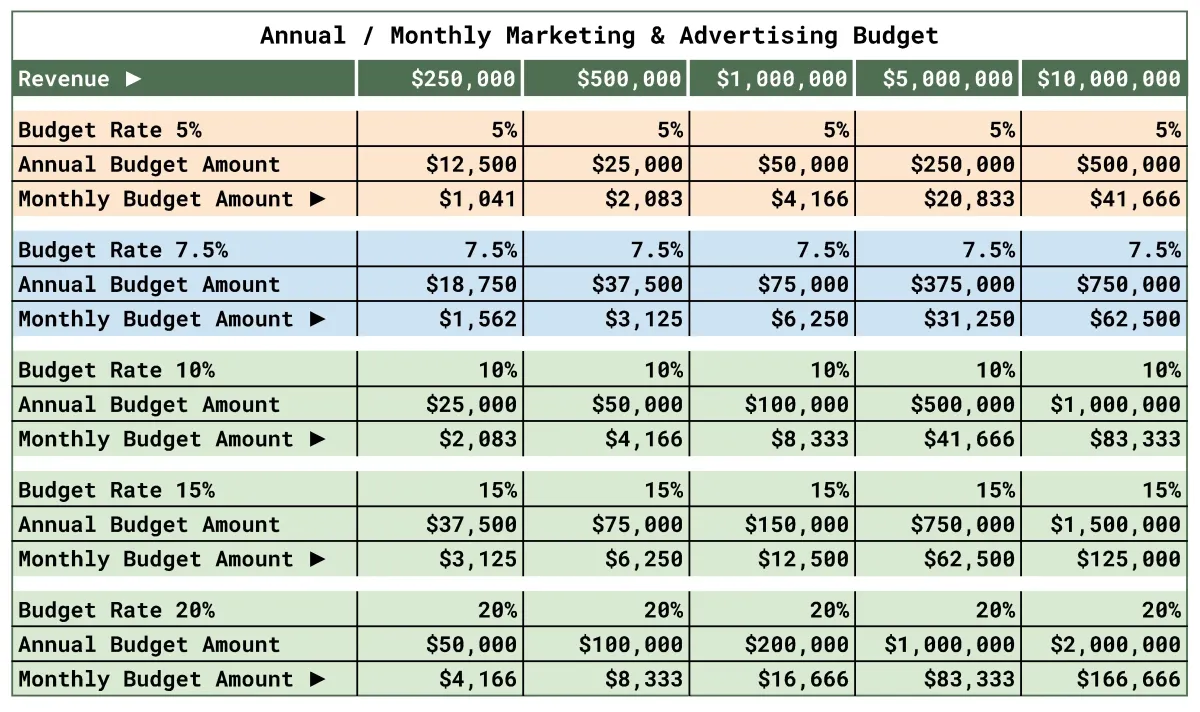
Example Marketing Budget Using Percentage of Revenue
2. Benefits of Investing in Marketing and Advertising
Investing in marketing and advertising, particularly online, can transform your financial services business. Here’s how:
Build Your Brand’s Authority
► Establish Trust and Credibility: A professional, smart AI website, educational blog, and active social media accounts position you as an industry expert.
► Expand Your Reach: Online ads can target clients based on location, demographics, and interests.
► Build Relationships: Engage with your audience on social media and build relationships with potential clients.
Increased Visibility
► Reach a Wider Audience: Online marketing allows you to reach a wider audience within and beyond your local area.
► Improve Search Engine Ranking: Local SEO strategies improve your visibility in search engine results pages (SERPs).
► Reach Your Ideal Clients: Online advertising allows you to target specific demographics, interests, and behaviors.
Generate a Consistent Flow of Leads
► Generate Qualified Leads: Properly run online marketing campaigns can effectively generate leads and drive inquiries and appointments.
► Targeted Campaigns: Use Google Ads, Facebook Ads, YouTube and LinkedIn to reach highly specific audiences.
► Lead Magnets: Offer free resources like e-books, checklists, webinars, or calculators to capture leads.
Save Time with Automation
► Business Growth Automation: Tools like Business Growth One automate follow-ups, nurture leads, and schedule appointments without extra effort.
► Automate Lead Capture: Utilize tools like website forms, AI voice and AI chatbots to capture leads 24/7/365.
Improve ROI and Cost-Effectiveness
► Analytics: Track your online marketing campaigns in real-time, measure their effectiveness, and optimize them for better performance.
► Cost-Effective Strategies: Digital marketing often costs less than traditional methods like print or radio ads but delivers higher returns.
► Optimize Spending: Adjust your campaigns based on performance data to maximize your return on investment.
Engage Your Audience Effectively
► Personalized Content: Email and SMS campaigns tailored to client interests will improve engagement.
► Interactive Tools: Online calculators, scheduling apps, and chatbots make it easy for prospects to take action.

3. Conclusion: Marketing Is a Smart Investment in Your Growth
Make It Happen
► Start Small and Scale: Begin with a modest budget and gradually increase your spending as you see results.
► Track Your Results: Monitor your marketing campaigns closely and track key metrics such as website traffic, lead generation, and conversion rates.
► Regularly Review and Adjust: Regularly review your marketing budget and make adjustments based on your performance and changing market conditions.
Your marketing budget is more than an expense; it’s an investment in the growth and sustainability of your business. By calculating the right budget based on your goals and leveraging the power of online marketing, you can attract the right clients, build long-lasting relationships, and grow your revenue predictably.
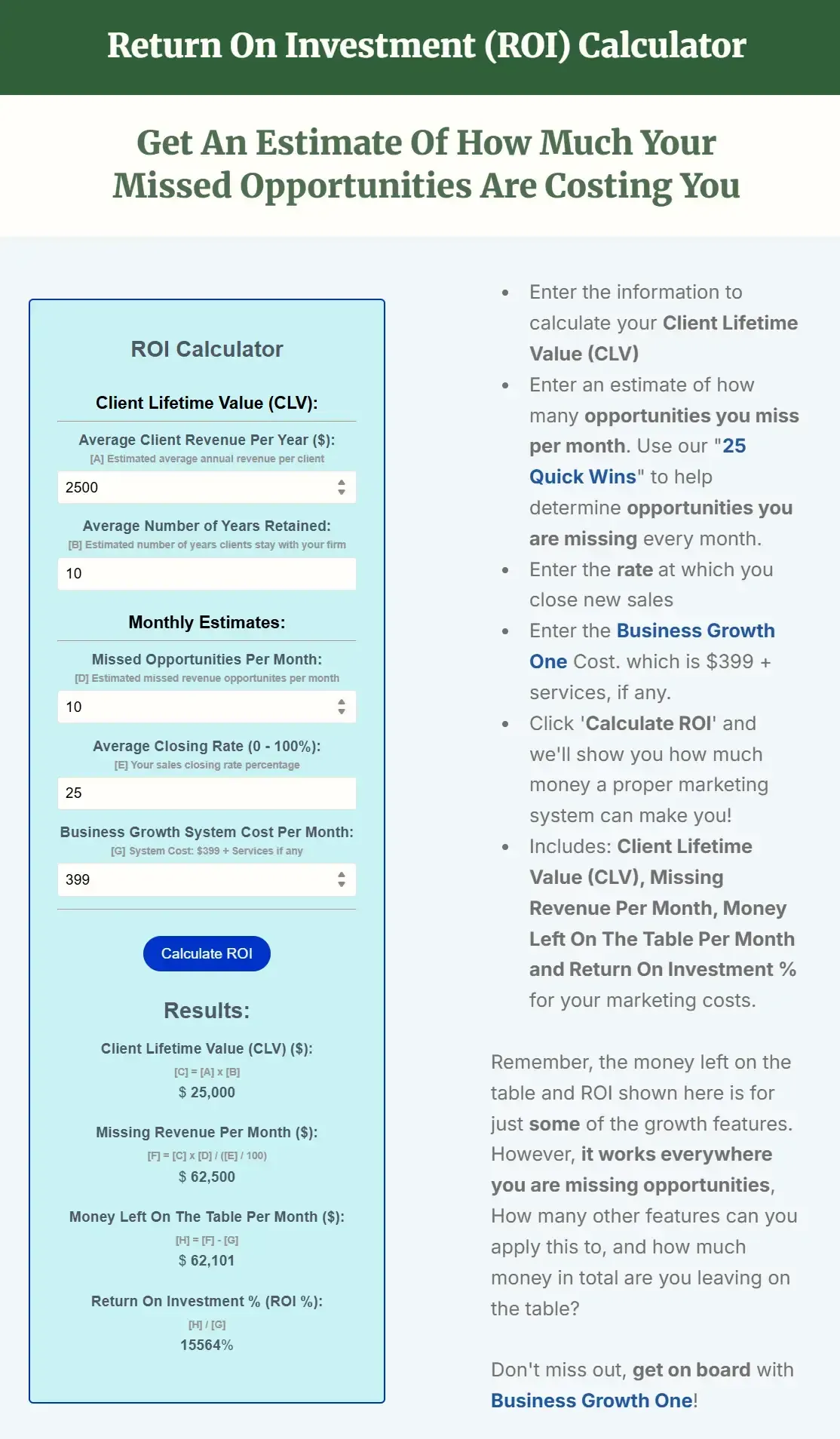
4. Want To Find Out How Much Money You Are Leaving On The Table By NOT Using A Business Growth Automation System?
Easy Math Will Tell the Tale
Our ROI Calculator reveals the impact that a powerful Business Growth Automation System can have on your bottom line. Go here to use our ROI Calculator and enter your numbers to find out:
Example Marketing Budget Calculations: Real-World Scenarios
Let's see how these formulas work for different financial practices:
Example 1: Established CPA Firm
Business Info:
• Annual Revenue: $500,000
• Business Stage: Established (5+ years)
• Growth Goal: Modest growth (10% increase)
• Recommended Percentage: 8% of revenue
• Annual Marketing Budget: $500,000 × 8% = $40,000
• Monthly Marketing Budget: $40,000 ÷ 12 = $3,333
Budget Allocation:
• Digital Advertising (Google Ads, Facebook): $1,200/month (36%)
• Website & SEO/AEO: $733/month (22%)
• Content Creation (blog, videos): $600/month (18%)
• Business Growth Automation Tools: $567/month (17%)
• Social Media Management: $233/month (7%)
Expected Results:
• 15-20 qualified leads per month, 3-4 new clients, $15,000-$20,000 in new monthly recurring revenue, 400-500% ROI.
Example 2: New Financial Advisory Practice
Business Info:
• Annual Revenue: $200,000 (first year)
• Business Stage: New (under 3 years)
• Growth Goal: Aggressive growth (30%+ increase)
• Recommended Percentage: 15% of revenue
• Annual Marketing Budget: $200,000 × 15% = $30,000
• Monthly Marketing Budget: $30,000 ÷ 12 = $2,500
Budget Allocation:
• Digital Advertising (Google Ads, Facebook): $1,000/month (40%)
• Website & SEO/AEO: $575/month (23%)
• Content Creation (blog, videos): $400/month (16%)
• Business Growth Automation Tools: $375/month (15%)
• Social Media Management: $150/month (6%)
Why Higher Percentage:
• New practices need aggressive investment to build brand awareness, compete with established firms, and accelerate client acquisition. As revenue grows and referrals increase, percentage can decrease while absolute dollars increase.
Example 3: Growing Bookkeeping Business
Business Info:
• Annual Revenue: $750,000
• Business Stage: Established (3+ years)
• Growth Goal: Aggressive growth (20% increase)
• Recommended Percentage: 10% of revenue
• Annual Marketing Budget: $750,000 × 10% = $75,000
• Monthly Marketing Budget: $75,000 ÷ 12 = $6,250
Budget Allocation:
• Digital Advertising (Google Ads, Facebook): $2,250/month (36%)
• Website & SEO/AEO: $1,563/month (25%)
• Content Creation (blog, videos): $1,125/month (18%)
• Business Growth Automation Tools: $938/month (15%)
• Social Media Management: $375/month (6%)
Strategic Notes:
• Higher absolute budget allows for more channels, more testing, and faster optimization. Can afford both organic (SEO/AEO, content) and paid (ads) strategies simultaneously.
How to Allocate Your Marketing Budget Across Channels
Once you've calculated your total budget, the next question is: where should you spend it? This will change over time and status, but here's a proven allocation framework for financial professionals:
1. Digital Advertising (30-40% of Budget)
Channels:
► Google Ads (search and display)
► Facebook/Instagram Ads
► LinkedIn Ads (B2B focus)
Why This Percentage:
► Digital ads deliver immediate visibility, precise targeting, and measurable results. You control spending, can test quickly, and scale what works.
Expected ROI:
► 300-500% when properly managed. $1,000 ad spend should generate $3,000-$5,000 in client lifetime value.
Pro Tip:
► Start with Google Search Ads (people actively searching for your services = highest intent). Add Facebook remarketing to follow up with website visitors.
2. Website & SEO/AEO (15-25% of Budget)
Channels:
► Website design/optimization
► SEO/AEO
► Local search optimization
► Conversion rate optimization
Why This Percentage:
► Your website is your own (you own it, unlike social media), 24/7 headquarters and sales tool. SEO/AEO delivers compounding returns - rankings improve over time, generating traffic for months/years without ongoing ad spend.
Expected ROI:
► 500-1000% long-term. It could take 3-6 months to see results, but compounds over time.
Pro Tip:
► Invest in conversion optimization (turning visitors into leads) before driving more traffic. A 2% conversion rate to 4% doubles leads without additional ad spend.
3. Content Creation (15-20% of Budget)
Channels:
► Blog posts, videos, guides, webinars, podcasts, infographics
Why This Percentage:
► Content demonstrates expertise, improves SEO/AEO, provides social media fuel, and nurtures leads. Creates assets that work for years.
Expected ROI:
► 400-600% over 12-18 months. Content is a long-term investment.
Pro Tip:
► Focus on answering the exact questions your prospects ask. "How to" content ranks well and builds trust.
4. Business Growth Automation Tools (15-20% of Budget)
Channels:
► CRM, pipelines, email / SMS marketing platform, social media scheduler, voice bots, chatbots, analytics, conversations
Why This Percentage:
► Automation multiplies your effort, ensures consistent follow-up, significantly reduces human error, and tracks everything. Essential for scaling without hiring, saving you time, effort and money.
Expected ROI:
► 800-1000+%. Automation captures leads you'd otherwise lose and nurtures them until they're ready to buy.
Pro Tip:
► An all-in-one Business Growth Automation system that includes CRM, email, SMS, calendars, and workflows and much more, like Business Growth One, is much more efficient and significantly less expensive than 10-20 separate tools.
5. Social Media Management (10-15% of Budget)
Channels:
► LinkedIn, Facebook, YouTube, Instagram, X
Why This Percentage:
► Social media builds relationships, establishes authority, and keeps you top-of-mind. Try a mix of organic and paid. Not higher because you don't own it (social media company owns everything on it), you have little control within it, and can lose your account through hacking or terms of service. However, do not ignore it.
Expected ROI:
► 200-400%. Longer sales cycle but strong for brand building.
Pro Tip:
► Choose 2-3 platforms where your ideal clients spend time. For financial professionals: LinkedIn (B2B), Facebook (B2C), and YouTube (educational content).
6. Testing & Contingency (5-10% of Budget)
Purpose:
► Reserve funds for testing new channels, responding to opportunities, or scaling winners.
Why Critical:
► Markets change. New platforms emerge. Winning tactics exhaust. Always have budget to test and adapt.
Expected ROI:
► 200-400%. Longer sales cycle but strong for brand building.
Pro Tip:
► Test one new channel per quarter. Give it 90 days and sufficient budget ($500-1,000 minimum) to properly evaluate.
Your Marketing Budget Action Plan: Start Today
Don't let analysis paralysis stop you. Here's how to implement your marketing budget starting this week:
Week 1: Calculate Your Budget
[ ] Pull last year's gross revenue figure
[ ] Determine your business stage (new 12-20%, established 6-12%)
[ ] Define your growth goal (modest 5-10%, aggressive 20%+)
[ ] Calculate: Revenue × Percentage = Annual Budget
[ ] Divide by 12 for monthly budget
Week 2: Allocate Across Channels
[ ] Use allocation percentages above as starting point
[ ] List channels you're currently using
[ ] Identify 2-3 new channels to test
[ ] Assign dollar amounts to each channel
[ ] Total should equal your monthly budget
Week 3: Set Up Tracking
[ ] Install Google Analytics / Google Tag Manager on website
[ ] Set up conversion tracking for all ads
[ ] Configure CRM to track lead sources
[ ] Create spreadsheet for monthly metrics
[ ] Define your key metrics (leads, cost per lead, conversion rate, ROI)
Week 4: Launch and Monitor
[ ] Start with highest-impact channels first
[ ] Monitor daily for first week
[ ] Review weekly for first month
[ ] Adjust based on early data
[ ] Schedule monthly review meetings
Monthly: Review and Optimize
[ ] Pull reports from all channels
[ ] Calculate cost per lead for each channel
[ ] Identify winners and losers
[ ] Increase budget to winners
[ ] Reduce or pause losers
[ ] Test one new tactic
Quarterly: Strategic Adjustments
[ ] Review overall ROI
[ ] Assess if budget percentage is right (too low? too high?)
[ ] Plan next quarter's channel mix
[ ] Set new goals based on results
Remember: Start small if needed, but START. Even $500/month strategically invested beats $5,000 scattered randomly. Consistency + tracking + optimization = success.
Frequently Asked Questions: FAQ's
How much should financial professionals spend on marketing?
Financial professionals should typically spend 6-12% of gross revenue on marketing if established, or 12-20% if the business is new (less than 3 years old) or in growth mode. According to the U.S. Small Business Administration, professional service firms average 6-12%, with financial advisors and accountants often at the higher end (10-12%) due to competitive markets. The exact percentage depends on your growth goals: modest growth (5-10%) requires 6-8% of revenue, while aggressive growth (20%+) may require 10-15% or more.
What is the percentage of revenue method for marketing budget?
The percentage of revenue method allocates a fixed percentage of your gross annual revenue to marketing. For new businesses (under 3 years) or those in growth mode, allocate 12-20% to establish brand and attract clients. For established businesses, allocate 6-12% to maintain and grow client base. Example: A firm with $500,000 annual revenue using 10% would have a $50,000 marketing budget ($4,167/month). This method is simple, scalable, and recommended by the SBA.
How do I calculate ROI on my marketing spend?
Calculate marketing ROI using this formula: (Revenue from Marketing - Marketing Cost) ÷ Marketing Cost × 100 = ROI%. Example: You spend $5,000/month on marketing and generate $20,000 in new client revenue. ROI = ($20,000 - $5,000) ÷ $5,000 × 100 = 300%. Track metrics like cost per lead, conversion rate, client lifetime value, and acquisition cost. Use analytics tools, CRM data, and attribution tracking to measure which channels deliver best ROI. A 300-500% ROI is considered good for professional services marketing. Go to our ROI Calculator web page to easily input your numbers and get instant results: Click here: ROI Calculator
Should new financial practices spend more on marketing than established ones?
Yes, new practices should spend significantly more. New businesses (under 3 years) should allocate 12-20% of gross revenue to marketing to establish brand recognition, build client base, and compete with established firms. Established businesses can maintain with 6-12% since they have existing client relationships, referrals, and brand awareness. The higher initial investment accelerates growth and market entry. As your practice matures and referrals increase, you can gradually reduce the percentage while maintaining absolute dollar growth.
What marketing channels should financial professionals invest in?
Depends on your situation, but here is a general recommended budget allocation: 30-40% digital advertising (Google Ads, Facebook, LinkedIn for targeted reach), 20-30% website and SEO (your 24/7 sales tool), 15-20% content creation (blogs, videos, guides that demonstrate expertise), 10-15% business growth automation tools (CRM, email marketing, lead nurturing), 10-15% social media management (engagement and authority building), 5-10% contingency for testing new channels. Digital channels typically deliver better ROI than traditional methods for financial professionals.
How often should I review and adjust my marketing budget?
Review your marketing budget and performance monthly for tactical adjustments, and quarterly for strategic changes. Monthly reviews track metrics like website traffic, lead generation, conversion rates, and cost per acquisition. Make immediate adjustments to under-performing campaigns. Quarterly reviews assess overall ROI, compare actual vs. planned spending, evaluate new opportunities, and adjust annual budget if revenue changes significantly. Annual planning sets the base budget using percentage of revenue method. Markets change quickly - rigid annual-only reviews miss optimization opportunities.
Is digital marketing more cost-effective than traditional marketing (print, radio, direct mail)?
Yes, for financial professionals, digital marketing typically delivers 2-5x better ROI than traditional methods. Digital advantages: precise targeting by demographics, location, and interests; real-time tracking and optimization; lower cost per impression; ability to test and iterate quickly; better conversion tracking; business growth automation reduces manual work. Traditional marketing (print, radio, direct mail) has higher cost per lead and much harder to measure ROI. Most successful financial practices use 80-90% digital, 10-20% traditional for brand awareness and local presence.
What if I can't afford the recommended percentage?
Start smaller and scale as you see results. Begin with 3-5% if budget is tight, but focus on highest-ROI channels: Business growth automation (saves time, money, and improves conversion), SEO and content marketing (long-term, compounding returns), targeted digital ads (measurable, adjustable). Avoid spreading thin across many channels. As marketing generates revenue, reinvest profits to increase percentage. Track metrics closely to prove ROI. Even small budgets can be effective with focus, consistency, and the right tools. Zero budget is false economy - you'll definitely lose to competitors who invest.

Powerful and Affordable Systems and Services to Help You Grow & Manage Your Business. Simplify, Integrate and Automate: Use the Latest Technology to Your Advantage!

877-398-4710 Text Us
120-3850 Dougall Ave #31055, Windsor, ON N9G 2Y2 Canada
Business Growth One
Certified Consultant
Zoho Authorized Partner
Alumni: PwC PricewaterhouseCoopers , Deloitte & RBC



Terms & Conditions | Privacy Policy | Sitemap
Created by Patrick Muldoon, CPA using Zoho One and Business Growth One
Overwhelmed owner-operated business owner? We can help you get clients, keep clients, work less and profit more.
Serving owner-operated SMBs that need new, modern & reliable ways to grow and manage their business.
Copyright © 2026 - Business Growth Success Inc. | Patrick Muldoon, CPA - All Rights Reserved.