Free Business Growth Assessment, Score & Profile ►
HOW TO GROW YOUR FINANCIAL BUSINESS
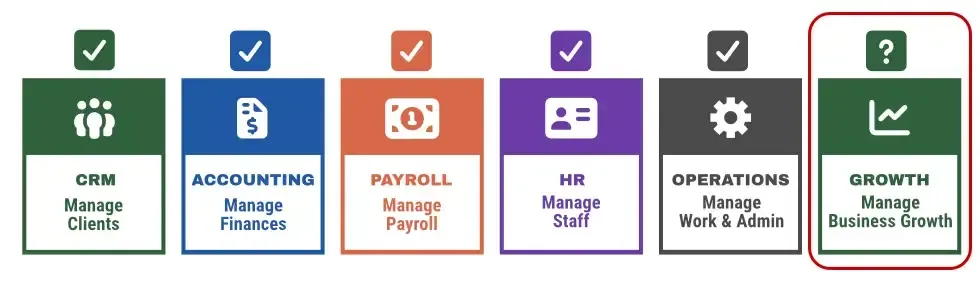
We’ve created the Business Growth Blueprint, a proven framework to help you attract more clients, increase revenue, and build a sustainable, thriving practice - all while saving you time, effort, and money. Our blueprint combines a powerful system with a clear and effective strategy and specific action plans to deliver measurable results.

Get Clients. Keep Clients. Work Less. Profit More.
Simplify ► (1) System (2) Strategy (3) Action Plans
From one Financial Professional to another: We help you cut through business growth chaos with a simple, automated lead generation, follow-up, appointment booking, client retaining and reselling system, so you can scale easily, profitably and sustainably.
If you're a CPA, accountant, bookkeeper, tax pro, estate or financial planner or financial advisor, you didn't get into this profession to become a marketer. You got in because you're good with numbers, you care about helping clients, and you value integrity and trust.
But here's the reality: being excellent at your craft doesn't automatically fill your pipeline with clients. You can be the best tax strategist, the most thorough bookkeeper, or the most knowledgeable financial planner — and still struggle to grow.
► Why? Because most financial professionals are stuck in RAM (Random Acts of Marketing). You post on LinkedIn when you remember. You try an ad campaign that fizzles out. You get a referral here and there, but it's feast or famine. You're too busy serving clients to build a real growth system — so you never escape the cycle.
That's where the Business Growth Blueprint for Financial Professionals comes in.
This isn't theory. It's a proven, 4-stage framework that's helped thousands of financial professionals move from chaotic, inconsistent growth to predictable, automated client acquisition. It's how you go from working 60-hour weeks and wondering where the next client comes from — to having a system that generates leads, converts prospects, and retains clients while you focus on high-value work.
Let's dive in.

► Growth Automation System: You need a Growth & Marketing Automation System. We recommend our Business Growth One, with the backend powered by HighLevel, the second leading CRM and marketing automation software on the planet (the first is Salesforce, which is ridiculously expensive). The system includes the latest technology, such as workflows, automation and AI to save you time, effort and money.
► Features: All-in-one solution, powerful and affordable, simple to use, completely integrated, includes the latest technology such as automation and AI (Artificial Intelligence), a turnkey solution with all assets ready so you can hit the ground running.
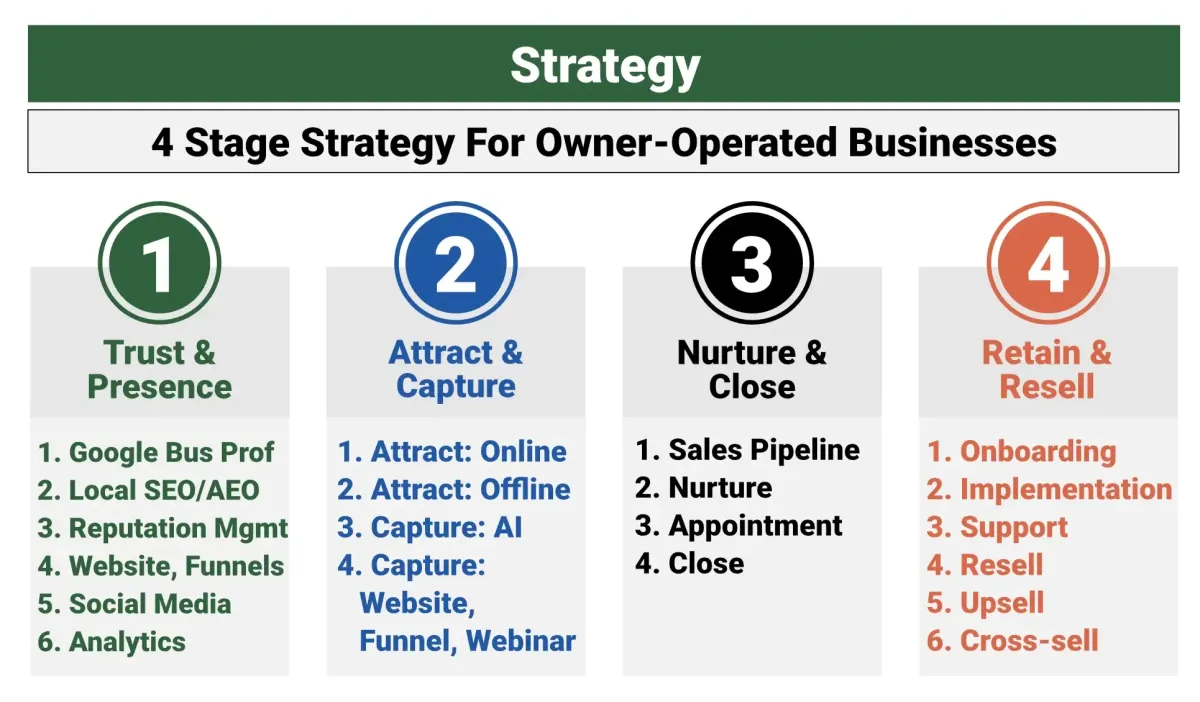
Stage 1: Trust & Presence - Be Found, Be Trusted, Be Chosen
Stage 2: Attract & Capture - Generate Consistent Leads
Stage 3: Nurture & Close - Convert Prospects Into Paying Clients
Stage 4: Retain & Resell - Maximize Client Lifetime Value
Many financial professionals make the mistake of jumping straight to lead generation - running ads, posting on social media, sending cold emails. But if your online presence doesn't signal trust, those leads evaporate.
Financial services are built on trust. Before someone hands you their tax return, their retirement savings, or their estate planning, they need to believe you're credible, competent, and trustworthy. In the digital age, that trust is built before they ever contact you.
Here's what happens when Trust & Presence is missing:
❌ Prospects Google your name and find... nothing. Red flag.
❌ They look for reviews and find two 3-star reviews from 2019. Red flag.
❌ They visit your website and it looks like it was built in 2005, loads slowly, and has no clear call-to-action. Red flag.
❌ The AI Crawlers do not find your website. Red flag.
You can have the best tax strategies, the most sophisticated financial plans, the most organized bookkeeping systems — but if your digital presence doesn't reflect that, prospects will never find out.
This phase is about making sure that when someone searches for a financial professional in your area — or when a referral Googles your name — what they find makes them think: 'This is the right person.'
Be Found, Be Trusted, Be Chosen
This powerful combination ensures that when clients are searching, they find you, trust you, and choose you. Without it, you risk being invisible to the very clients you want to attract. Here are the 6 Trust & Presence elements:
► 1. Google Business Profile (GBP): Enhance your online visibility and attract local clients with an optimized Google Business Profile.
► 2. Local SEO/AEO: Boost your local search ranking and get found by nearby clients actively looking for your services. Ensure that your site is properly configured so the AI Bots (GPTBot, ClaudeBot, PerplexityBot, CCBot, anthropic-ai, Google-Extended, etc.) can find you, since search is moving past your web browser.
► 3. Reputation Management: Build trust and credibility with glowing online reviews that influence client decisions.
► 4. Website, Funnels, Blog & Forms: Capture and convert visitors into clients with a professional website, persuasive funnels, informative blog content, forms, surveys and quizzes.
► 5. Social Media: Engage your audience, build relationships, and expand your reach through strategic social media presence.
► 6. Analytics & Web Insights: Make informed decisions and optimize your online strategy with powerful insights and performance tracking.
You can have the best online presence in the world — a gorgeous website, glowing reviews, top Google rankings — but if you're not actively generating leads, your pipeline stays empty.
► Here's the uncomfortable truth: Referrals alone will not scale your practice.
Referrals are wonderful. They convert well, they're low-cost, and they come with built-in trust. But they're also unpredictable, unscalable, and entirely outside your control. You can't wake up on Monday morning and decide "I need three new clients this month" and make referrals appear.
That's why Phase 2 exists — to give you consistent, predictable lead flow that doesn't depend on whether past clients happen to mention you to their friends.
The Two-Part System: 'Attract AND Capture'
Most financial professionals focus only on the "attract" part. They run ads, post on LinkedIn, host webinars, go to networking events. Some leads come in. And then... those leads disappear.
Why? Because attraction without capture is just expensive brand awareness.
If someone visits your website, attends your webinar, or meets you at a networking event — and you don't capture their contact information and add them to your CRM — that lead is gone. They'll forget about you, get distracted, or choose a competitor who followed up faster.
The capture piece is what turns interest into opportunity.
Every lead generation channel you use should have a corresponding capture mechanism:
► Running ads? Drive to a landing page with a form.
► Posting on LinkedIn? Offer a lead magnet that requires an email to download.
► Hosting a webinar? Collect registration info and add to your CRM automatically.
► Networking at an event? Scan business cards into your system the same day.
AI has changed the game here.
Voice AI can now answer your phone 24/7/365 and capture lead information even when you're asleep or in a client meeting. Conversation AI (website chatbots) can engage visitors, qualify them, and book appointments without you lifting a finger. Reviews AI can automatically request, collect, and respond to reviews, building your reputation while you work.
Content AI can help you generate lead-attracting content for email and all your channels.
The bottom line:
Phase 2 Attract & Capture isn't about doing more. It's about doing it systematically. Pick 2-3 lead generation channels that make sense for your practice (don't try all 20 at once), set up the capture mechanisms, and let automation do the heavy lifting.
Because once leads are in your system, Phase 3 Nurture & Close can take over and convert them into clients — automatically.
1. Ads Online
Paid digital advertising that places your practice in front of targeted prospects based on demographics, interests, job titles, or search intent - you pay per click or per impression.
► Examples: Google Search Ads appearing when someone types "CPA near me" or "tax planning for small business," Facebook or Instagram ads targeting small business owners in your city, or LinkedIn ads targeting CFOs and controllers by job title.
2. Social Media
Organic (unpaid) content posted to social platforms that builds awareness, demonstrates expertise, and drives profile visitors to your website lead magnet or booking page.
► Examples: LinkedIn posts sharing tax-saving tips for business owners, Instagram Reels showing behind-the-scenes of your firm during tax season, Facebook posts answering common questions like "Should I be an S-Corp?" or short YouTube videos explaining financial planning concepts for new business owners.
3. Content
Written, video, or audio content published on your own platform that attracts prospects searching for answers to financial questions - this is the foundation of long-term organic lead generation.
► Examples: Blog articles ranking on Google for "how to reduce taxes as a self-employed professional," a YouTube channel explaining estate planning basics, a podcast for small business owners on financial strategy, or downloadable guides like "7 Tax Mistakes CPAs See Every Year."
4. Local SEO & AEO
Optimizing your online presence so your practice appears prominently in Google searches and AI Crawlers that include a location or have local intent - the most high-intent leads you can get online because the prospect is actively searching right now.
► Examples: Optimizing your Google Business Profile so you appear in the map pack when someone searches "accountant in [your city]," building local citations on directories like Yelp and Yellow Pages, collecting Google reviews consistently, and adding location-specific pages to your website for each city or neighborhood you serve.
5. Online Communities
Participating in forums, groups, and communities where your ideal clients already gather - building trust and visibility by being genuinely helpful rather than promotional.
► Examples: Answering tax questions in Reddit's r/personalfinance or r/smallbusiness, participating in Facebook Groups for entrepreneurs or real estate investors, contributing to LinkedIn Groups for business owners in your niche, or answering questions on Quora where your expertise is relevant.
6. Micro Products
Low-cost or free digital products that attract your ideal client, demonstrate your expertise, and create a natural entry point into your services.
► Examples: A $27 "Small Business Tax Checklist" that attracts cost-conscious business owners, a free "Financial Practice Self-Assessment", a downloadable "Year-End Tax Planning Guide," or a paid mini-course on bookkeeping basics for new entrepreneurs that warms up prospects before they book a consultation.
7. Banner Ads
Display advertising that places visual ads on websites, apps, and platforms your target audience visits - typically used for brand awareness and retargeting people who have already visited your site.
► Examples: Retargeting ads that follow a visitor around the web after they visited your sales page but didn't purchase, display ads on financial news websites like Investopedia or NerdWallet, or banner ads placed on local business association websites and regional news outlets.
8. Cold Email
Sending targeted, personalized outreach emails to prospects who have not previously expressed interest in your services - effective when highly targeted and genuinely relevant to the recipient.
► Examples: Emailing the controllers and CFOs of mid-sized businesses in your city introducing your CFO advisory services, reaching out to recently incorporated LLCs in your state with a relevant tax tip and offer, or contacting real estate investors in a local investor group with a message specifically about real estate tax strategy.
9. Voicemail Drops
Pre-recorded voice messages delivered directly to a prospect's voicemail inbox without their phone ringing — a non-intrusive outreach method that feels more personal than email.
► Examples: A 20-second message from you introducing one of your services to a list of financial professionals who recently attended a local business event, a seasonal outreach drop to small business owners reminding them about year-end tax planning before December 31st, or a re-engagement message to past clients who haven't been in touch for 12+ months.
10. Affiliates / Partners / Centers of Influence
Arranging with other businesses or individuals to refer clients to your practice in exchange for a referral fee, reciprocal referrals, or a commission on sales - one of the highest-quality lead sources because the prospect arrives with a trusted recommendation already in place.
► Examples: A partnership with a business coach who refers their clients to you for financial planning, an arrangement with a bookkeeper who refers clients needing CPA services, a referral relationship with a commercial mortgage broker who sends you business owner clients, or an affiliate program where financial coaches earn a commission for referring practitioners to your product.
1. Networking & Meetups
Building relationships in person at regular gatherings of business owners, professionals, and community members - the oldest and still one of the most effective lead generation methods for financial professionals because trust is established face-to-face before a prospect ever visits your website.
► Examples: Attending your local Chamber of Commerce monthly breakfast and becoming a recognized regular, joining a BNI (Business Network International) chapter where you hold the exclusive accountant or financial advisor seat, participating in local entrepreneur meetups through Meetup.com, or attending your city's small business association events where your ideal clients gather consistently.
2. Events
Hosting or sponsoring your own in-person gatherings that position you as the authority in the room and attract prospects who are already interested enough to show up - a significantly warmer lead than someone who clicked an ad.
► Examples: Hosting a free "Tax Planning for Small Business Owners" workshop at your local library or co-working space, running a quarterly "Financial Fitness" breakfast seminar for local entrepreneurs, sponsoring a table at a local business awards evening, or presenting a 20-minute educational session at a real estate investor association meeting where your ideal clients are already assembled.
3. Referrals
Generating new clients through deliberate, systematic requests and incentives directed at your existing happy clients and professional network - the highest-converting lead source available to any financial professional because the prospect arrives pre-sold by someone they trust.
► Examples: Asking satisfied clients directly after a successful tax filing or financial review if they know any business owners who could benefit from your services, creating a formal referral program with a thank-you gift or charitable donation in the referrer's name, building a Centers of Influence (COI) network of complementary professionals such as lawyers, mortgage brokers, and business coaches who refer clients to each other systematically.
4. Newspaper, Magazine & Radio Ads
Paid placements in print publications or broadcast media that reach a broad local or niche audience - most effective when targeted to publications your ideal clients actually read or stations they listen to.
► Examples: A quarter-page ad in your city's business journal timed to run in January promoting your tax planning services, a sponsored column or "financial tips" feature in a local lifestyle magazine that positions you as the go-to expert, a 30-second radio spot on a morning business news station during drive time promoting your free Business Growth Assessment, or a sponsored advertorial in a trade magazine read by the specific niche you serve such as dental practice owners or real estate investors.
5. Direct Mail
Sending physical letters, postcards, or packages to a targeted list of prospects at their home or business address - direct mail, especially "lumpy mail" (includes a token of some kind - not a flat envelope - which they will definitely open to find out what it is) has seen a resurgence in effectiveness because digital inboxes are saturated while physical mailboxes are less competitive.
► Examples: A high-quality postcard mailed to all incorporated businesses within 10 miles of your office promoting your offer, a personalized letter sent to recently registered LLCs in your area introducing your services at their most financially vulnerable moment, a lumpy mail package containing a small useful item like a branded tax deadline calendar sent to a list of high-net-worth households in your target neighborhood, or a seasonal mailer sent every November reminding local business owners that year-end tax planning appointments are filling up fast.
6. Tradeshows
Exhibiting or presenting at industry conferences and expos where your ideal clients are already gathered in one place - a high-visibility opportunity to meet a large number of qualified prospects in a compressed period of time.
► Examples: Exhibiting at a local or regional small business expo with a booth offering free 15-minute financial health consultations, presenting a session at an accounting or financial planning industry conference to establish authority with peers who may refer clients, attending a franchise expo to connect with new franchise owners who need financial and tax guidance, or sponsoring a booth at a real estate investor summit where attendees are actively seeking tax strategy expertise.
7. PR: Public Relations & Press Releases
Earning media coverage in news outlets, podcasts, and publications without paying for ad space — when a journalist or host features you, it carries far more credibility than a paid advertisement because it signals third-party endorsement.
► Examples: Sending a press release to local business journalists in January announcing a free tax planning resource you have created for small business owners, pitching yourself to a local TV news station as the go-to expert for a segment on year-end tax changes, being interviewed on a podcast that serves your ideal client audience such as a show for real estate investors or franchise owners, writing a contributed expert article for a regional business publication on a timely financial topic, or getting quoted in a national outlet like Forbes or Entrepreneur by responding to journalist queries through platforms like HARO (Help a Reporter Out) or Qwoted.
8. Cold Phone Calls
Proactively calling prospects who have had no prior contact with your practice to introduce yourself and your services - most effective when highly targeted, brief, and focused on opening a conversation rather than closing a sale on the first call.
► Examples: Calling newly incorporated businesses in your area within their first 90 days when their need for accounting and tax guidance is highest and they have not yet established a firm relationship, reaching out to business owners you have identified as underserved by their current accountant based on a specific trigger such as a recent news mention or business expansion, calling the CFOs of mid-sized companies in your city to introduce your fractional CFO or financial advisory services, or following up by phone with prospects who downloaded your free assessment or attended one of your events but have not yet booked a consultation.
1. Voice AI (Automated Phone Call Handling 24/7/365)
An AI-powered system that answers incoming calls to your practice automatically, qualifies the caller, answers common questions, and books appointments directly into your calendar - so you never miss a lead because you were with a client, in a meeting, or it was 11pm on a Sunday.
► Examples: A prospective client calls your office after hours asking about tax planning services - Voice AI answers immediately, collects their name and situation, answers their top questions about your process and pricing, and books them into your calendar for a discovery call without you lifting a finger. During tax season when call volume spikes, Voice AI handles the overflow so every caller gets an immediate response instead of voicemail. A prospect who found you on Google at 9pm calls to ask if you work with real estate investors - Voice AI confirms your specialization, answers three qualifying questions, and schedules a consultation for the following week.
2. Conversation AI (Website Chatbot Engaging Visitors 24/7/365)
An AI-powered chat assistant embedded on your website that proactively engages visitors, answers their questions in real time, qualifies their needs, and guides them toward booking a call or taking your free assessment - turning passive website visitors into active leads around the clock. Again, without you lifting a finger.
► Examples: A small business owner lands on your Financial Audit page at 7am before your office opens - Conversation AI greets them, asks what brought them to the site, answers their questions about what the Financial Audit includes, and offers to book them a free 15-minute clarity call before they leave. A visitor reading your How to Grow page hesitates at the CTA (Call To Action) - the chatbot appears and asks "Not sure where to start? Take our free 5-minute Business Growth Assessment and get your score instantly." A prospective client from the UK visits your site on a Saturday and wants to know if the Audit is relevant outside North America - Conversation AI confirms your international coverage and captures their email for follow-up.
3. Reviews AI (Automated Request, Collection and Reply to Online Reviews 24/7/365)
An AI system that automatically sends review requests to clients at the optimal moment after a positive interaction, monitors incoming reviews across platforms, and generates and posts personalized replies — building your online reputation consistently without requiring any manual effort from you or your team.
► Examples: Immediately after a client marks their tax return as complete in your system, Reviews AI automatically sends them a personalized text message thanking them for their trust and asking if they would be willing to share their experience on Google - a request that arrives at exactly the right emotional moment. When a five-star review comes in at midnight, Reviews AI posts a warm, personalized reply by morning so the reviewer feels acknowledged and Google sees consistent engagement on your profile. When a less-than-positive review appears, Reviews AI flags it immediately so you can respond personally before it affects your reputation. Over 12 months of consistent automated requests, your Google Business Profile grows from 14 reviews to 80+ - dramatically improving your local SEO ranking and the trust level of every prospect who researches you before reaching out.
4. Content AI (Use AI to Provide a Framework for Your Ads, Content and Email)
Using AI tools to accelerate and systematize the creation of your marketing content - ads, social posts, blog articles, email sequences, and video scripts - by providing AI with your voice, your audience, and your message so it generates structured first drafts you refine and publish rather than starting from a blank page every time.
► Examples: You feed your ideal client profile and your top three services into an AI content tool and it generates 30 days of LinkedIn post ideas specifically for CPAs targeting small business owners - you review, adjust to your voice, and schedule in advance instead of writing from scratch each week. You brief an AI tool on your free Business Growth Assessment offer and it produces three versions of a Facebook ad with different angles - urgency, curiosity, and authority - ready for you to test without hiring a copywriter. You use AI to write a six-email welcome sequence for new lead magnet leads that nurtures them toward your main product, with each email answering a different objection. You provide AI with the transcript of a client discovery call and it produces a blog post, a LinkedIn post, a short video script, and a follow-up email - four pieces of content from one conversation.
1. Website (Lead Magnets, Newsletters, Forms, Surveys & Quizzes)
Your website is not just a digital brochure - it is a lead capture system that should be actively converting visitors into identified prospects through valuable offers, structured forms, and interactive tools that give visitors a reason to share their contact information before they leave.
► Examples: A lead magnet such as a downloadable "Year-End Tax Planning Checklist for Small Business Owners" offered in exchange for an email address, capturing visitors who are not yet ready to book a call but are willing to trade their email for something useful. A newsletter opt-in on your blog promising monthly financial tips specifically for CPAs and accountants, building a long-term nurture list from organic traffic. A contact form that asks three qualifying questions beyond just name and email - such as company size, biggest challenge, and how they found you - so every inquiry arrives pre-qualified. A quiz titled "What Type of Business Owner Are You?" that segments visitors into profiles and delivers a personalized result, capturing emails while delivering immediate value, qualifying and warming prospects for the next step.
2. Funnels (Landing Pages, Opt-In Pages, Sales Pages)
A funnel is a dedicated, distraction-free page or sequence of pages with a single focused goal - either capturing a lead or making a sale - stripped of navigation menus, sidebars, and anything else that might pull a visitor away from taking the one action you want them to take. Funnels are extremely important for growing your business. They can bring in much more business than your website alone.
► Examples: An opt-in landing page for your free Financial Assessment that has no navigation menu, one headline, three bullet points explaining what the visitor gets, and a single email field - nothing to click except "Get My Free Score," which dramatically increases conversion compared to sending traffic to your full website. They only have 2 choices: take your CTA (Call To Action) or exit. A sales funnel for one of your main products or services that takes a prospect through a sequence of pages: a problem-focused landing page, a detailed sales page with features and testimonials, an order page, and a thank-you page with a next-step offer - each page designed to move the visitor one step forward. A webinar registration funnel that captures a name and email on page one and immediately shows a confirmation page telling the registrant exactly what to expect, reducing no-show rates. A two-step funnel where a Facebook ad drives traffic to a free "Financial Practice Scorecard" opt-in page, and everyone who opts in is immediately shown an upsell offer for one of your main products or services at a special one-time price.
3. Webinars (Educate Leads, Move Them to Book or Buy)
A webinar is a live or pre-recorded online presentation that educates your ideal client on a problem they are already experiencing, builds deep trust and authority over 45 to 90 minutes, and ends with a natural, non-pushy invitation to take the next step - making it one of the highest-converting lead-to-client mechanisms available because attendees who show up are already highly engaged.
► Examples: A live monthly webinar titled "The 5 Biggest Mistakes Business Owners Make — And How to Fix Them" that attracts local business owners, walks them through your framework, and closes with an invitation to book a free 15-minute clarity call or purchase your main product or service at a webinar-only price. An automated evergreen webinar that runs on demand 24/7 - a prospect registers, watches a pre-recorded 60-minute training at their convenience, and is presented with a limited-time offer at the end, generating sales while you sleep. A free workshop-style webinar titled "How to Optimize Your Estate Plan for Your Wishes" that attracts prospects feeling overwhelmed, delivers genuine value through the Estate Planning Blueprint you created, and converts attendees into Estate Planning leads at the end. A quarterly client webinar exclusively for existing clients that reviews new opportunities, shares success stories, and presents an upgrade path - generating upsell revenue from your existing client base.
4. Email Campaigns (Send Links to Lead Magnets, Funnels and Webinars)
Email is the only marketing channel where you own the audience outright - unlike social media followers or ad audiences that can disappear overnight. Your email list is a direct, algorithm-free line to every prospect and client who has given you permission to reach them, making it the most reliable and highest-ROI channel for nurturing leads and driving traffic to your offers.
► Examples: A weekly email to your list of clients and prospects sharing one actionable wealth tip, with a soft call-to-action at the bottom linking to your free Financial Assessment — consistently sending warm traffic to your highest-converting lead capture page. A five-email nurture sequence triggered automatically when someone downloads your tax planning checklist: email one delivers the checklist, email two shares a related case study, email three introduces the concept of a tax savings diagnostic, email four handles the most common objection, and email five makes a direct invitation to take the Tax Savings Diagnostic. A promotional email campaign sent to your entire list before a webinar — a sequence of three emails over five days: the first announces the webinar and explains why it matters, the second shares a preview of what will be covered, and the third is a same-day reminder sent two hours before the event, each email linking to the webinar registration funnel. A re-engagement campaign sent to subscribers who have not opened an email in 90 days — a three-email sequence with subject lines designed to provoke curiosity, ending with a simple one-question survey asking what they are currently struggling with in their business, which both re-engages cold subscribers and provides valuable intelligence about what your audience needs most right now.
You've built trust. You've attracted leads. They're in your CRM.
Now comes the moment of truth: Can you convert those leads into paying clients?
This is where most financial professionals hemorrhage money. Not because they're bad at their craft — they're excellent accountants, brilliant financial planners, skilled bookkeepers. They lose money because they're terrible at follow-up.
Here's what typically happens:
► A lead fills out a form on your website. You see the notification... but you're in the middle of client work. You tell yourself you'll follow up later. Later becomes tomorrow. Tomorrow becomes next week. The lead goes cold and hires someone else.
► A prospect attends your webinar. They're interested but not ready to commit. You send one follow-up email. They don't respond. You assume they're not interested and move on. Meanwhile, they were just waiting for the right moment and your competitor stayed top-of-mind with consistent follow-up.
► Someone books a discovery call. They no-show. You don't have automated reminders set up, so they forgot. You don't have a no-show follow-up sequence, so they disappear forever.
The brutal math: If you're generating 20 leads per month and only converting 20% because of poor follow-up, you're leaving 16 potential clients (and thousands of dollars) on the table every single month. Over a year? That's nearly 200 lost opportunities.
Nurture is not optional. It's the difference between feast and famine.
The financial services buying cycle is long. People don't usually hire a CPA, financial planner, or bookkeeper on impulse. They research, compare options, think it over, talk to their spouse, procrastinate a bit, and then — when they're finally ready — they choose whoever stayed top-of-mind.
That's why automated nurture campaigns are non-negotiable:
► Email sequences that educate prospects on why they need your services (tax planning emails for CPAs, retirement planning emails for financial advisors, cash flow management emails for bookkeepers)
► SMS reminders for appointments so no-shows drop from 30% to under 5%
► Retargeting ads that keep your brand visible even when prospects aren't actively thinking about hiring you
► A visual sales pipeline so you actually know where each prospect is in the journey, what actions have already been taken, and what actions to take next
Here's what changes when you implement Phase 3 Nurture & Close correctly:
Instead of manually chasing leads and wondering "did I follow up with that person who emailed me last week?", your CRM does it automatically. Leads get nurtured whether you're on vacation, in a client meeting, or sleeping. Your calendar fills with qualified appointments from people who've been educated and warmed up through your automated sequences.
And when it's time to close? You're not starting from scratch. The prospect already knows you, trusts you, and understands the value you provide. The close becomes a natural next step, not a high-pressure sales pitch.
This is how you go from "I hope someone refers me this month" to "I have a predictable pipeline of prospects at every stage, and I know exactly how many will convert into clients."
Automation doesn't replace the human touch — it amplifies it. You show up for the high-value conversations (discovery calls, presentations, closing the deal) while the system handles the repetitive, time-consuming follow-up that most people simply don't have time to do consistently.
Convert Prospects Into Paying Clients. Automatically warm up your leads with value‑driven messaging and strategically prompt them to take the next step and become clients
► 1. Sales Pipeline: Visually track & measure opportunities through your sales process.
► 2. Nurture: Follow up manually and educate or persuade with automated email and SMS campaigns.
► 3. Appointments: Simplify using automated online appointment bookings with automated reminders.
► 4. Close: Present your pitch, overcome objections and seal the deal.
Let's get into more detail, because nurturing and closing is the most important aspect:
1. Sales Pipeline: Visually Track & Measure Opportunities Through Your Sales Process
A sales pipeline is a visual, stage-by-stage system inside your CRM that shows you exactly where every prospect stands in your sales process at any given moment - so nothing falls through the cracks, no follow-up is forgotten, and you always know precisely how much potential revenue is sitting at each stage of your practice's growth.
Without a pipeline, most financial professionals are managing prospects in their head, in scattered spreadsheets, or not at all - which means qualified leads go cold simply because life got busy and follow-up never happened. With a properly structured pipeline, you see at a glance which prospects need a follow-up call today, which proposals are outstanding, which verbal commitments are waiting on a signed agreement, and what your projected revenue looks like for the next 30 to 90 days.
For financial professionals, a well-managed pipeline typically includes stages such as New Lead, Discovery Call Booked, Discovery Call Completed, Proposal Sent, Verbal Yes, and Closed Won or Closed Lost - each stage representing a clear milestone with a defined next action. The pipeline also doubles as a performance measurement tool: when you track how long prospects sit at each stage and what percentage move forward, you quickly identify whether your biggest revenue leak is at the top of the funnel, in the proposal stage, or somewhere in between — and you fix the right problem instead of guessing.
Please see our important discussion of pipelines by clicking here ► The 4 Core Pipelines: Complete Architecture
2. Nurture: Follow Up Manually and Educate or Persuade With Automated Email and SMS Campaigns
Nurture is the systematic process of staying in front of prospects who are not yet ready to buy. You continue to build trust, demonstrate expertise, and maintain top-of-mind awareness through a consistent sequence of valuable touchpoints until the prospect is ready to make a decision. For financial services, this can take hours, days, weeks, or months depending on the size and complexity of the engagement.
The fundamental reality that most financial professionals ignore is this: research consistently shows that the majority of prospects require between five and twelve touchpoints before making a purchasing decision, yet the average financial professional follows up fewer than two times before giving up and moving on.
Nurture solves this by taking the follow-up burden entirely off your shoulders - automated email sequences deliver the right message at the right time based on where a prospect is in your pipeline, while SMS messages add a personal, immediate dimension that email alone cannot replicate.
For financial professionals, effective nurture content includes educational emails explaining complex financial concepts in plain language, case study emails showing how a practice similar to the prospect's improved after working with you, objection-handling emails that directly address common hesitations such as cost or timing, and social proof emails featuring client results and testimonials.
The combination of manual personal outreach for your highest-value prospects and automated sequences for your broader lead base means every prospect receives consistent, professional communication from your practice - whether you have 10 leads in your pipeline or 100.
3. Appointments: Simplify Using Automated Online Appointment Bookings With Automated Reminders
Appointment booking automation replaces the time-consuming, error-prone back-and-forth of scheduling calls and meetings through phone and email. You give prospects a direct link to your live calendar where they can self-select a time that works for them. Then they automatically receive confirmation emails, calendar invites, and a sequence of reminders that dramatically reduce no-show rates without requiring any manual effort from you or your team.
For financial professionals, the traditional appointment booking process is a significant hidden time drain: a prospect expresses interest, you email back with availability, they respond two days later with a conflict, you suggest three alternative times, they pick one but then forget - and what should have been a five-minute task consumed a week of back-and-forth and resulted in a missed appointment anyway.
Automated booking eliminates this entirely: your discovery call link goes in every email signature, every nurture email, every social media profile, and every SMS follow-up - a prospect clicks it, picks a time from your real availability, and the meeting is confirmed instantly with a calendar invite sent to both parties. The automated reminder sequence is where the real value lies for conversion: a well-structured reminder sequence might send an email confirmation immediately upon booking, a 24-hour reminder with a brief note on what to prepare, and a 1-hour SMS reminder on the day of the call - automatically reducing no-show rates from the industry average of 30 to 40 percent down to single digits. It also ensures the prospects who do show up arrive prepared and engaged rather than having forgotten what the call was even about.
4. Close: Present Your Pitch, Overcome Objections, and Seal the Deal
Closing is the structured process of presenting your solution compellingly, addressing every concern a prospect raises with confidence and empathy, and asking for the commitment. For financial professionals it is the stage most commonly left to chance, with many practitioners hoping a good discovery call naturally leads to a yes rather than having a deliberate, repeatable closing process they execute consistently with every qualified prospect.
An effective closing process for a financial professional starts well before the final conversation: your discovery call is structured to uncover the prospect's specific pain points and desired outcomes so that your proposal or pitch directly mirrors their own words back to them, making the value of your solution feel personally relevant rather than generic.
Common objections in financial services — "I need to think about it," "the timing isn't right," "I'm already working with someone," and "I'm not sure I can afford it" — should never catch you off guard because you have prepared and practised a genuine, non-pushy response to each one that acknowledges the concern, reframes the cost of inaction, and offers a clear path forward.
The mechanics of closing also matter significantly: making it frictionless to say yes through digital contracts that can be signed in 60 seconds, offering payment plans that reduce the perceived barrier of a larger investment, and following up a verbal yes within hours rather than days with a formal agreement to prevent the enthusiasm from cooling.
For practices selling higher-value engagements, the close is not a single moment - it is the natural conclusion of a well-run nurture and discovery process where the prospect has been educated, their objections have been addressed proactively through content, and by the time they are on a closing call they are already 80 percent sold before you say a word.
Still... you must ask for he sale! Don't let that slide.
Let's talk about the elephant in the room: Most financial professionals spend 90% of their effort acquiring new clients and 10% keeping them.
It should be the opposite.
Here's why: Acquiring a new client costs 5-7 times more than retaining an existing one. Existing clients convert on upsells at 60-70%, while new prospects convert at 5-20%. A 5% increase in client retention can increase profits by 25-95%.
Translation: The clients you already have are sitting on a goldmine of untapped revenue - if you know how to retain them and expand the relationship strategically.
But here's what usually happens instead:
The Onboarding Gap:
A new client signs up. You're excited. They're excited. And then... you drop the ball. There's no formal onboarding process, no "welcome to the firm" experience, no clear explanation of what happens next. The client feels like just another file on your desk. They start questioning whether they made the right choice.
The Service Delivery Gap:
You deliver excellent work - great tax returns, solid financial plans, clean books. But you never proactively communicate what you're doing or why it matters. The client sees the invoice but doesn't see the value. When renewal time comes, they're lukewarm at best.
The Upsell Gap:
Your clients have multiple needs. The business owner who hired you for bookkeeping also needs tax planning, payroll, government remittances, financial models, and maybe CFO-level strategic advice. The individual who hired you for basic financial planning could benefit from estate planning, tax optimization, and insurance review. But you never ask. You never present these options. You leave money on the table — and worse, your clients go elsewhere to get services you could have provided.
The Churn Gap:
A client quietly leaves. You don't notice until they stop paying invoices. You have no early warning system, no way to identify at-risk clients, no process for re-engaging people who've gone quiet. You lose clients not because they're unhappy with your work, but because you didn't stay top-of-mind or ask them for feedback.
Phase 4 Retain & Resell fixes all of this — and it's shockingly simple to implement.
Professional Onboarding:
Create a structured onboarding experience. Welcome email. Kick-off call. Clear timeline of what happens next. Introduction to your team. Access to your client portal. Educational resources. This sets the tone for the entire relationship and drastically reduces early churn.
Proactive Communication:
Regular check-ins aren't just nice-to-haves - they're retention tools. Quarterly reviews. Annual planning sessions. "Here's what we accomplished this year" recaps. Mid-year tax planning calls for CPAs. Portfolio reviews for financial advisors. Financial health check-ins for bookkeepers. These touchpoints remind clients of your value and create opportunities to identify new needs.
Strategic Upselling:
This isn't pushy sales. It's recognizing unmet needs and solving problems your clients didn't even know they had. The key is sequenced offers based on client lifecycle:
► Month 1-3: Deliver core service, build trust
► Month 4-6: Introduce complementary service (e.g., bookkeeping client → tax planning)
► Month 7-12: Present premium service (e.g., basic tax prep → strategic tax optimization)
► Year 1+: Ongoing expansion (CFO services, estate planning, family office services)
Automated Retention Monitoring: Your CRM should flag at-risk clients automatically. Hasn't logged into the portal in 60 days? Trigger a check-in. Hasn't opened the last 5 emails? Trigger a personal outreach. Renewal date approaching and no recent communication? Trigger a proactive renewal conversation.
Maximize Client Lifetime Value. This phase focuses on delivering continuous value that deepens relationships and drives repeat revenue.
► 1. Onboarding: A professional and complete on-boarding experience sets up a successful relationship.
► 2. Implementation: Track and deliver results that meet your client's specific needs and goals.
► 3. Support: Quick, high quality client support.
► 4. Resell, Upsell and Cross-sell: Increase revenue and provide more value to your clients.
1. Onboarding: A Professional and Complete Onboarding Experience Sets Up a Successful Relationship
Onboarding is the first experience a new client has inside your practice after saying yes - and it sets the emotional tone for the entire relationship that follows. This means a disorganized, slow, or informal onboarding process can undo all the trust you built during the sales process and plant the seeds of early churn before you have delivered a single result.
Most financial professionals treat onboarding as an administrative task - send a welcome email, collect some documents, schedule a kickoff call when you get around to it - rather than recognizing it as the highest-leverage moment in the entire client lifecycle. A client who feels genuinely welcomed, clearly informed, and professionally handled in their first two weeks is dramatically more likely to stay, refer, and upgrade than one who experienced confusion or silence after signing.
A world-class onboarding process for a financial professional covers five critical elements:
► i. An immediate welcome that confirms the client made the right decision and sets clear expectations for what happens next,
► ii. A structured intake process that collects all necessary information through a professional client portal rather than a chaotic email chain,
► iii. A clearly communicated timeline showing the client exactly what will happen and when,
► iv. A kickoff meeting that aligns on goals and establishes the communication rhythm for the engagement, and
► v. A 30-day check-in that catches any early dissatisfaction before it becomes a cancellation.
When your onboarding is systematized and automated — welcome emails triggered instantly upon payment, intake forms delivered to the client's inbox within minutes, calendar links for the kickoff meeting embedded in the confirmation - your practice delivers a Fortune 500-level client experience regardless of whether you are a solo practitioner or a firm of ten, and every new client begins the relationship feeling confident they made an excellent decision.
2. Implementation: Track and Deliver Results That Meet Your Client's Specific Goals
Implementation is the ongoing delivery phase of your client relationship - the period between onboarding and renewal where the actual work gets done, results are generated, and the client either experiences the value you promised or quietly begins looking for a reason to leave. This makes it the phase that most directly determines whether a client renews, refers, or churns, yet paradoxically the phase most financial professionals manage the least systematically.
The core failure in most financial practices during implementation is the absence of visible progress: the advisor is doing excellent work behind the scenes, but the client has no window into what is happening, no milestones to celebrate, and no data showing the impact of the engagement. Clients who cannot see value will eventually conclude there is none, regardless of how good the actual work is.
Effective implementation management for financial professionals requires three things working together:
► i. A structured project or task management system that tracks every deliverable with assigned owners and due dates so nothing is missed or delayed,
► ii. A regular communication cadence that proactively updates clients on progress without waiting for them to ask — monthly progress emails, quarterly review calls, and milestone notifications sent automatically when key deliverables are completed, and
► iii. A results measurement framework that translates your work into the outcomes the client actually cares about, whether that is tax dollars saved, revenue growth percentage, hours reclaimed, or practice valuation improvement.
3. Support: Quick, High-Quality Client Support
Support is every interaction a client has with your practice outside of scheduled meetings and planned deliverables - the questions they ask mid-engagement, the urgent issues that arise unexpectedly, and the moments of confusion or concern. If you handle these well, you deepen trust and loyalty. If handled poorly, they become the specific stories clients tell when they explain why they left.
For financial professionals, the quality and speed of support is one of the most powerful competitive differentiators available because the industry standard is poor - clients of accounting firms, financial advisors, and tax practices routinely report slow response times, being passed between staff members, and feeling like a low priority outside of peak season. This creates a significant opportunity for any practice that commits to a genuinely responsive, high-quality support experience as a core part of their service promise.
The three dimensions of excellent client support that financial professionals need to systematize are:
► i. Responsiveness, which means setting and consistently meeting clearly communicated response time standards - for example, all client messages acknowledged within four business hours and fully resolved within one business day for non-urgent matters ,
► ii. Accessibility, which means giving clients a dedicated, professional communication channel that is not your personal cell phone number or a generic office inbox, such as a client portal with two-way messaging that creates a clean record of every conversation, and
► iii. Quality, which means every support interaction is handled by someone with the knowledge to actually resolve the issue rather than creating a frustrating chain of transfers and follow-ups.
4. Resell, Upsell and Cross-Sell: Increase Revenue and Provide More Value to Your Clients
Reselling, upselling, and cross-selling to your existing client base is the single highest-ROI growth activity available to any financial professional. A current client who trusts you, has experienced your value, and already has a billing relationship with your practice requires zero cold outreach, zero trust-building, and a fraction of the conversion effort of a brand-new prospect.
Yet most financial professionals leave enormous recurring revenue on the table by never systematically presenting additional services to the clients who are most likely to say yes.
Reselling
Refers to renewing or re-engaging a client on the same service - ensuring that annual tax clients re-engage every year through a proactive outreach sequence rather than waiting and hoping they come back, and that subscription clients renew their engagement through a deliberate renewal process that begins 60 days before expiry rather than a last-minute panic when the contract ends.
Upselling
Presenting a higher-tier version of what the client is already buying - for example, a client on a compliance-only bookkeeping plan is a natural candidate for an upgraded advisory or CFO services package, and a client who attended one workshop is a natural candidate for an ongoing coaching or accountability program.
Cross-selling
is introducing a complementary service the client is not yet receiving - a tax client who has no financial planning in place is a natural candidate for an introduction to your planning services, a client using your CRM setup service is a natural candidate for your marketing automation package, and a client who identifies retention gaps in their results is a natural candidate for your onboarding and client success consulting.
Here's the math that makes this matter:
Let's say you have 50 clients at $3,000/year average revenue = $150,000/year.
Scenario A (No Retention Strategy):
- 20% annual churn = lose 10 clients = $30,000 lost
- Replace with 10 new clients = $30,000
- Marketing and admin spend on 10 new clients = $15,000 (conservative $1,500 cost per acquisition)
- No upsells = $0 expansion revenue
- Net: $150,000 - $30,000 + $30,000 - $15,000 = $135,000
Scenario B (Phase 4 Resell & Retain Implemented):
- 10% annual churn (retention improved) = lose 5 clients = $15,000 lost
- Replace with 5 new clients = $15,000
- Marketing and admin spend on 5 new clients = $7,500 (conservative $1,500 cost per acquisition)
- 20% of clients upsell to higher service (10 clients x $2,000 additional) = $20,000 expansion revenue
- Net: $150,000 - $15,000 + $15,000 - $7,500 + $20,000 = $162,500
$162,500 - $135,000 = $27,500. That's a $27,500 difference — from the same 50-client base.
And this compounds. Year 2, those retained clients are more likely to refer, to upsell again, and to stay longer. Meanwhile, Scenario A is constantly replacing churned clients at high cost and never building momentum.
The best part? Phase 4 Resell & Retain requires the least amount of new effort.
You're already serving these clients. You're already delivering value. Phase 4 just adds structure, communication, and strategic planning to maximize the client lifetime value (CLV) of relationships you've already built.
Bottom line:
New client acquisition gets all the attention because it's exciting. But retention and expansion is where the real profit lives. Master Phase 4 Resell & Retain, and you'll work less, earn more, and build a practice that actually grows in value over time - instead of constantly churning through clients on an expensive acquisition treadmill.

Referrals are great — but they're not a growth strategy. They're unpredictable, unscalable, and you have no control over timing. Successful practices use referrals as one channel in a multi-channel system.

You can't personally follow up with every lead, send every email, post on every platform, and respond to every inquiry — while also serving clients. Growth requires automation. Period.

Mailchimp for email marketing. Calendly for booking. A spreadsheet for tracking. A separate CRM, pipeline, website and sales funnel builder, etc. Multiple communication apps. Nothing talks to each other, so leads fall through the cracks, and you waste hours moving data around.

Running a Facebook ad campaign is a tactic. Building a lead generation system that consistently attracts, nurtures, and converts prospects — that's a system. Tactics are short-term. Systems compound automatically and consistently.

Most financial professionals spend 90% of their effort acquiring new clients and 10% keeping them. It should be the opposite — acquiring a new client costs 5-7x more than retaining one, and a 5% improvement in retention can increase profits by 25-95%.
1. Before You Buy Any Tools: Know Where You Stand
First, avoid SOS - Shiny Object Syndrome. Here's the mistake most financial professionals make: They see a shiny new CRM, a fancy scheduling tool, or an automation platform — and they buy it immediately, hoping it will solve their growth problems.
Six months later, the tool sits unused. Why? Because they bought a tactic (not a solution) before they even understood their problems.
Before you invest in any tools, you need to know exactly where your practice stands right now. What's working? What's broken? Where are leads falling through the cracks? Which phase of the Business Growth Blueprint needs attention first?
Start here — it's free:
► Take the Free Business Growth Assessment
In under 10 minutes, you'll get a personalized Business Growth Score and Profile showing exactly where your practice is strong and where you're losing ground. This assessment evaluates your firm across all 7 critical growth areas and tells you what to prioritize first.
Want the complete picture?
► Get the Business Growth 360° Diagnostic & Roadmap
(Charter Member Sale on now, first 50 purchasers only)
This is a deep-dive analysis of 88 questions and should take you 20 to 30 minutes to complete. It will give you a significant understanding of the business growth gaps you face in today's world, along with solutions and action plans. A consultant would charge $5K to $15K for this, but you can get it in the Charter Member's sale for only $499.
You'll receive:
► A comprehensive scored report identifying every profit leak in your practice
► A detailed 90-day action roadmap showing exactly what to implement and when
► A 1-hour one-on-one strategy session to walk through your results
► Prioritized recommendations based on your specific situation
2. Essential Tools:
Google Business Profile (GBP): Formerly called Google My Business (GMB). Free. Set this up first. A Google Business Profile makes you visible, credible, and easily discoverable when local prospects search for the financial guidance you provide.
► Recommended: Google Business Profile
► Alternatives: None
CRM & Marketing Automation Platform: This is non-negotiable! Manual tasks and follow-up doesn't scale. Centralizes your client data, automates your follow‑up, and ensures every prospect and client receives consistent, timely communication that drives growth.
► Recommended: All-In-One system - Business Growth One. Unified inbox, contact profiles, tagging, smart lists, pipelines, call/SMS/email/WhatsApp messaging.
► Alternatives: Business Growth One replaces these: HubSpot CRM, Pipedrive, Zoho CRM.
Smart Website with Sales Funnels and Lead Capture: Even a simple site works, as long as it has forms and landing pages to capture leads. It turns anonymous visitors into qualified prospects by guiding them to take action the moment they’re ready.
► Recommended: All-In-One system - Business Growth One. Full website builder, templates, blog builder, hosting, unlimited funnels, drag‑and‑drop builder, templates, and split testing.
► Alternatives: Business Growth One replaces these: WordPress + Elementor, Wix, Squarespace, ClickFunnels, Leadpages, and Unbounce.
Email Marketing Platform: Keeps your prospects and clients engaged with simple, consistent communication that builds trust and drives more appointments. And unlike social media, you own it.
► Recommended: All-In-One system - Business Growth One. Broadcasts, campaigns, templates, drag‑and‑drop builder, and automation.
► Alternatives: Business Growth One replaces these: Mailchimp, Constant Contact, and ConvertKit.
Online Appointment Scheduling: Makes it easy for prospects and clients to book time with you anytime, 24/7/365. without the back‑and‑forth emails that slow everything down.
► Recommended: All-In-One system - Business Growth One. Unlimited calendars, multi‑staff scheduling, reminders, payments, Zoom/Google Meet integration.
► Alternatives: Business Growth One replaces these: Calendly, Acuity Scheduling, and ScheduleOnce (OnceHub)
Forms, Surveys & Quizzes: Makes it easy to collect the right information from prospects and clients up front, so you can qualify leads faster and deliver more personalized guidance.
► Recommended: All-In-One system - Business Growth One. Drag‑and‑drop forms, surveys, conversational forms, and data-gathering quizzes.
► Alternatives: Business Growth One replaces these: Typeform, Jotform
SMS, Phone, IVR (Interactive Voice Response) & 2‑Way Messaging: Makes it easy to reach clients quickly, respond in real time, and ensure no important conversation or opportunity gets missed.
► Recommended: All-In-One system - Business Growth One. SMS, calling, voicemail drops, IVR, missed‑call text‑back, WhatsApp integration.
► Alternatives: Business Growth One replaces these: Twilio, CallRail, SimpleTexting
Payments, Invoicing & Proposals: Make it simple to bill clients, get paid faster, and present your services professionally without juggling multiple systems.
► Recommended: All-In-One system - Business Growth One. Text2Pay, invoicing, proposals, subscriptions, coupons, Stripe/PayPal/NMI integrations.
► Alternatives: Business Growth One replaces these: PandaDoc, FreshBooks, HoneyBook
Reporting & Analytics: Shows exactly what’s working, what’s not, and where to focus your time so you can make smarter, data‑driven decisions.
► Recommended: All-In-One system - Business Growth One. Custom dashboards, ad reporting, attribution, pipeline analytics.
► Alternatives: Business Growth One replaces these: Google Data Studio (Looker Studio), AgencyAnalytics, WhatConverts
3. Highly Recommended:
Review Management Tool: This helps make it easy to collect positive client reviews, boost your online reputation, and stand out when prospects search for someone they can trust.
► Recommended: All-In-One system - Business Growth One. Automated review requests, review dashboard, Google/Facebook/Yelp and 40+ other integrations.
► Alternatives: Business Growth One replaces these: Birdeye, Podium, or Grade.us.
AI Tools: AI tools like Voice AI for phone handling and Conversation AI for website chat help by instantly answering common questions, capturing leads around the clock, and making sure prospects get help the moment they need it. They fulfill the "Speed to Lead" necessity.
► Recommended: All-In-One system - Business Growth One.
► Alternatives: Business Growth One replaces these: Retell Ai, Synthflow AI, and Vapi.
Social Media Scheduler: This helps you keep your content consistent and visible, in multiple channels, without you having to post manually every day.
► Recommended: All-In-One system - Business Growth One. Schedule posts across platforms, manage social content.
► Alternatives: Business Growth One replaces these: Buffer, Hootsuite, and Later.
Marketing Automation & Workflows: This helps you handle routine follow‑up and client communication automatically, so nothing slips through the cracks and you stay consistently top‑of‑mind.
► Recommended: All-In-One system - Business Growth One. Visual workflow builder, multi‑channel automation (email, SMS, calls, social), triggers, and AI assistants.
► Alternatives: Business Growth One replaces these: ActiveCampaign, Infusionsoft/Keap, Zapier.
Memberships, Courses & Communities: Give clients an easy way to learn from you, stay engaged between meetings, and build long‑term trust at scale. Can also work internally to provide and monitor staff training.
► Recommended: All-In-One system - Business Growth One. Unlimited courses, communities, drip content, certificates, membership sites, monitoring and video uploads.
► Alternatives: Business Growth One replaces these: - Kajabi, Teachable, Thinkifi, Vimeo, Wistia
Client Portal & Mobile App: Give clients a simple, secure place to access information, stay organized, and communicate with you without endless emails or paperwork.
► Recommended: All-In-One system - Business Growth One. Centralized client portal, branded mobile app.
► Alternatives: Business Growth One replaces these: - ClientPortal.io, Notion (as a client hub), Basecamp (client access)
NOTE: Individual products must be integrated or data must be moved between them manually.
The Key
Don't try to cobble together 10 separate tools. Use an all-in-one platform like Business Growth One that integrates everything, saving you time, effort, money, and the headache of managing multiple subscriptions.
Business Growth One gives you the power of 10+ tools, the simplicity of one platform, and the strategic advantage of having everything automated, integrated, and professionally managed.
The Situation:
Sarah, CPA in Houston, TX, running a 3-person firm
She had 42 clients, was working 55 hours a week
Her revenue had plateaued at $280K/year for three years straight
She was exhausted and referrals had slowed down
She didn't know how to grow without burning out
The Problem:
Firm had no online presence (her website was 8 years old)
No lead capture system (inquiries came via email and were often missed or not followed up on quickly)
No follow-up process (if a prospect didn't book immediately, they disappeared)
No client retention strategy (she assumed good work was enough)
The Implementation:
Sarah followed the Business Growth Blueprint:
Phase 1: Claimed and optimized her Google Business Profile | used the client reactivation process and collected 15 five-star reviews from existing clients | rebuilt her website with clear service descriptions and lead capture forms
Phase 2: To generate leads, she launched a simple content strategy (monthly blog posts answering common tax questions), started running targeted Facebook Ads for "CPA in Houston", and set up a lead magnet (free tax planning checklist).
Phase 3: Implemented Business Growth One to automate email follow-up, set up drip campaigns for prospects at different stages, added online appointment booking, and used the visual pipeline to ensure all leads went through the entire lead nurturing and closing process.
Phase 4: Created a formal onboarding process for new clients, implemented quarterly check-ins with existing clients, introduced a tax strategy service as an upsell.
The Results (12 Months Later):
Clients: 42 → 78 (+86%)
Revenue: $280K → $520K (+86%)
Weekly hours: 55 → 48 (-13%)
Lead inquiries: 2-3/month → 15-20/month
Conversion rate: ~30% → 52%
Sarah now has a system that runs without her constant attention, a pipeline full of warm leads, and the time to actually take a vacation.

Simplifies Growth
One system! You don’t need to manage multiple tools or guess your next steps - we’ve done the hard work for you.
Support
Get more leads, grow your revenue and profit, and increase client retention with less time and effort.
Cost-Effective
Business Growth One is an affordable solution that delivers big-business results without breaking the bank.
Proven System
The HighLevel backend we use supports over 2 million businesses. It is battle-tested. Built on years of expertise and powered by the latest marketing automation technology.
Generate FREE Leads From Existing Traffic
Unlock More Prospect Channels
Turn First-Time Customers Into Repeat Buyers
Drag-And-Drop Email Builder
Quickly & Easily Send Review Requests
Read & Reply To New Reviews From Your Pocket
Growing a financial advisory firm requires a systematic approach across four key phases: (1) Build Trust & Presence online so prospects can find and trust you, (2) Attract & Capture leads through online and offline channels, (3) Nurture & Close deals using automated follow-up and a structured sales process, and (4) Retain & Resell to clients through excellent service and strategic upselling. This Business Growth Blueprint provides the complete framework, combining an affordable, reliable growth automation system, proven strategies, and consistent, automated action plans.
The best approach combines multiple lead generation channels: (1) Optimize your Google Business Profile (GBP) for local search visibility, (2) Build your online reputation through client reviews, (3) Create valuable content (blogs, guides, social media) that attracts your ideal clients, (4) Use paid advertising strategically (Google Ads, Facebook Ads, LinkedIn Ads), (5) Leverage referrals from existing clients, (6) Network at industry events and local business groups, and (7) Implement marketing automation to nurture leads consistently. The key is using a business growth automation system to capture and follow up with every lead automatically.
Financial professionals need a CRM that handles the complete client journey — lead capture, automated follow-up, appointment booking, email/SMS campaigns, pipeline management, and analytics. Business Growth One is specifically pre-built for financial professionals, powered by HighLevel (the #2 CRM platform globally after Salesforce, but significantly more affordable). Unlike generic CRMs, it includes pre-configured workflows, campaigns, and templates designed for accountants, bookkeepers, CPAs, tax professionals, and financial advisors. It's a turn-key system so you can start attracting, capturing and converting leads immediately.
Timeline varies by strategy and current state: (1) Quick wins (30-60 days): Optimizing Google Business Profile, reputation management, and basic email follow-up can generate leads within weeks. (2) Medium-term (30-90 days): Automated nurture campaigns, improved website conversion, and consistent content marketing starts compounding. (3) Long-term (90+ days): SEO, thought leadership, and referral systems build momentum and provide sustainable growth. Most financial professionals see measurable improvement within the first 30 to 90 days when implementing the complete Business Growth Blueprint systematically.
Not necessarily. Many financial professionals successfully implement growth strategies themselves using the right system and guidance. The Business Growth Blueprint can be executed in three ways: (1) DIY (Do It Yourself) — you implement using the framework and tools provided, (2) DWY (Done With You) — you work alongside a consultant who guides the process, or (3) DFY (Done For You) — a specialist implements everything for you. The advantage of working with a boutique firm like Business Growth Success is we can help you in all three ways. You are getting CPA-led expertise at a fraction of what large marketing agencies charge.
Start with Phase 1 (Trust & Presence): (1) Claim and optimize your Google Business Profile — this is free and immediately increases visibility, (2) Collect and display client reviews — trust signals are critical for financial services, (3) Ensure your website clearly communicates what you do and who you help, with working contact forms, (4) Set up basic email capture (lead magnet + newsletter signup). Once these foundations are in place, move to Phase 2 (Attract & Capture) to drive consistent traffic. Many practices try to skip Phase 1 and wonder why their marketing doesn't convert — trust and presence must come first.
Traditional approaches involve cobbling together 10+ separate tools: email marketing ($50-150/mo), CRM ($50-200/mo), appointment scheduling ($15-30/mo), landing page builder ($50-100/mo), social media planner ($30-50/mo), reputation management ($150-300/mo), and more — totaling $600-$1,500/month. Business Growth One consolidates all of these into a single platform for $299 or $499/month, saving you significant costs. The ROI is substantial: if automation helps you close just 2-3 additional clients per year, it pays for itself many times over.
The Business Growth Blueprint is specifically designed for solo practitioners and small to mid-sized financial firms (1-25 people). Large firms typically have dedicated marketing teams and enterprise budgets. Solo practitioners and small firms need affordable, automated systems that work without requiring a full-time marketer. Business Growth One and the strategies in this guide are built to give solo practitioners access to the same capabilities that large firms use — at a fraction of the cost and complexity.


"Your Paragraph text goes Lorem ipsum dolor sit amet, consectetur adipisicing elit. "


"Your Paragraph text goes Lorem ipsum dolor sit amet, consectetur adipisicing elit. "


"Your Paragraph text goes Lorem ipsum dolor sit amet, consectetur adipisicing elit. "
Follow Us
Powerful and Affordable System and Services to Help You Grow Your Financial Business. Simplify, Integrate and Automate: Use the Latest Technology to Your Advantage!

877-398-4710 Text Us
120-3850 Dougall Ave #31055, Windsor, ON N9G 2Y2 Canada
Business Growth One
Certified Consultant
Clickup
Certified Expert
Alumni: PwC PricewaterhouseCoopers, Deloitte & RBC
Terms & Conditions | Privacy Policy | Sitemap This site was created by Patrick Muldoon, CPA using Business Growth One
Are you a Financial Professional? We can help you get clients, keep clients, work less and profit more.
We help firms in Accounting, Bookkeeping, CPAs, Tax, Estate & Financial Planning & Advisory
Copyright © 2026 - Business Growth Success Inc. | Patrick Muldoon, CPA - All Rights Reserved.
Mail
Facebook
LinkedIn
X
Pinterest
Reddit